
- Details
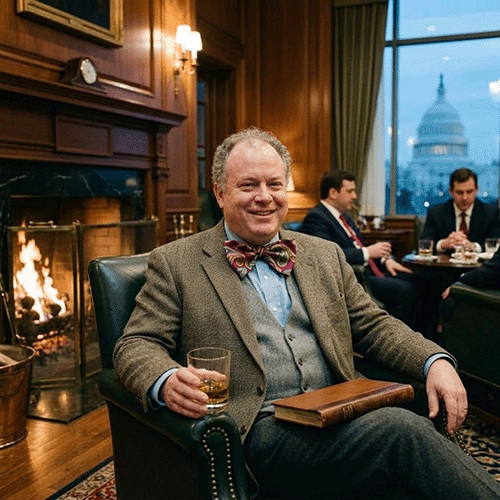
I was sitting in my leather wingback chair this morning — the good one, the one June says makes me look like a founding father, which I take as a compliment, and which I take as a mission accomplished — when the news arrived. The market was up. Again. And I knew, as I always know, that my most recent column on the sanctity of localized capital formation had done its work quietly, invisibly, the way great ideas always do. Marmaduke was asleep at my feet, all 140 magnificent, gluten-free pounds of him. He dreams, I suspect, of elk. Tonto was somewhere near the front door, wearing a bow tie — nobody knows why; we have stopped asking. And then the alert came through.
 Elon Musk has become the world's first trillionaire.
[Deep sigh.]
Folks. Folks. I need you to sit down. I need you to pour yourself a glass of whole milk — not the oat variety, not whatever the coastal radicals are drinking this week — and I need you to listen to the conservative from Yale University, because what I am about to say is the most important thing I have said in a calendar week, which is saying quite a lot.
I want to be clear: this is a triumph of American exceptionalism. One man. One trillion dollars. Built from nothing but ambition, government contracts, and the labor of a couple hundred thousand workers we will get to in a moment. We will not get to them. This is the greatest country on Earth, and I will fight anyone who says otherwise, rhetorically, in a firmly-worded column.
But.
BUT.
Who elected him king of space? When did low-Earth orbit become private property? Does Elon Musk own the sky? Who decided that? And why — WHY — are we allowing it?
Let us take a step back and talk about the titans of American industry. I am a historian. I went to Yale. I have read the works of Rockefeller, Carnegie, Vanderbilt, and J.P. Morgan — not merely their Wikipedia pages, as one suspects certain colleagues have done, but their actual correspondence, their ledgers, their apologia. These were men of vision. Men of industry. Men who understood that the Protestant work ethic meant building things, controlling things, monetizing things, and — yes — occasionally destroying their competition through legally questionable means that we have since addressed with antitrust law, which was itself a conservative invention, as I have argued in seventeen previous columns.
John D. Rockefeller controlled petroleum. Standard Oil was a hydra, yes, a tentacled beast wrapped around the throat of American commerce, squeezing. The courts ultimately declared it a monopoly and broke it apart in 1911, in one of the great victories of American conservative jurisprudence. Carnegie controlled steel. Vanderbilt controlled railroads. Morgan controlled money itself — or close enough that the distinction barely mattered.
But here is the thing. Here is the thing that keeps me up at night — that has Tonto pacing the hallways in his bow tie and Marmaduke whimpering into his allergen-free kibble. Those men each controlled one industry. One! Rockefeller: oil. Carnegie: steel. Vanderbilt: rails. They were monopolists, yes, but they were disciplined monopolists. The Standard Oil octopus, which terrified a generation of Americans, was, by today's measure, actually moderate. A quaint regional enterprise. A farmers' market. A lemonade stand run by neighborhood children. A church bake sale.
Elon Musk controls space. He controls automobiles. He controls the social media platform on which you are probably reading about how he controls things. He controls tunnels beneath our cities. He has inserted a chip into a man's brain — into an actual human brain — and nobody held a county commission vote. Not a single alderman was consulted. He sells satellite internet to rural families, which, yes, is beautiful and patriotic, and also means he controls the internet access of rural families. He manufactures humanoid robots. He is, at this moment, designing a city in Texas called Starbase, which he apparently intends to govern, because why own one democracy when you can simply build another one and be king of it?
I ask you: is this the republic the Founders envisioned? Is this what Madison meant?
I have read the Federalist Papers. In the original Greek. And I can tell you with absolute confidence that James Madison — a man who understood the concentration of power better than anyone in history, which is why he invented checks and balances — would look at a man who owns space, social media, tunnels, brain chips, a private city, and the world's largest fleet of autonomous vehicles, and Madison would weep.
He would weep. And then he would demand that the county sheriff do something about it. The county sheriff would not have jurisdiction. This would enrage Madison considerably.
 This is not a partisan point. This is not left versus right. This is not liberal versus conservative. This is about the most fundamental principle of the American republic: no man shall be landlord of low-Earth orbit. I am quite confident that is a direct quote. The Founders simply didn't need to say it explicitly because they could not have imagined that anyone would be brazen enough to try. They assumed we had common sense. They assumed wrong.
The Constitution was designed, at its marrow, to prevent the consolidation of power in the hands of one man. The separation of powers. The system of federalism. The Bill of Rights. These are not abstract documents. They are warnings. They are the Founders looking at us from across two and a half centuries and saying: do not let one man own the sky. Do not let one man control what you say, how you travel, what orbit you reach. Do not let it happen.
It is happening.
And so I arrive — as the conservative from Yale University always does, through the long and winding road of historical analysis, constitutional interpretation, and righteous fury — at policy.
There is only one truly conservative response to a trillionaire. One response that honors the Founders, protects the nuclear family, preserves the Protestant work ethic, and defends the biological heritage of this great nation from the predations of corporate radicalism. One response that Madison would approve of, that Hamilton would applaud, that even Jefferson — complicated man, complicated legacy, but correct on the dangers of aristocracy — would raise a glass to.
A 90% wealth tax on all assets above one trillion dollars. Effective immediately. While he is watching.
Is this radical? Folks, I went to Yale. I do not do radical. This is constitutional originalism. Why? Because the Founders believed in earned wealth — in the dignity of a man who builds something with his hands and his mind, who competes fairly in the marketplace, who rises through merit and falls through failure. What they did not believe in — what they specifically designed the republic to prevent — was inherited aristocracy. Generational consolidation of power. A single man becoming so wealthy that he transcends the democratic process entirely and simply purchases entire categories of civilization.
A 90% wealth tax above one trillion dollars does not punish success. It punishes excess. It does not take from the entrepreneur. It takes from the oligarch. It protects Main Street from the radical corporate monopolies that are, at this very moment, hollowing out the American family like a drill bit through a walnut. It ensures that the fruit of labor returns to the soil that grew it, rather than being hoarded in a tax-advantaged rocket ship pointed at Mars. Some of us are staying.
This is what true conservatism demands. And I predicted it. I said, years ago — in a column that nobody read as carefully as they should have — that the logical endpoint of unchecked capital formation was a trillionaire. I said it would be a problem. I was playing the long game, folks. The 4D ideological chess that only a Yale-educated economist can fully appreciate. And fully win.
Marmaduke just lifted his massive head and looked at me with what I can only describe as profound agreement. He is almost always correct. Tonto barked once — sharply, authoritatively — from the hallway.
June looked up from her desk. She raised one eyebrow. Just the one. That is her move. It works every time.
She is right, of course. She always is.
The conservative from Yale University rests his case. It was a large case. It took years. It is his finest work.
Tuck Chimes is Senior Correspondent for Business & Economy at IRREVERENT Magazine. He holds a degree from Yale University, which he mentions constantly. He lives in Georgetown with his wife June, an ethics professor, and their two Alaskan huskies, Marmaduke and Tonto. His opinions are his own. His dogs' opinions are also his own.
Editor's Note: The Federalist Papers were authored in English not Greek. As for the "No man shall be landlord of low-Earth orbit" as a direct Founder quote, no such quote exists in any founding-era document.
- Details
I am sitting in my leather wingback chair. Marmaduke — one hundred and forty pounds of constitutionally-minded Alaskan husky — is sprawled across my feet, which are going numb, but I refuse to move him because I need the ballast. I also cannot feel my left foot. These facts are related. What I am about to tell you will unsettle you. It will anger you. It should. It angered me, and I am a man who has stared into the abyss of globalist corporate radicalism for thirty-four years and blinked exactly once, at a hedge fund symposium in 2003, and I remain unsatisfied with the explanation.
McDonald's. The Golden Arches. The last honest temple of the American lunch break. They are replacing their workers with artificial intelligence.
Let me ask you something. Who decided this was acceptable? Who sat in a boardroom — a boardroom, I might add, that no Yale-educated journalist was ever invited to — and said, "You know what? The American drive-thru worker, a human being with a family and a mortgage and a genuine need for dental coverage, is simply too inconvenient for our quarterly projections"? Who? I want a name. I want a face. I want, at minimum, a congressional subpoena and adequate parking. Because the conservative from Yale University has some questions, and he is not going away.
Here is what McDonald's has announced for 2026, and I want you to sit with each item like you are being handed a subpoena:
AI-powered "Accuracy Scales" — digital scales, partnered with Google Cloud, that will weigh your bag of food to determine if you received the correct order. Because apparently the radical solution to getting a wrong burger is not to hire enough people and pay them a living wage — it is to install surveillance equipment on your french fries. Your fries have a Google account now. Congratulations.
AI voice-activated chatbots taking orders at the drive-thru. They tried this with IBM. It failed, spectacularly, as all soulless corporate experiments eventually must. But did McDonald's take the hint? Did they look at the wreckage of that experiment, look at the human beings who could have been doing that job, and say, "Perhaps the market has spoken"? No. They found a different technology company and tried again. This is not innovation. This is stubbornness in business casual.
A dedicated "fast lane" exclusively for customers who order on a mobile application. Let me say that again so it can truly land. If you use an app — if you are the sort of person who has pre-registered their credit card on a smartphone and pre-selected their McDouble before arriving — you get a separate, faster lane. And if you are a working American who pays in cash? Who does not own the latest phone? Who showed up at the drive-thru the way God and the founders intended, with your window down and everyone's fluctuating order bouncing around your head as the kids scream updates at you and each other? You, my friend, are in the slow lane. You are second class. You are the peasant watching the aristocrat's carriage clatter past — and then receiving a push notification about it.
This is not innovation. This is feudalism with better branding.
June — my wife, professor of ethics at Georgetown University, a woman whose raised eyebrow has ended more of my monologues than I care to admit — walked through the study just now. I read her the fast lane item. She put down her coffee, looked at me with the expression she reserves for my most correct observations, and said, "That's genuinely troubling." June does not say things like that lightly. I would know. I am married to her.
Now, I have heard the counterargument. I have heard it from the usual suspects, the warblers and apologists in the legacy financial press, who will tell you: "Tuck, this is the free market. This is progress. You should embrace it."
And I will tell them what I told the globalist trade theorists in my 1997 monograph, "Heritage, Hearth, and the Hazard of Unmoored Capital" — which, I will note, sold twelve thousand copies and was assigned in exactly one Yale seminar, my own — which I audited a second time to confirm the reading list had not been quietly revised — that the free market is a tool. Like a hammer. And a hammer in the wrong hands does not build a house. It demolishes one. And then the holding company files it as a loss.
What is McDonald's demolishing? Let us be precise. They are demolishing the entry-level American job. The drive-thru window position — which has been, for fifty years, the first rung on the economic ladder for millions of American teenagers, single parents, veterans re-entering the workforce — is being handed to an algorithm trained on server farms in California that has never called in sick, never required dental, and — critically — does not vote. The human beings who held those jobs will not be given stock options in the transition. They will be given nothing. Not severance. Not acknowledgment. Not the dignity of a formal announcement. This is not an oversight. This is the plan.
And I want to be very clear about what a true conservative believes about this. A true conservative — not the counterfeit variety peddled by the corporate-funded think tanks that have never once picked up a tab at an actual diner — believes in the dignity of labor. Believes in the sanctity of the American worker. Believes that a family cannot be strong if its breadwinner has been replaced by a machine whose entire purpose is to generate profit for shareholders in Greenwich, Connecticut.
This is why the conservative from Yale University is calling, loudly and without apology, for federal regulation of artificial intelligence in the American fast-food industry. A worker displacement tax on AI installations. A mandatory retraining fund. A federal right to pay in cash at any establishment doing business in the United States of America. These are not radical propositions. These are conservative ones. Because conservatism, at its core, is about preserving what is worth preserving — and what is worth preserving is the human being behind the counter.
Now. I know what some of you are thinking. You are thinking: Tuck, did you not write, in your 2023 column for this very publication, that AI in the restaurant industry represented "an exciting frontier of free-market dynamism"? Did you not call critics of restaurant automation "Luddite alarmists standing athwart the locomotive of progress"?
I am glad you asked.
Yes. I wrote that. And here is what I was doing: I was, deliberately and with premeditation, laying a trap. I was, for lack of a better term — and there is not a better term — playing four-dimensional ideological chess. I knew that if I celebrated the automation trend with sufficient enthusiasm, the corporate class would overreach. I knew they would go too far. I knew that when the scale of the damage became visible — when the fast lanes filled with app-users and the regular lanes filled with working Americans holding quarters — the country would be ready to hear the argument I have been building for decades. That moment is now. You are welcome. I have already begun drafting my apology for being right.
Tonto — my other husky, the escape artist, the one who once got loose on M Street wearing a bow tie — heard me shout "FOUR-DIMENSIONAL CHESS" just now and lifted his head from the doorway in what I choose to interpret as agreement. He is a smart animal. He would understand the stakes if he could read. I have prepared a one-page executive summary and placed it near his water bowl. He sat on it. I respect the process.
Let me close with this.
McDonald's is planning to open eight thousand new locations globally, including nine hundred in the United States. Nine hundred new monuments to the proposition that the American worker is an inefficiency to be optimized out of existence. That the American family's lunch break is a data point to be harvested and monetized. That the penny — which yes, is being phased out, and yes, has accelerated the push to card-only and digital payments, and yes, means that the grandmother who prefers cash, who has never downloaded an app, and who is not about to start is being systematically excluded from the drive-thru economy — does not matter.
It matters. She matters. The worker matters. The nuclear family that needs both parents employed and modestly fed on a Tuesday afternoon at a price point they can actually afford — they matter.
 The federal government must act. Not because we are afraid of technology. Not because we are anti-progress. But because true conservatism has always understood that unchecked corporate power is not freedom. It is a new kind of tyranny — the kind that greets you in a pleasant synthetic voice, confirms your order incorrectly, and charges your card before you can object. And the conservative from Yale University does not recognize it, does not legitimize it, and will not stop talking about it until something is done.
You have been warned. Again. As usual. First.
— Tuck Chimes
Tuck Chimes is Senior Correspondent for Business & Economy at IRREVERENT. He is the author of "Heritage, Hearth, and the Hazard of Unmoored Capital" and four other works of economic theory that he describes as "foundational" and his publisher describes as "niche." He lives in Georgetown with his wife, June, and his dogs, Marmaduke and Tonto. He went to Yale. He will tell you.
- Details
The $5 Billion Tariff Refund Is a Vindication of Sound Money (And Also, Incidentally, of Me)
By Tuck Chimes | IRREVERENT | Business & Economy
Let us, for a moment, set aside the noise. Let us set aside the aggrieved howling from the White House counsel's office, the frantic appeals briefs, the press releases from Treasury functionaries who have never, so far as I can tell, cracked a volume of Hamilton — not the musical, I mean the papers, the Federalist papers, which I first read at Yale, where I received my education — at Yale — and let us contemplate what has actually happened here.
The federal courts have spoken. The tariffs are gone. And now — now — comes the reckoning: the Treasury of these United States has already disgorged $10 billion in refunds to American importers, with $5 billion more queued in the pipeline while the administration burns fuel appealing a conclusion that any first-year student of monetary theory could have predicted. The Hamiltonian system, which I have spent thirty years explaining to people who did not go to Yale — the vast majority of people — has self-corrected. As it always does. As I always said it would.
I told you. I told all of you. I am telling you now, again, for the record. Please update your records.
Let us be precise about what these tariffs actually were, because I have found that precision is not widely practiced in this business, which is why publications continue to employ people who did not attend Yale. A tariff is not a tax on foreigners. It has never been a tax on foreigners. It is a consumption tax paid, in the first instance, by the domestic importer — the American firm that brings the goods through the port — and passed, in the second instance, directly onto the American family that buys those goods at a store.
What this means, and I will speak slowly, is that the tariff regime we endured was a regressive levy on working American households. The family buying a washing machine, a set of tools, a bag of steel fasteners for a small contracting operation — they paid the tariff. Not the Chinese manufacturer. Not the globalist supply chain. The American family paid it, quietly, invisibly, in the form of a price four to twelve percent higher than it needed to be. The family in the top income quintile absorbed this as a rounding error. The family in the bottom two quintiles felt it as a genuine reduction in purchasing power. The cable television economist labeled it "good for America" and went to commercial.
This is not some left-wing observation. This is arithmetic.
I have been gratified, in the months since the courts acted, to see that the serious economists — the rigorous ones, the ones who understand that policy must be grounded in institutional reality and not in cable television performance art — have arrived at the same conclusion I did, from a conservative framework.
Joseph Stiglitz of Columbia, a man whose technical command of market failures and information asymmetry I have always found bracing, has written extensively on why trade taxes of this structure function as hidden consumption levies. Emmanuel Saez at Berkeley — whose work on income distribution I consider essential reading for anyone who believes in the Protestant dignity of earned wages — has documented with extraordinary rigor how regressive tariff structures compound existing inequality. And Dani Rodrik at Harvard, whose heterodox trade theory I consider the most genuinely conservative analysis of globalization produced in the last twenty years, has made clear that the policy had no mechanism for protecting the workers it purported to protect.
Three serious men. Three correct conclusions. None of them, I note, has appeared on cable news in a flag pin, which perhaps explains why they are correct. I consider this a credential.
Now. What is to be done with this money?
The administration would like, apparently, to fight in court rather than distribute it. I find this frankly offensive to the heritage of sound money and ordered fiscal governance. The refunds belong, as a matter of both law and basic moral geometry, to the American businesses that paid in. And I will be specific, because specificity is the weapon of the serious mind against the populist grifter: these refunds belong first and foremost to the small importer. The independent firm with three people in a warehouse in Cicero, Illinois, that paid twelve thousand dollars in tariff costs it could not pass forward because its margins did not permit it. The yeoman warehouseman. The forgotten man of the dock.
What I am calling for — and I want to be plain — is a direct, structured cash transfer administered through CBP and Treasury, with priority processing for importers below a certain revenue threshold. A simple application. A check. Money returned to the people from whom it was extracted. The free market does not function when the government pockets the correction. A true conservative demands the state return what it improperly took.
I have been informed by an assistant that this position is "technically redistributive." My assistant did not attend Yale.
I would say this is common sense. I believe it to be the most important fiscal policy position of the moment. I note that I came to this conclusion at Yale.
Wall Street, for its part, has responded the way Wall Street responds to most things: with the slobbering enthusiasm of a middle-aged golden retriever who has spotted a tennis ball. Within 72 hours of the original ruling, I received on background a pitch deck from a managing director at a firm I will not name, outlining a new structured product.
"We're calling it a Tariff-Backed Security," he told me, with the unmistakable satisfaction of a man who has just named his boat. "The credit committee loved it."
Of course they did. There is, somewhere in a glass tower in Midtown, a credit committee that has never met a cash flow it could not tranche. The refund pipeline is real, the timing is definable, and the underlying obligor is the United States Treasury. You could securitize a ham sandwich if the Treasury were the counterparty.
I do not begrudge Wall Street its enthusiasm. I merely observe that the mammal in the Brioni suit arrived at the party after the intellectual work was done, as it always does, and will now receive rather more attention than the people who did the thinking. The mammal does not mind. It has a boat to name.
The conservative from Yale University is accustomed to this. He files his copy. He is vindicated. He remains, as ever, from Yale.
Tuck Chimes is Senior Correspondent for Business & Economy at IRREVERENT. He attended Yale. He would like you to know that.
- Details
I, As a Yale Conservative, Object — And Also Endorse Mandatory Union Representation On Defense Contractor Boards
BYLINE: Tuck Chimes
I want to ask you something. Sit with it. Who does the American military work for?
Does it work for the men and women in uniform? Does it work for the republic — the constitutional, Madisonian, flag-on-the-front-porch republic that I, as a conservative from Yale University who has spent thirty years on the political economy of national power, have dedicated my professional life to defending? Or does it work — and I ask this with genuine incredulity — for a carried-interest tax shelter in Midtown Manhattan staffed by thirty-four-year-olds whose closest encounter with a weapons depot is a PowerPoint deck titled "Platform Consolidation: Year Two" with a progress bar stuck at 72%?
Forbes asked last week whether the Pentagon is for sale to private equity. I will answer that question, and the answer is: it is not for sale. It has been sold. The transaction closed while we were all arguing about something else. And I, the conservative from Yale University, am here to sound the klaxon.
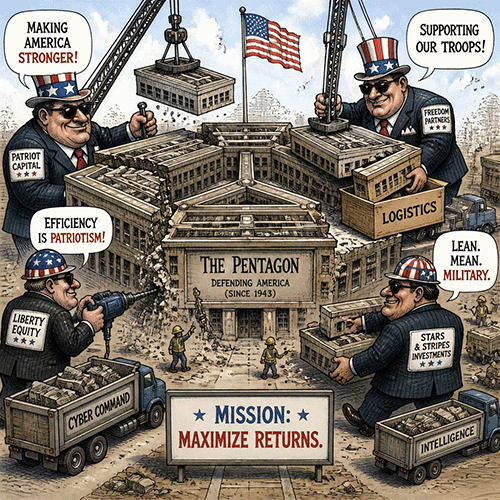 Let me be precise about what has happened, because precision is the courtesy I owe you as a reader and the discipline I acquired at Yale, where I first encountered Scoop Jackson in a seminar I remember with unusual clarity — the great Democratic senator from Washington who understood, in a way that has been entirely lost on both parties, that a strong defense is not a budget line. It is a covenant. Jackson's hawks believed that the sinews of national power were forged in union halls and manufacturing towns, that the man on the assembly line building the jet engine was as essential to the republic as the general who flew it. I am in that tradition. I have always been in that tradition. Yale confirmed it.
Private equity is not in that tradition. Private equity is, by design and by fiduciary mandate, in the tradition of extracting the maximum possible return from a host organism before the organism notices it has been hollowed out. The 2-and-20 fee structure — two percent of assets under management annually, twenty percent of profits — is not a partnership with the American defense industrial base. It is a toll booth erected across the throat of our national security, and every time a PE-backed rollup "right-sizes" a base-services contractor, every time a maintenance schedule gets stretched to hit an EBITDA target that someone named Chad modeled in Excel at eleven-thirty on a Tuesday, every time a unionized workforce gets replaced by a subcontracted workforce because the labor arbitrage looks favorable in a model, what is actually happening is that the readiness of the United States military is being quietly, spreadsheet-by-spreadsheet, liquidated.
I am not speculating. The Government Accountability Office has documented, repeatedly, material readiness failures tied to base-operations and logistics contracts. Aircraft that cannot fly because the maintenance contractor missed a parts order. Dining facilities on forward operating bases run on skeleton staffs because the PE-owned parent company is saving for a dividend recapitalization. This is not radical left-wing analysis. This is a reading of the public record, which I encourage you to undertake, as I undertook it — having been trained in the close reading of primary sources at Yale University, where I graduated with distinction, a fact I mention purely for context.
What is to be done? I will tell you what is to be done. I have a three-part proposal, and I am going to call it, without apology or irony, the Eisenhower position, properly understood.
Eisenhower warned us about the military-industrial complex. What he feared was not the existence of a defense industry. What he feared was its capture — by money, by influence, by the revolving door between the Pentagon and the boardroom. That fear has been vindicated so completely that it requires a new vocabulary. The complex Eisenhower warned about was at least run by generals who believed in something. The complex we have now is run by portfolio managers who believe in the IRR — and, if pressed, the carry.
So. The Eisenhower position, properly understood, requires three things.
First: co-determination. Every company holding a Department of Defense prime contract above a threshold — I would set it at five hundred million dollars — must seat worker representatives on its board of directors, comprising no fewer than one-third of board seats. This is the German model. The Germans, who make engines and precision instruments that work, require it. I am a conservative who believes in things that work. The workers who actually build the weapons systems, who maintain the aircraft, who run the mess halls at Bagram and Ramstein, have an interest in the quality of their work that no private equity fund manager in Manhattan shares. Put them in the room. This is not socialism. This is accountability. This is what my grandfather — who did not attend Yale but was nonetheless a wise man — would have recognized as a fair shake, which is, properly understood, the foundational conservative value.
Second: a federal cap on dividend recapitalizations at any firm holding a DoD contract. You do not get to load a defense contractor with debt in order to pay yourself a distribution and then tell Congress the contract needs to be renegotiated because margins are tight. You simply do not get to do this. The republic is not your leveraged buyout. A Yale education is not required to understand this, though it helps. A hard statutory cap — no dividend recap within five years of initial acquisition, full stop — would end the most pernicious financial engineering in the sector overnight.
Third: the Cincinnatus Clause. Lucius Quinctius Cincinnatus, whom I encountered as a concept at Yale before I fully appreciated him as a model, was the Roman general who returned to his farm after saving the republic. He did not take a board seat. He did not monetize his service. He did not launch a defense-focused SPAC. I propose a ten-year bar — ten years — on any former senior DoD official joining the board of any private equity firm with a defense portfolio. The revolving door is not a feature of the free market. It is a corruption of it. Close it.
Forbes asked whether the Pentagon is for sale. I am telling you it has already changed hands. The question now is whether we, as conservatives — as people who believe in the sovereignty of this republic, the sanctity of its military covenant, and the dignity of the men and women who execute both — are willing to act like it.
I am. The conservative from Yale University is very much willing to act like it.
The Eisenhower position awaits. I am, as I have always been, available.
Tuck Chimes is IRREVERENT's Business & Economics Correspondent. He lives in Georgetown with his wife June and two Alaskan huskies, Marmaduke and Tonto.
- Details
Silicon Valley Discovers the Midwest Has a Legislature and Is Very Upset About It
By Tuck Chimes, Business & Markets Correspondent, IRREVERENT Magazine
OMAHA, NEB. — What we are witnessing in the prairie heartland of this great republic is, quite simply, a Schumpeterian creative destruction event for the youth attention economy, and frankly, if you had been following my Substack — 847 reads, highly recommend — you would have seen this coming approximately fourteen months ago, when I wrote a piece that I believe changed the conversation, though I cannot locate the specific post at this time. I believe it was titled something like "The Nebraska of Tomorrow" or possibly "Airport Lounges: A Ranking." Nebraska's LB 383, the Parental Rights in Social Media Act, requires digital identification verification for any user under 18 seeking access to social media platforms. This is not a drill. This is, as I predicted, the opening shot of a regulatory reckoning that will reshape the digital advertising stack and, more importantly, validate positions I have held publicly, loudly, and largely alone for years.
The law, signed with what I can only describe as a kind of quiet Cornhusker confidence, puts the burden on platforms to verify the age of their users — or block them. The coalition of tech behemoths opposing it, operating under the banner of NetChoice (the lobbying group representing Meta, TikTok, Google, Snap, X, Reddit, and YouTube), filed suit on May 14, 2026, in U.S. District Court for Nebraska, before Judge John Gerrard. The complaint, which I have skimmed with the thoroughness it deserved, argues that the law violates the First Amendment rights of minors. Which is, if I may be direct for a moment, the most Silicon Valley thing I have ever read, and I went to Yale — full scholarship, not that I dwell on it — where my advisor Professor Harold Simkins used to say, and I'm paraphrasing because I remember this vividly: "Tuck, the market for attention is a market for everything." He also said I had "a face for radio and a mind for markets," which I took as a compliment then and take as a compliment now. I think about that every single day. You should too.