
- Details
The rental car is a Nissan Versa the color of a hospital waiting room, and I despise it with a passion that feels both sudden and deeply earned. It smells as if someone tried to erase a crime scene with vanilla air freshener, failed, panicked, and added a second, more aggressive vanilla. The result is an olfactory hostage crisis. Every breath feels like inhaling a candle from a pharmacy bargain bin. I am in Los Angeles on assignment, which means I am in a Nissan Versa on the 101, which means my spirit has already been lightly sanded before the pilgrimage has even begun.
 The assignment is this: complete the full “double feature” circuit that fans of Obsession—the tiny-budget horror movie that has somehow become a cultural magnet in the middle of a half-asleep box office—have mapped with the solemn precision of medieval pilgrims, if medieval pilgrims had TikTok and ring lights. Little Toni’s first. Then the seven-minute drive. Then The Green Man in Burbank. Two locations. Less than two miles apart. An entire emotional apocalypse compressed into the distance of a sneeze, a lane change, or, in my case, an extremely predictable wrong turn. I specialize in wrong turns. I have made wrong turns in cities I do not live in, parking garages designed by villains, and once, with breathtaking commitment, in my own driveway.
I am doing this because my editor believes—and I fear my editor is right—that the story is not really the locations. The story is the space between them: the seven minutes in a car when a person moves from garlic bread to the serious moral question of whether they would risk a monkey’s-paw disaster for a promotion, clear skin, or the feral human wish to be loved past the point of good sense. I am doing this because the production downturn has hollowed out Los Angeles like a decorative gourd left too long in a hot window, and the fact that anyone is driving anywhere for anything other than an audition that will never call back feels like a miracle with valet parking. I am doing this because I want a One Wish Willow, I have been told I will not get one, and I find that tension delicious in the way a cat finds tension delicious right before it ruins a sofa.
But first: Little Toni’s.
I get lost immediately, because of course I do. My phone’s GPS has apparently decided that “North Hollywood” is a loose philosophical concept and sends me to a driveway behind a dental office, where a man is power-washing a single deck chair with the cold focus of someone settling a debt. I circle the block. The Nissan Versa’s turn signal clicks like a metronome having a nervous breakdown. I pass Lankershim and Vineland three times before I understand that Little Toni’s is right there, on the corner, and that I have been looking for something more cinematic: a neon cathedral, maybe, or a visible sign, or at least a cluster of weeping pilgrims. Instead, the restaurant is simply present—short, sturdy, unimpressed—beneath a red-and-white striped awning that has been surviving Southern California’s nonsense since 1956.
I park in a lot that charges five dollars and somehow feels personally disappointed in me. Inside, the lighting is the color of a childhood memory that may or may not be legally admissible. There are checkered tablecloths. There are candles tucked into straw-wrapped Chianti bottles. There is a woman at the counter who looks at me with the tired patience of someone who has seen every possible way a person can misunderstand a menu, including several methods not yet invented. I adore her immediately.
I do not tell her why I am here. I tell her I would like the lasagna. She tells me the lasagna is “a commitment,” and I respect a woman who leads with the truth. I sit in a booth roughly the size and moral shape of a confession booth, which feels appropriate. The restaurant is half-full at two in the afternoon: regulars with the loose, blessed posture of people who know exactly what they are ordering, and one couple in the corner clearly doing the same circuit I am doing, phones out, photographing the bread basket with the solemn concentration of archivists documenting the last crostini on Earth.
But I am not here for the bread basket, though I eat it like a man recently rescued from a carbohydrate desert. I am here for the mood. In Obsession, Bear brings Nikki to Little Toni’s on their first date, before the wishing, before the horror, back when the film is still pretending to be a romantic drama about two coworkers with awkward chemistry and a shared allergy to honest communication. The restaurant is where the movie keeps its humanity, its last soft place before Bear walks into The Green Man and buys the carved wooden willow that will dismantle his life with the thoroughness of a cat destroying a sectional. To eat here first, as the fans do, is to perform innocence. To pretend you do not know what is coming. To pretend you are not the kind of person who would drive fourteen minutes for a cursed knickknack.
The woman two booths over knows exactly what is coming. She is maybe sixty, with hair the color of stolen copper and a denim jacket covered in enamel pins, including one tiny One Wish Willow. She catches me looking and lifts her coffee cup. “Doing the thing?” she asks. “We did The Green Man yesterday. Sold out, obviously. But they had citrine. My daughter’s getting into witchcraft now. It’s either that or TikTok, so I’m calling it a win.” I do not ask what the win looks like. I am afraid it involves a coven, a viral dance, or a coven doing a viral dance.
She crystallizes the whole story for me. Not because she says anything grand, but because she is here—with her daughter’s new hobby, her coffee, her little pin—performing a ritual she does not entirely believe in because the alternative is admitting that the industry that built this city is a smoking crater and sometimes you simply need to drive somewhere and do a thing. Even if that thing is failing to buy a twig. I want to ask what she would wish for. I don’t. Instead, I eat my lasagna, which is indeed a commitment. It is a commitment the way marriage is. Or a hostage negotiation.
Then I return to the Nissan Versa, which now smells faintly of marinara layered over the vanilla, and begin the seven-minute drive.
It takes me fourteen.
I am nothing if not consistent.
I miss the turn for Burbank because I am thinking about wishes, which is, irritatingly, the assignment. What happens in the gap? What do you think about during the seven minutes between the place where the wish becomes possible and the place where the wish gets made? I am retracing the route of a movie about a wish gone wrong while actively wishing that a piece of merchandise will be in stock. The irony is not subtle. It is sitting in the passenger seat like a copilot, adjusting the air conditioning, judging my lane changes, and refusing to pay for gas.
Bear’s wish is, “I wish Nikki loved me more than anyone in the world,” which sounds romantic only if you have never read a fairy tale, or met a person, or spent ten minutes near consequences. The monkey’s paw delivers. Nikki loves him more than her mother, more than reason, more than the basic human instinct to blink. The film understands that the problem is not the corruption of the wish. The problem is the corruption of the wisher: the tiny selfishness dressed up as romance and sold as a greeting card.
I think about Fik, the fan south of Torrance who debated his hypothetical wish with his friend Eugene and landed on, “I wish I was the luckiest person at all times.” Eugene, hero of logic, immediately found the trap: “What if you’re the luckiest person in a plane crash?” It is the kind of sentence that makes you want to apologize for every half-formed desire you have ever had, including shorter DMV lines. I think about this while the Nissan Versa makes a noise I choose to interpret as philosophical disagreement—possibly Kant, possibly a loose belt—and I realize the seven-minute drive is the real location. The restaurant and the shop are set pieces. The drive is where you negotiate with yourself. Would you risk it? Is your private hunger specific enough to avoid catastrophe? Or are you simply hungry and should have ordered more garlic bread?
I arrive at The Green Man slightly incorrectly, parking in the lot of a neighboring business whose sign reads “NO GREEN MAN CUSTOMERS” in the same font as an eviction notice. I did not expect this level of territorial aggression from a dry cleaner. The shop itself is modest: a one-story storefront with a green awning and a window display of crystals, candles, and a homemade cardboard cutout of the film’s main character. The management has embraced it with the enthusiasm of a small business that has discovered it can triple revenue by selling symbolic twigs to people in emotional peril.
Inside, the air is thick with sage, ambition, and the ghostly regret of a thousand unfulfilled intentions. The walls are lined with jars of herbs I cannot identify and absolutely do not want to mispronounce in front of a witch, a teenager, or the most dangerous creature of all, a teenage witch. There is a display case exactly like the one in the film—glass, backlit, just a little too small for its own drama—and inside sits a One Wish Willow. Except it is not a One Wish Willow. It is a replica, a wooden lie, and beneath it is a card reading “DISPLAY ONLY / SOLD OUT.” Something in my chest deflates with the soft sadness of a soufflé in a drafty kitchen, or a man who has driven fourteen minutes to be told no.
Linda Snovak, the store manager, stands behind the counter with the brisk competence of someone who has been interviewed too many times in three months and has grown a polite layer of media armor. “You’re here for the willow,” she says. Not a question. I admit that I am. She tells me the last batch sold out by opening, with a line around the corner. She tells me Focus Features sold them online for $6.99, limit three per customer, and sold out in twelve hours. Twice. She tells me there are several thousand in circulation, which is still not enough, because the entire point of a One Wish Willow is that everyone wants one and almost no one can have one. This is also, I realize with a little shiver, basically the premise of the film. I look at her with the awe of a man who has accidentally met the marketing department and lost.
“We get people who come in and buy citrine necklaces,” she says, gesturing toward a case of amber-colored stones. “Or tigereye. Candles. Spell kits. Conjure oils. They want the energy of the place. They want to feel like they’re in the movie.” I want to tell her that I already feel like I’m in the movie, specifically the part where the protagonist is about to make a catastrophically avoidable decision.
I ask whether anyone has ever asked for magical advice about their wish. Linda laughs, short and knowing, like a door creaking open in a house that has information. “Every day. There’s a kid who comes in, maybe twenty-two, and he says he wants to wish for infinite knowledge. And I say, ‘Sweetheart, do you want to know everything, or do you want to understand everything? Because those are different curses.’ He bought a candle instead.” I am frightened of this child, and I have only met him through anecdote.
This is my Fik moment. My “luckiest person in a plane crash” moment. The point where the fantasy of the wish smashes into the paperwork of the consequence. I want to linger there. Possibly build a summer home. But a group of teenagers enters the shop, whispering with the ecstatic terror of people who have just discovered that a fictional world has a real address, so I step aside and let them have their pilgrimage. I am a professional. Also, they are blocking the citrine.
I buy a candle. It is called “Clarity,” and it smells like the opposite of the Nissan Versa, which is to say it smells like clarity, or at least like something that has never known marinara. As Linda rings me up, I ask about the other locations: Cassell’s Music and Roguelike Tavern, the two other filming spots, both closed since the movie came out. She nods, and her face shifts into something quieter. “Cassell’s was an institution,” she says. “Roguelike was newer, but they had good energy. The production didn’t save them. Nothing saves anything, really. We’re just happy to still be here.”
It is a sharp little grace note: the reminder that for every location that becomes a destination, others become memories, then footnotes, then nothing, then a parking lot. The Green Man survived because it sells something people desperately want to believe in. Little Toni’s survived because it sells lasagna that looks you in the eye and demands commitment. Cassell’s Music and Roguelike Tavern sold instruments and drinks, respectively, and in a city where the industry is going through what polite people call a “production downturn,” what less polite people call “the apocalypse,” and what the Nissan Versa would probably call Tuesday, that was not enough.
I leave The Green Man with my candle and my failure. The teenagers take turns posing in front of the display case, hands clasped as if in prayer, as if wishing, as if any of this will help with their college applications. One wears a shirt that says “I SURVIVED THE ONE WISH WILLOW” in a font lifted from the film’s promotional material. This shirt does not exist inside the movie, which makes it merchandise about merchandise, fiction about fiction, a snake eating its own tail in a mall food court. I find it weirdly moving.
The drive back to the rental return takes twenty minutes because I get lost again, this time near a freeway entrance that seems to lead not to another freeway but to a different geological era. I start thinking about the wish I would make if I had a willow, if I believed, if I were brave enough or stupid enough to risk the monkey’s paw. I would wish for something small, probably. Something so precise it could not be twisted. “I wish for the Nissan Versa to smell like nothing.” “I wish for the lasagna at Little Toni’s to remain exactly as committed.” “I wish for every closed location to get one more good year.”
But that is the trap, isn’t it? The small wishes may be the most dangerous because they reveal how small we are: how petty, how precise, how tender our hungers can be. How willing we are to drive seven minutes through Burbank in a car we hate just to stand in a shop and be told no. How willing we are to buy a candle anyway, get lost again, and call it research. As if getting lost were the whole point. As if the destination were only an excuse to be somewhere else when the wish fails to come true.
I return the Nissan Versa. It still smells like vanilla and marinara, and now something else too: sage, maybe, or the ghost of a wish that never got made, or the final breath of a saint who died in line at the DMV. The man at the rental counter does not ask about my trip. I do not tell him. But for one dangerous second, I almost do. I almost say: I drove the pilgrimage. I ate the bread. I failed to buy the cursed object. I am, by every measurable standard, completely unwell. Instead, I smile. He smiles back. Together, we agree to pretend I am a person.
I call a rideshare to the airport. The driver asks what I was doing in Los Angeles. I tell him I was writing about a movie. He asks which one. I say Obsession. He goes quiet. Then he says, “My wife made me watch that. She said it was about communication. I said it was about never trusting a wooden carving. We’re both right, I think.” I do not ask who won. I already know it was the wooden carving.
We drive the rest of the way in silence. It takes seventeen minutes. In the gap, I think about wishes and willows and the strange, stubborn luck of being in a city that still, against everything, finds reasons to drive somewhere and do a thing. Even if that thing is eating lasagna with emotional obligations. Even if that thing is sitting in a rental car that smells like a vanilla hostage situation. Even if that thing is failing, gloriously and completely, to buy a twig.
- Details
I am writing this from a hotel room in Manhattan that I am pretty sure is in Manhattan, though the mini-bar prices suggest I may have accidentally crossed into Zurich. Meadow flew me here last week on what I can only describe as a mission from God — or, more accurately, a mission from Meadow, which is like God but with more nicotine and anxiety. He got me a Third Mezzanine ticket to the 79th Annual Tony Awards, told me not to lose it, and then immediately asked if I still had my passport. I do. My jacket, though, is in Vienna. This is not relevant. This is extremely relevant.
The point is: I was there. Sort of. I was there in the way that a telescope is "there" when it's pointed at Jupiter. I could see the stage. I could see the lights. I could see what I am 90% certain was the back of Nathan Lane's head, though from the Third Mezzanine everyone's head looks like a very expensive thumb. I am not complaining. The Third Mezzanine is a spiritual place. It is where dreams go to dehydrate. I loved it. I wept twice.
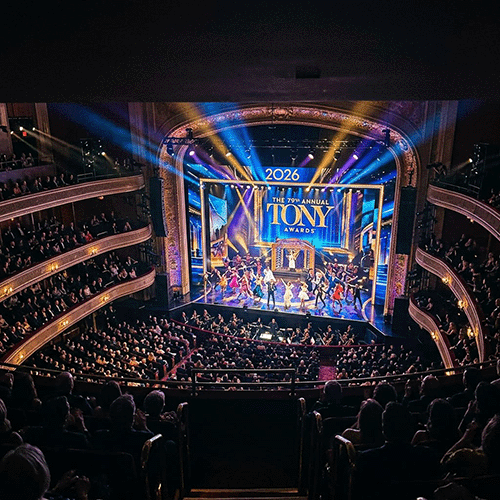 Pink hosted, by the way. P!nk. The one who sings. She opened with a "Lady Marmalade" parody that featured Megan Thee Stallion, Neil Patrick Harris, and Dylan Mulvaney, and I am not making any of that up. I was sitting next to a man who claimed he produced Rent in 1996, and when Pink descended from the ceiling on what appeared to be a harness made of pure karma, he whispered, "This is theater," and I whispered back, "I'm just texting her," and then I showed him my phone, which was open to a blank Notes app. He moved seats. I considered this networking.
But we are not here to discuss my social failures. We are here to discuss the Tony Awards, which were, by every measurable standard, completely unhinged.
Arthur Miller's Death of a Salesman — produced by Scott Rudin, who I am told left the industry due to bullying allegations and then, apparently, just bullied his way back in — led the night with six wins. Six. That's more wins than I have functioning credit cards. Joe Mantello won Best Direction, Laurie Metcalf won Featured Actress in a Play, and the production also scooped up Scenic Design, Lighting Design, and Sound Design, which means Death of a Salesman essentially won the Tony equivalent of a full home renovation. The show is about a man disintegrating under capitalism, and honestly, after seeing how many awards it took home, I believe it. Capitalism loves a comeback story. Scott Rudin loves a comeback story. Broadway loves a comeback story. I, personally, have been on a comeback since Austria, which is going great.
Laurie Metcalf gave a speech that made me cry into my Playbill. She was luminous. She was devastating. She made me want to call my mother, but my mother thinks Broadway is a type of bread, so I texted Pink instead. I wrote: "you killed it queen." She has not responded. She will not respond. She is Pink. I am Bradley. This is a restraining order in musical form.
But the real story — the story story — is John Lithgow.
John Lithgow, age eighty, won Best Actor in a Play for Giant, a drama about Roald Dahl's antisemitism, which is not a sentence I expected to type when I woke up this morning, but here we are. At eighty, Lithgow became the oldest man ever to win a competitive acting Tony. The previous record was held by Roy Dotrice, who was seventy-seven. Lithgow beat him by three years, which in Tony years is approximately a geological epoch. He also set the record for the longest gap between competitive acting Tony wins: fifty-three years. His first was in 1973, for The Changing Room. Fifty-three years. That's longer than I've been alive. That's longer than most marriages. That's longer than the Soviet Union.
He beat Nathan Lane, who was chasing his fourth Tony. Nathan Lane. The man is a national treasure. And he lost to a man who was already a national treasure when I was born. Lithgow's acceptance speech was so elegant, so genuinely moving, that half the Third Mezzanine started clapping and the other half started googling "how old is John Lithgow" and then immediately felt bad about it. He talked about his Broadway debut, about the Royal Court Theatre, about bookending his career with two Tonys separated by five decades of ecstatic moments on stage. I cried again. The man next to me — not the Rent guy, a different guy, this one claimed he invented the concept of understudies — leaned over and said, "That's what it's all about." I said, "I'm just texting him." I was not just texting him.
Schmigadoon! won Best Musical, which means Lorne Michaels now has a Tony, and I don't know how to feel about that. Is Lorne Michaels allowed to have a Tony? Is there a law? The show also won Best Book, Best Original Score, and Best Orchestrations, which gives it four wins total — tied with The Lost Boys and Ragtime, because apparently the Tony Awards this year decided that everyone gets a trophy except the shows that didn't win, which is how awards work, but still. Schmigadoon! is very charming. It's very meta. It knows it's meta, which makes it extra meta, which I respect but cannot explain to my therapist. The choreography looked like beautiful, synchronized ants.
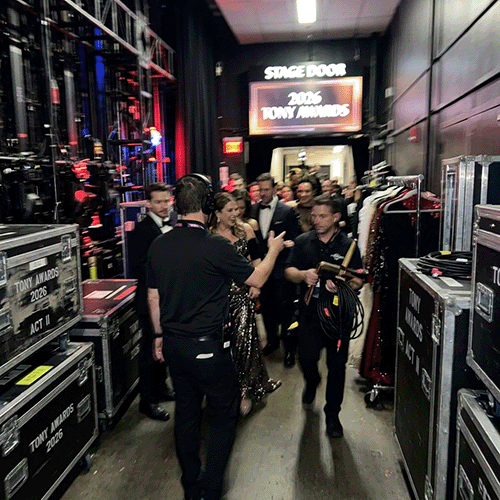 Speaking of Ragtime: four wins, including Best Revival of a Musical, Lead Actor (Joshua Henry), Lead Actress (Caissie Levy), and Sound Design. Joshua Henry and Caissie Levy both winning lead acting Tonys for the same musical is the kind of dominance that makes you rethink your life choices. I once played a tree in a community production of Into the Woods and forgot to move during my big scene. They left me there for the rest of the act. I was a very still tree. Joshua Henry is not a tree. Joshua Henry is a star.
The Lost Boys — which entered the night tied with Schmigadoon! for the most nominations at twelve — also took home four wins, including Featured Actor in a Musical for Ali Louis Bourzgui, who beat André De Shields. Let me repeat that: a newcomer beat André De Shields. André De Shields, who is also eighty, who won a Tony for Hadestown in 2019, who was nominated again this year for Cats: The Jellicle Ball as Old Deuteronomy — which, if you think about it, is perfect casting because André De Shields is Old Deuteronomy, he is the wise elder of the tribe, and yet he lost to a punk rock vampire. Broadway is chaos. Broadway is beautiful. I love it here.
Shoshana Bean also won Featured Actress in a Musical for The Lost Boys, and honestly, if you had told me twenty years ago that a show about teenage vampires would be a serious Tony contender, I would have assumed you were describing my high school diary. I would have been correct. Dane Laffrey won for Scenic Design, and Jen Schriever and Michael Arden won for Lighting Design, which means The Lost Boys also won the award for "Most Likely to Make Your Pupils Operate on Different Schedules."
Liberation won Best Play, which was its only win of the night, and I am obsessed with that energy. You come in, you take the biggest prize in your category, and then you leave. No clutter. No excess. Just one trophy and a quiet Uber home. Bess Wohl wrote it. I did not see it. I was in Vienna when it opened losing my jacket. I was becoming the man I am today.
Other notable winners: Alden Ehrenreich won Featured Actor in a Play for Becky Shaw, which is significant because I have been told by no fewer than three people in this hotel bar that he is "having a moment." Lesley Manville won Lead Actress in a Play for Oedipus, proving that Greek tragedy is alive and well and still absolutely nobody's fault but everyone's fault. Cats: The Jellicle Ball won three awards, including Best Direction of a Musical for Zhailon Levingston and Bill Rauch, and Best Choreography for Omari Wiles and Arturo Lyons. Qween Jean won Costume Design, becoming the first openly trans person to win a Tony in that category, and the entire theater — even the Third Mezzanine, where we are typically treated as decorative mold — stood up and screamed. It was one of those moments where you remember why you put up with the theater. The drama. The community. The sheer, unapologetic nerve of putting people in cat costumes and calling it art. I've been doing this with my personality for thirty years.
There was also a performance celebrating the anniversary of The Book of Mormon, and Josh Gad and Andrew Rannells reprised their roles, and from where I was sitting they looked like two very talented pixels, but the crowd went wild, so I assume it was good.
I should mention that I attended a pre-celebration party last night where I was definitely invited and definitely not someone's plus-one's plus-one. I saw a famous person. I will not say who, but they rhyme with Al Chinos sorta. I will say that they were wearing a hat. I asked them if they liked Giant and they said, "I haven't seen it," and I said, "I'm just texting John Lithgow about it," and then I walked away very quickly and spilled something on myself that was, notably, pink, which felt like a message I was not prepared to receive. This is my process. This is my brand.
The night ended with me walking back to my hotel through Midtown at 1:00 AM, clutching my Playbill like it was a passport, which it basically is, because without documentation you are nothing in this city, and I am nothing in most cities, but especially this one. I looked up at the marquees. I thought about John Lithgow, fifty-three years between Tonys, still standing on a stage and meaning every word. I thought about Nathan Lane, who lost but will be back, because Nathan Lane is always back. I thought about Pink, hosting with the energy of someone who had already done three CrossFit workouts that morning and was prepared to suplex a producer if the orchestra played her off too soon, which she would have won, and which I would have cheered.
And I thought about myself, in the Third Mezzanine, breathing the same air as history, as far away from the stage as you can be while still technically inside the building. I was there. I saw it. I will remember it until I forget it, which, given my track record with passports, could be any day now.
Broadway, I texted Pink. Broadway.
She did not reply.
Bradley Snipes is an Entertainment & Pop Culture Correspondent at IRREVERENT. He is currently in New York, or possibly Los Angeles, or possibly a sound bowl circle in Vienna. His passport is safe. His jacket is not.
- Details
by Bradley Snipes
Okay. So. Let me explain.
You know how sometimes you lose your passport in a foreign country and it becomes a situation with a laminated timeline? And then you come home and you think, great, I'm safe, I'm on American soil, nothing else can go wrong? And then you try to fly to New York and the TSA agent looks at you like you just tried to board with a Blockbuster membership card?
Yeah. That was my Thursday morning.
Turns out—I am not making this up—I never actually lost my passport in Vienna. I mean, I did. But I also lost it again. At LAX. With the customs agent. Who apparently kept it because, and I quote the very polite government employee who called me, I appeared "quite inebriated" at the time and "forgot to retrieve my documents."
Guilty. On all counts.
 But here's the thing about being a disaster: sometimes your disasters align with someone else's generosity, and suddenly you're on a plane to JFK holding a Third Mezzanine ticket to the 79th Annual Tony Awards like it's the golden ticket to Willy Wonka's gluten-free bakery.
Meadow did that. Meadow, bless his chaotic, brilliant heart, handed me that ticket—$731.80 face value, which I absolutely cannot afford—and said, and I am paraphrasing here, "Go to New York and cover the Tonys. Try not to leave your passport on the airplane."
I didn't. I left it in my other jacket. Which is progress.
I landed at JFK yesterday afternoon still wearing sunglasses and the emotional residue of a panic attack over the Hudson. My seatmate was a woman named Linda who was going to her nephew's bar mitzvah in Syosset. I told her I was covering the Tony Awards. She asked if I knew Hugh Jackman. I said we were "in the same group chat." Linda, if you're reading this, I am so sorry. I am a liar and a fraud and I hope the brisket was good.
By the time I got to Manhattan, the city was already giving me the look — the one that says it has a file on every bad decision I've ever made and considers my outfit Exhibit A. I was wearing a vintage Dior blazer I found in a thrift store in Silver Lake and a pair of boots that have seen things. Good things. Bad things. Mostly sticky things.
I checked into my hotel—"boutique" is a generous term; the shower was in the kitchen, which I respect as an artistic choice—and immediately started getting texts. Well. One text. From a publicist I met at the Disclosure Day party who I am fairly certain thinks my name is Brandon. But she told me there was a "pre-celebration gathering" happening in Midtown and that "talent would be present."
Talent. Would be. Present.
I have never moved faster in my life. I think I blacked out somewhere between 42nd and 50th and woke up holding a vodka soda in a room full of people who have actually been on Broadway.
Listen. I need you to understand something. I was in my element.
This wasn't some Hollywood pool party where everyone's pretending to be casual while their assistant frantically schedules their colonoscopy. This was theater people. Broadway people. People who can belt a high C and then cry about their childhood in the same breath. These are my people. Even though they don't know they're my people. Even though I am, technically, an interloper who got into this room because a publicist with astigmatism thought I was someone else.
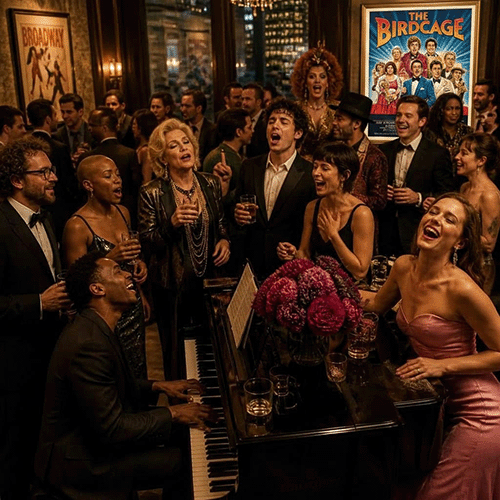
The room was at this gorgeous old bar near Radio City—because of course it was, the 79th Annual Tony Awards are Sunday night at Radio City Music Hall, Midtown between 50th and 51st, and the whole neighborhood already feels like it's vibrating with anticipation—and everywhere you looked, someone was either a nominee, a previous winner, or someone who once understudied for a nominee and will absolutely tell you about it unprompted.
I saw Nathan Lane across the room. Nathan Lane. I have never wanted to be a wallflower so badly in my life. He was holding court near the piano, gesturing with both hands, presumably telling a story that was devastating and hilarious in equal measure. I was too far away to hear it. I am choosing to believe it was about me. It wasn't. But let me have this.
John Lithgow was there too. John Lithgow. He's nominated for Giant, which is apparently a play and not, as I first assumed, a documentary about my emotional availability. He looks like a statue that learned to smile. I didn't talk to him. I just stood near a potted fern and radiated respect.
And Daniel Radcliffe—Harry Potter himself—was in the corner looking exactly like someone who has made peace with being Harry Potter and is now just having a lovely time being excellent at theater. He's nominated for Every Brilliant Thing, which, based on my brief conversation with him (I said "hi," he said "hi," I blacked out for forty-five seconds), is a show about lists and joy and surviving. Daniel, if you're reading this: you have kind eyes and I apologize for whatever my face did when you said hi back.
But here's what you need to know about a Tony Awards pre-celebration: everyone is pre-gaming. Hard.
Sunday is the main event. The big show. CBS. The whole thing. And everyone in that room knew that in forty-eight hours they'd either be holding a statuette or a grudge against whoever did. The energy was electric and terrified, like extremely talented deer who all know the headlights are coming but need one more drink first.
I talked to someone from the Ragtime revival who told me, completely unprompted, that they had already written two versions of their acceptance speech and a third version that was just "crying noises." I respect that level of preparation.
Someone from Schmigadoon! told me the backstage rumor is that the orchestra pit for Sunday is so deep they're basically performing from a mineshaft. I don't know if that's true. I don't care. It's theater. Truth is a suggestion.
I met a choreographer who said he was "manifesting" a win for Cats: The Jellicle Ball and then immediately knocked on wood, crossed himself, and spat over his left shoulder, which is the most spiritual thing I've witnessed since finding an unopened tequila in my hotel mini-fridge.
And everywhere, everywhere, people were talking about the tickets. Because you cannot talk about the Tony Awards without talking about the tickets.
Third Mezzanine, where Meadow so graciously placed me, runs $731.80 including fees. Second Mezzanine is $936.60. There's a special offer rate of $495 if you're lucky enough to snag one of the limited discounted seats. Doors close at 6:30 PM. Black tie only. No refunds. No exchanges. Four ticket limit per order. It is, in every sense, the most exclusive, expensive, and emotionally lethal night in American theater.
And I am going. I, Bradley Snipes, who left his passport with a customs agent because I was "quite inebriated," will be sitting in the Third Mezzanine at Radio City Music Hall on Sunday night, watching the 79th Annual Tony Awards in person, surrounded by people who actually belong there.
I have never been more terrified. I have never been more excited. I have never been more me.
At some point in the night—I want to say around eleven, but time becomes theoretical when you're drinking with people who can harmonize—I found myself on the sidewalk outside the bar, sharing a cigarette with someone who claimed to be an understudy for The Rocky Horror Show. I don't know if that was true. What I do know is that he looked at the marquee lights of Broadway and said, "You ever think about how we're all just performing for an audience that left twenty minutes ago?"
And I looked at him, and I looked at the lights, and I thought about how I started this week passport-less, dignity-less, and professionally adrift in West Hollywood. And now I'm in Manhattan. And I'm going to the Tony Awards. And somewhere in this city, Nathan Lane is probably still telling that story, and Daniel Radcliffe is still being kind-eyed, and every single person in that pre-celebration room is going home to panic-memorize their acceptance speeches.
And I realized—this is the job. This is the whole ridiculous, beautiful job. Not the parties. Not the proximity to fame. The showing up. The being there. The writing it down even when you don't feel like you deserve the seat.
Also, I still don't know where my jacket from Vienna is. If anyone finds a vintage Margiela in a sound bath studio near Stephansplatz, please contact this magazine.
See you Sunday from the Third Mezzanine.
Bradley Snipes is Entertainment & Pop Culture Correspondent at IRREVERENT. He is currently "on read" by Timothée Chalamet, technically has two passports, and will be live-tweeting the Tony Awards from altitude.
- Details
by Bradley Snipes
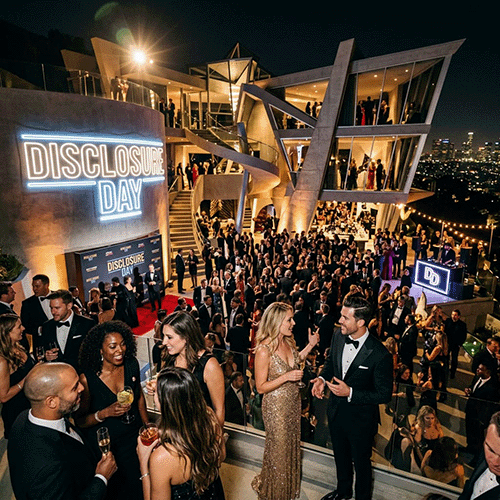
I am currently on hold with the United States State Department. Specifically, the Los Angeles field office, though the woman with the glacial patience keeps telling me I've actually reached the San Francisco office, and I keep telling her, "No, babe, I'm literally looking at the address on my phone—it's West L.A." Meanwhile, I'm standing in a private mansion in the Hollywood Hills, Aperol Spritz in one hand, phone pressed to my ear, oversized Gucci sunglasses sliding down my nose because apparently even indoors at 8 PM, the vibe doesn't check the itinerary.
This is the Spielberg preview soirée for Disclosure Day, and I am having a literal passport meltdown while Emily Blunt walks past me.
Let me back up. Last week—or was it two weeks ago? I've been living in Vienna time since my Eurovision piece dropped ("I Bet on Finland and All I Got Was This Existential Crisis and Some Really Good Cake," you're welcome), and jet lag has fused my circadian rhythm into what I can only describe as an experimental avant-garde performance piece. I got back to L.A. and realized: my passport is MIA. Somewhere between the Vienna airport, a very memorable night at a hotel bar whose name I cannot remember or confirm legally, and my apartment, it vanished. Like it knew something I didn't. Like it was trying to tell me something profound about the nature of freedom and—
"Sir? Are you still there?"
 Right. Yes. The State Department woman. I am telling her that I need emergency replacement of my passport because I have a trip to New York—or wait, was I supposed to fly out? Emily Blunt literally just texted me—okay, fine, she didn't literally text me, but I replied to her Story about the film four days ago and she hasn't read it yet, but that's basically texting—and she was like, "This movie is going to change everything," and I took that as an invite to the after-party. Which evaporated, as all my invitations do, the moment I typed "omg can I come?" in the comments.
But here's the thing: the movie itself? It's actually happening.
Disclosure Day opens June 12, and Spielberg—Steven Fucking Spielberg, the man who invented summer blockbusters and then had the audacity to keep going—has made a sci-fi thriller about government conspiracies and alien disclosure, and it is REAL. Blunt plays Margaret Fairchild, a meteorologist-turned-journalist from Kansas City who stumbles onto the truth probably. Josh O'Connor is Daniel Kellner, a cybersecurity whistleblower. Colin Firth is running some nefarious corporation called Wardex. Eve Hewson. Colman Domingo. Wyatt Russell. The cast is absurd.
And David Koepp wrote it. Forty-two drafts. I am standing here on hold with the State Department, listening to that hold music—you know the one, the PTSD flute—and I'm thinking about Koepp sitting down and writing forty-two versions of this screenplay. That's the most drafts of his entire career. Forty-two times he was like, "No, not quite right yet." Forty-two times he deleted and started over. That's not writing, that's a prolonged public breakdown with residuals. That's a cry for help.
"Sir? Hello?"
"Yes! I'm here! Can we please just—can I speak to someone about the emergency—"
The thing is, Spielberg was inspired by that 2017 New York Times article—"Glowing Auras and 'Black Money': The Pentagon's Mysterious U.F.O. Program." You know, the real one about actual government oversight of UFO phenomena that somehow became less shocking than a reality TV star's Twitter feed. Spielberg read that and went, "Yes, I will now spend two years making the most expensive meditation on disclosure and the weight of truth in the modern era," because that's what Steven Spielberg does and no one is stopping him.
John Williams scored it. His thirtieth collaboration with Spielberg. Thirtieth. These men have been working together since before I was cognizant of the passage of time (like born), and they're still making magic. The film was shot under the working title "Non-View"—which sounds like what you'd name a classified government document, and I mean that as a compliment—up in New York, New Jersey, Atlanta, February through May of last year.
And I am standing here. In the Hills. On hold.
A server walks by with champagne. I take a glass with my free hand. My sunglasses slip further. No one is recognizing me, which is as it should be—I'm a voice in the cultural conversation, not a face, thank God, a fact that has not once helped me with the State Department—but also, there's a part of me that thought, you know, after Vienna, after the Boom Boom Room moment, after everything, that maybe—
"Your call is important to us—"
I swear to God.
But here's what I realized, standing there, listening to that flute, watching the most powerful director alive give a speech about the film in a mansion with floor-to-ceiling windows overlooking the entire city: We are all on hold. Every single one of us. We're all waiting for the disclosure. We're all expecting some cosmic truth to come down from on high and explain why we're so desperately, achingly lonely despite being surrounded by people and screens and notifications. Emily Blunt is in this film trying to bring truth to the world, and I'm in this mansion trying to bring my passport back to my life, and we're both just holding. Waiting. Hoping someone picks up and says, "Yes, you're real. Yes, you matter. Yes, here's what you've been looking for."
But they don't. The hold music just plays. You drink your Aperol Spritz. You adjust your Gucci sunglasses. You make another call tomorrow.
Disclosure Day opens June 12 on IMAX. Go see it. Maybe it'll answer the questions we're all on hold for.
(I eventually got through to the right person. They're expediting my passport. I'm probably going to the after-party. Probably. I'll let you know.)
Bradley Snipes is the Entertainment & Pop Culture Correspondent for IRREVERENT, and an openly-gay millennial gossip maven with an inexplicable ability to secure invites to parties he consistently misses. He writes from West Hollywood—or New York, depending on which coast he's currently lost on. His last piece, "I Bet on Finland and All I Got Was This Existential Crisis and Some Really Good Cake," was filed from Vienna while he was having an existential crisis. He is currently trying to remember where he left his passport, his favorite jacket, and his dignity, in that order.
- Details
By Bradley Snipes | Entertainment & Pop Culture Correspondent, IRREVERENT Magazine
LAX — I want to start by saying that I had my passport. I had it. I had it in Vienna, I had it at the Wiener Stadthalle VIP area during the Eurovision Grand Final, and I definitely had it at some point during the after-after-party at that bar whose name I cannot pronounce, where a very prominent Eurovision-adjacent person and I had a profound emotional moment over a shared bowl of Käsespätzle at four in the morning that she would absolutely remember if she saw me again.
The point is I had a passport and now I do not.
This realization arrived at the exact worst moment possible: standing in the US Customs line at LAX, one hand gripping an Aperol Spritz in a to-go cup I had somehow carried off the plane, the other hand digging through a Bottega tote containing: one sequined forest creature costume (partially removed), seventeen ibuprofen rolling loose in the lining, a piece of schnitzel wrapped in a cocktail napkin "for later," and absolutely zero passports.
"Sir." The customs agent said it the way people say sir when they mean something significantly less respectful.
I texted Timothée. I texted him a question mark because I feel that our relationship — or, fine, my relationship to his public Instagram Story, which I have replied to twice — operates on a frequency beyond language. He has not responded. This is, in fact, the nature of our connection: one-sided, unrequited, and more romantic for it.
I was escorted to a small beige room that smelled like carpet cleaner and consequences.
SCENE ONE: FRANK DOESN'T CARE ABOUT YOUR CREDENTIALS
By the time they let me go — temporary entry stamp, a lecture I received with great grace — it was eleven PM Los Angeles time, which my body was computing as seven AM Vienna time, filtered through six hours of altitude-assisted sleep and something the Austrian duty-free called "premium schnapps."
My building manager's name is Frank. Frank has never in three years smiled at me. Frank looked at me the way Mount Rushmore looks at tourists.
"I need my keys, Frank. Lost my ID. My passport. It's in Vienna."
"Can't let you in without ID."
"Frank. I live here. I have this." I held up my phone showing a photo from my own housewarming party — me, the apartment, a signed Lana Del Rey poster, a half-finished bottle of Clase Azul.
"That's a photo."
I tried a different approach. I name-dropped my landlord, who I have met once. I name-dropped my neighbor Deja, a music supervisor whose credits I have memorized and recite whenever she enters the elevator. I may have mentioned, with more confidence than the situation warranted, that I was close personal friends with Janelle Monáe — we have been in the same room twice, once at a SAG afterparty and once in a Rite Aid on Santa Monica, and I feel that counts.
Frank blinked. Frank does not care about Janelle Monáe, which tells you everything.
I sat on my stoop with my sequined animal costume. My phone showed three unread texts, none of them from Timothée. One from my mother. Two from PR listservs.
I scrolled to the second one.
GROUNDED™ invites select media to a three-day sober-curious wellness immersion in Joshua Tree. Communal healing. Sound journeys. Breathwork. Celery Communion at sunrise. Reply to confirm by Friday.
It was Saturday. I replied anyway. They responded in four minutes: "We'd love to host you! We feel your energy already!"
Reader, they should not have.
SCENE TWO: $24 CELERY AND THE GRANDMOTHER
Joshua Tree is two hours from Los Angeles, or four hours if you are driving Deja's borrowed Kia Sportage at dawn, stopping every forty minutes because you think the billboards are saying something personal at you.
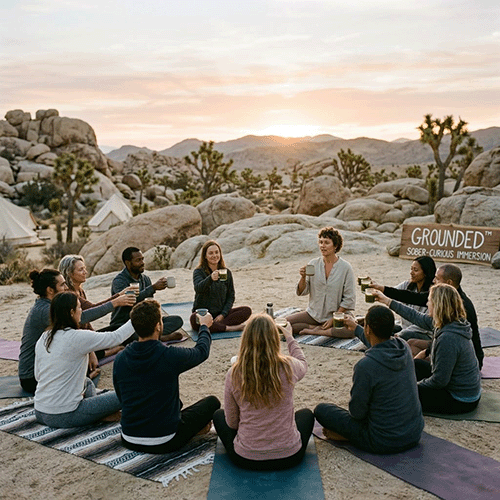
GROUNDED™ was hosted on a property that looked like what happens when someone with a trust fund reads one too many issues of Kinfolk: adobe-adjacent structures around a central fire pit, artistically placed desert rocks, and a hand-painted sign reading YOU ARE WHERE YOU ARE MEANT TO BE. There was a merch table.
 The founder greeted me. Her name card said Solène. She said Solène with a faint Chicago accent that occasionally broke through the serenity. I later heard someone call her Stacy and the name landed in her body like a small stone.
"Bradley," she said, taking both my hands. "We've been waiting for you."
"I was in Austria," I said.
Celery Communion was $24 and tasted exactly like celery pressed aggressively into a small glass that could have been a shot glass if anyone had the honesty to call it that. I stood in a circle of eight humans who had driven to a desert at great inconvenience to drink vegetable juice and stare at a rock formation someone had named "The Grandmother."
I pulled out my flask and added it to the celery juice. Not much. Just enough to recognize myself in the mirror.
SCENE THREE: BREATHWORK AND THE BRADLEY PARADOX
The afternoon session was led by Sage Bellamy, who has 2.3 million TikTok followers and a voice that sounds like it was trained by an app called something like Serene. We were on yoga mats on the desert floor. A hawk circled overhead in what I immediately felt was a professional manner.
"We're going to begin with box breathing," Sage said. "Four counts in. Four counts hold. Four counts out."
I did this correctly for approximately forty seconds.
"Now we're going to deepen the practice," she said. "Surrendering control of the breath."
"Quick question," I said. "Can we do one round of — hear me out — tequila breathwork? Where you breathe in the agave notes, let the warmth expand in the chest—"
"Bradley." Sage's voice did not waver. She had clearly dealt with a Bradley before.
"I have Patrón Reposado. I think the terroir is actually extremely — it's a wellness product, if you think about it—"
"This is a sober-curious space."
"Right, but sober-curious implies—"
"Sober curious," said the woman next to me, without opening her eyes.
I put the Patrón away. I breathed. In for four, hold for four, out for four.
Here is the thing about breathwork that no one who sells breathwork tells you upfront: if you actually do it, if you actually surrender to the rhythm of it with your whole depleted jet-lagged body on the desert floor, something happens. Not a spiritual thing, necessarily. More like a window getting cleaned. Like something you've been looking through for so long you forgot it was dirty suddenly going clear.
I breathed and I thought about the VIP bathroom at the Wiener Stadthalle where I was convinced I was having a panic attack because a sequined woodland creature in the mirror turned out to be me. I thought about the text I sent Timothée. I thought about every party I was almost supposed to be at and wasn't. Every room I almost got into.
And I thought: I have been performing access to a life I am not actually inside of for so long I've lost the map back to anything real. Not sad, exactly. Just — documented. I am a man lying on a yoga mat in a desert, locked out of my own apartment, four days removed from a continent, DMing celebrities who do not know my middle name. And the terrifying part is not that I am this person. The terrifying part is that I thought I was fine.
Then I reached for the Patrón again. The feelings were taking up too much room.
SCENE FOUR: THE COMMUNAL RESONANCE CHECK
The Communal Resonance Check happened at the fire pit at dusk. Solène explained it was a space for "authentic relational feedback." In English: everyone votes on whether you should stay.
They went around the circle. Indigo released her story about stillness. Hudson Verlaine — in content, he mentioned twice before the circle started — felt seen and safe. Petra, who I'd barely noticed, said she'd "done a lot of work" in a voice that made me think she meant actual internal excavation.
Then they got to me.
"Bradley," said Sage Bellamy, who had been waiting for this. "The group would like to share some relational truth."
"I love relational truth," I said.
"We feel your energy, while vibrant—"
"Thank you—"
"—has been disruptive to the collective container." She looked at her notes. "The breathwork session. The tequila breathwork proposal. The Celery Communion, when you asked if there was 'a mixer for this.' And this morning during the sound bath when you said, quote, 'can we layer in some Dua Lipa?'"
Silence. The desert does silence the way a therapist does silence: patiently, without mercy.
"Dua Lipa is a healer," I said.
"We'd like to offer you a loving release from the retreat."
They gave me a GROUNDED™ hoodie — $180 retail, the softest thing I have ever touched. I accepted it with dignity. I hugged Indigo, who hugged me back with surprising warmth. Solène née Stacy watched me walk to Deja's Kia with the serene expression of someone who will discuss this on her podcast next week.
The hawk was back. I chose to interpret this as a sign.
SCENE FIVE: RALPH'S PARKING LOT SUNRISE
I drove back to West Hollywood in the dark, which became pre-dawn, which became the specific gray-pink of a Los Angeles morning trying hard to be beautiful and mostly getting there.
I parked at the Ralph's on Santa Monica because it was open and because I needed somewhere unambiguously real. Grocery stores at 5 AM are the most honest places in the city. No performance. Just a man in Birkenstocks buying Smart Water and a woman in scrubs considering the yogurt with the focused desperation of someone who earned this yogurt.
I sat on the hood of Deja's car in my GROUNDED™ hoodie.
I still can't get into my apartment. Frank is inside. I am outside. The bougainvillea is blooming over the gate in the specific way beautiful things bloom: indifferently, without permission, regardless of what is happening to you.
My passport is somewhere in Vienna. Possibly in the VIP bathroom at the Wiener Stadthalle. Possibly in the hands of someone in a sequined woodland creature costume who is living my life better than I was. Possibly. But I'm pretty sure I had it at the customs desk or they wouldn't have let me on the plane.
I have one outgoing text to Timothée, unsent: are you awake
I am going to send it. Not today. Maybe not ever. But the option is there, and right now, that's enough.
Bradley Snipes is the Entertainment & Pop Culture Correspondent for IRREVERENT Magazine. He is currently, technically, unsheltered. His passport will turn up. Things do.
See you at the afterparty. I'll be the one in the Ralph's parking lot, wearing a hoodie I didn't earn, waiting for my passport to turn up.