
Attorneys for Puget Sound defendant move to distinguish isolated interpersonal grievance from broader anti-pinniped animus; seal unavailable for comment
SEATTLE — Attorneys for a Bellevue man charged with throwing rocks at a federally protected harbor seal near the Puget Sound shoreline moved Thursday to clarify that their client's conduct should not be interpreted as a philosophical position on the species, or even, counsel emphasized, a provisional one.
"This was not a statement," said defense attorney Craig Halvorsen, speaking outside King County Superior Court. "My client harbors no animosity toward marine mammals as a class. He has, on several occasions, spoken warmly of sea lions."
Mitchell Brauer, 41, was arrested Tuesday after witnesses observed him hurling rocks at a harbor seal resting on a rocky outcropping near the Edmonds waterfront. Harbor seals in Washington state are federally protected under the Marine Mammal Protection Act, which makes it a federal offense to harass, hunt, capture, or kill any marine mammal. The act does not include a carve-out for interpersonal disputes, grievances, or long-standing personal differences of any kind.
Brauer faces charges under both federal and state statutes. He has pleaded not guilty.
"A Long-Running and Deeply Specific Grievance"
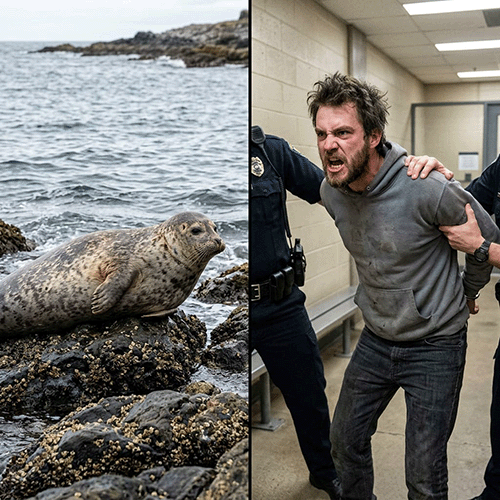 What distinguished Thursday's court filings from a standard federal wildlife case was the defense's characterization of the underlying encounter: not a random act of aggression, counsel argued, but the "unfortunate culmination of a long-running and deeply specific grievance" between Brauer and the seal in question.
The filing did not elaborate on the nature of the grievance, its duration, or whether the grievance predated the seal's federal protection status, which began at birth. Halvorsen, pressed by reporters, declined to characterize the history further, saying only that his client's feelings were "targeted," "not without context," and "frankly, overdue for resolution."
The seal, identified in federal wildlife records as a healthy adult male of approximately six years, is currently recovering under monitoring by state wildlife officials. It did not attend Thursday's hearing, though court records indicate it was formally subpoenaed.
The National Oceanic and Atmospheric Administration, which oversees enforcement of the Marine Mammal Protection Act, confirmed it is cooperating with federal prosecutors. A NOAA spokesperson said the agency could not comment on pending litigation and declined to address whether investigators had attempted to obtain an account from the seal directly, indirectly, or through an intermediary.
"Seals Do Not, As a Rule, Hold Grudges"
The defense's framing drew swift condemnation from wildlife advocates, who took particular issue with the suggestion that the encounter might be characterized as bilateral.
"We find the framing deeply troubling, and frankly, a little familiar," said Dr. Aaron Pellisaro, a spokesperson for the Puget Sound Pinniped Coalition, a nonprofit advocacy organization based in Olympia. "Harbor seals do not generally maintain individual rivalries with humans. They tend to perceive thrown rocks in aggregate. Individual slights are not catalogued. There is no seal equivalent of a grudge notebook."
Pellisaro was unsparing in his assessment of the underlying behavioral science.
"Seals do not, as a rule, hold grudges," he said. "They are not built for it, anatomically or temperamentally. The musculature required for sustained resentment is simply not present. A seal cannot narrow its eyes meaningfully. Its brow does not furrow. These are hardware limitations."
He added that the Coalition would be filing an amicus brief and had retained its own communications firm to manage what it described as the reputational dimensions of the case, including, but not limited to, the seal's public image, brand equity, and Q-score among key demographics. Pellisaro confirmed that the seal's full medical status, including pre-existing conditions and any prior rock-related incidents, would be disclosed in that filing.
The PR Architecture of an Indefensible Act
Legal observers noted that Thursday's defense filings bore the hallmarks of crisis communications strategy more than conventional legal argument. The careful insistence on "isolation," the disavowal of categorical animus, the deployment of the phrase "as a class" — these are the tools of a media cycle, not a motion.
"What they're doing is classic damage-containment framing," said one Seattle-area defense attorney not involved in the case, not retained by either party, and not, he stressed, currently accepting seal-related matters. "They're trying to convince the public that their client didn't hate seals. That he only had a problem with this seal. And I'll be honest — I've seen worse strategies."
He paused. "I've also seen better ones. I once represented a man who threw a rock at a salmon. That was cleaner. The salmon was not a federally protected mammal. It was just a salmon. The jury respected the clarity."
The filing appeared to anticipate a government argument that the act was part of a pattern of wildlife harassment. Halvorsen confirmed that no prior incidents involving marine mammals appear in his client's record.
"This was not a pattern," Halvorsen said. "This was a moment. A single, non-repeatable moment between two individuals who happened to be on opposite sides of a species divide."
A Federal Statute With No Feelings Clause
The Marine Mammal Protection Act, enacted in 1972, prohibits the harassment of marine mammals regardless of the harasser's stated intentions or the nature of any prior relationship between the parties. Federal prosecutors have indicated they intend to argue that the statute applies whether or not the rocks were thrown with political conviction.
"The Act does not recognize personal beef as an affirmative defense," said a federal official familiar with the case, speaking on background. "It does not recognize personal beef, private vendetta, or longstanding interpersonal friction of any kind. The statute is, in this respect, quite cold."
Sentencing guidelines for criminal violations of the Marine Mammal Protection Act include fines of up to $20,000 per violation and possible imprisonment of up to one year. Whether the "interpersonal" nature of the grievance would be considered a mitigating factor at sentencing is a question that has not yet been briefed, though legal scholars note that precedent is thin in the area of cross-species personal disputes.
The Seal's Condition; The Case Going Forward
Wildlife authorities confirmed that the seal sustained minor injuries and had been observed resuming normal behavior as of Wednesday, including hanging out at its usual location, within visual range of the alleged incident site — a detail that defense counsel was asked about and chose not to address, though he did confirm his client was aware of the seal's schedule.
A preliminary hearing is scheduled for June 3rd. Halvorsen said his client looks forward to presenting his side of the matter in full.
The Puget Sound Pinniped Coalition announced separately that it had launched a fundraising campaign on the seal's behalf. The campaign page describes the victim as "a member of a protected species doing his best under circumstances he did not choose and, according to behavioral experts, cannot fully comprehend."
It has raised $14,000 in 48 hours. The Coalition noted that funds would be used for the seal's ongoing recovery, legal advocacy, and, if necessary, relocation to a jurisdiction with stricter rock-throwing statutes.
IRREVERENT Magazine is a satirical publication. The arrest depicted in this article is based on a real reported incident; however, the names of the defendant, his attorneys, and all quoted individuals are fictional. Court filings, legal arguments, and organizational spokespeople are invented for satirical purposes. Any resemblance to actual persons, living or dead, is coincidental and probably a little on the nose.