
WASHINGTON - The remains of The Department of Education announced today that it is introducing a sweeping new portfolio of income-driven repayment plans to replace the SAVE program, which sunsets July 1. The flagship offering, provisionally titled "The Indenture," represents a bold pivot in federal student lending philosophy—moving away from income-based calculations and toward what DOE officials describe as "a more holistic collateral framework," a phrase that never appeared in policy papers before 9 a.m. today.
Under the Indenture plan, borrowers must assemble what the department calls a "repayment tribunal." The tribunal comprises a notary public, a certified public accountant, and—and this is crucial—a state-licensed spiritual medium who will conduct a preliminary séance to "establish metaphysical clarity" regarding the borrower's debt capacity. The medium's fee is not covered.
 "The Indenture is fiscally responsible," said Dr. Arnie Lipton, Deputy Assistant Secretary of Debt Actualization at the DOE, speaking from his office in the Ronald Reagan Building. "Previous programs attempted to measure debt burden through crude metrics like 'income' and 'ability to repay.' We've moved beyond that. The Indenture measures debt through a more sophisticated instrument: binding intergenerational entanglement."
The plan's centerpiece is a set of naming rights. In exchange for a 0% interest rate—currently the lowest available in the federal portfolio—borrowers cede the perpetual right to name their firstborn child. The DOE retains this right indefinitely and may assign it to the government contractor responsible for loan servicing. Early projections suggest the servicer will name approximately 47,000 children annually, primarily variants of "FEDLOANS" (FedLoan, Fed-Loans, Feddie, and the unisex "Servicer") to establish brand recognition in the demographic cohort known as "The Splurge Generation."
The most popular variant of the Indenture plan—the "Standard 40," which caps repayment at 40 years—includes additional requirements: quarterly blood samples (collected by a DOE-authorized phlebotomist; costs subsidized), a signed affidavit attesting that the borrower has "reflected deeply and with honest self-reckoning" on their undergraduate major, and a biannual survey in which borrowers rate their regret on a scale of 1 to 10. A score below 6 triggers additional paperwork.
"We found that regret data correlated strongly with on-time payment," explained Michelle Satterfield, Chief Economist for the Student Loan Portfolio Division. "The more regretful a borrower is about their educational choices, the more motivated they are to pay the federal government money. It's a virtuous cycle. We have a dashboard named that."
The Indenture plan also includes a novel provision known as "equity participation." In exchange for deferred interest accrual during months 1–24, borrowers grant the federal government a 3% minority stake in their net worth as of age 65, adjusted for inflation. A DOE calculator—available on the renovated StudentLoans.gov website, which now requires three-factor authentication (PIN, retinal scan, and a voice sample of the borrower reading the sentence "I understand this is legally binding") — allows borrowers to estimate the present value of their future selves.
"People ask me, 'Gus, isn't this basically indentured servitude?'" said Dr. Lipton at the press conference, which was held via Zoom in a room with no windows that looked like a bunker. "And I say: no. Indentured servitude involved a defined end date. This is much more flexible."
The repayment tribunal requirement has already generated anxiety among borrowers trying to understand eligibility. A spirit medium contacted by this newsdesk—who identified herself only as "Cassandra," charged $250 for a 15-minute consultation, and would not accept Venmo—explained that the tribunal is meant to prevent "spiritually unready" borrowers from over-leveraging themselves.
"The séance serves a gatekeeping function," Cassandra said, waving a bundle of sage over a crystal. "We're here to make sure the Indenture is truly binding. In the mystical sense. The government reimburses nothing."
The Indenture plan has attracted attention from financial advisors, who generally regard it as a lateral move at best.
 "Look," said Brett Cornelius, Senior Wealth Strategist at Pinnacle Advisory Group in Manhattan. "If you're making $60,000 a year and carrying $120,000 in student debt, the Indenture might actually save you money compared to the old income-driven plans. You get 0% interest. The naming rights thing—most people don't have kids. The equity stake is complicated, but if you die before 65, the government doesn't collect. It's a bet, basically. On you not getting rich." Cornelius added: "The blood tests are annoying, but that's where we are. I had one client who tried to game it with a dog. They knew. They always know."
Wall Street's reaction to the Indenture announcement was muted but not hostile. The student loan servicing sector—a sleepy corner of the financial markets dominated by three mega-firms and a handful of smaller players—experienced a 40-minute rally after the DOE's 10 a.m. press conference. Servicers, who stand to inherit naming rights to tens of thousands of children annually, suddenly owned a new revenue stream in the form of brand-building through demographic assignment. Winning Kalshi bets on the announcement, and six Senior Administration Officials purchasing 2026 Rolls-Royce Phantoms within hours are uncorrelated as of filing.
"People didn't know what they were looking at," said one analyst at a major trading desk in lower Manhattan. "First reaction was horror. Then we realized: naming rights could be monetized. Servicer could auction the right to name your child to celebrity culture vultures. Think about it. Someone pays $50,000 to name your kid 'Elon' or 'Taylor.' Servicer gets the money. Borrower's kid gets a TikTok following. Where's the downside?" The same analyst told us about an hour later that he'd already "established a derivative" based on said naming rights, but nobody at IRREVERENT could figure out what that meant.
By 11 a.m., the sector rallied 2.3%. By noon, it had retreated 1.7% on profit-taking. By 1:45 p.m., trading in student loan stocks had been so chaotic that the NYSE informally requested traders "please stop emailing the Slack channel about whether the government had accidentally created a child-commodification scheme." The market closed flat, with investors uncertain whether they had just witnessed genius or bureaucratic horror, and deciding that ambiguity was the safest position. One analyst updated his LinkedIn headline to "Child-Commodification Strategist" before the closing bell.
Borrowers seeking more information can visit StudentLoans.gov or contact their local repayment tribunal coordinator. The DOE estimates that approximately 3,400 notaries, 8,700 CPAs, and 1,200 licensed spiritual mediums will be required to process the initial wave of Indenture applications. Mediums will be issued government ID badges and a handbook. Training materials will be available by late July, or "whenever we finish figuring out how to format the spirit medium credentials module or get fired."
The Indenture plan goes into effect July 1. Borrowers currently on SAVE have until June 30 to migrate, though the DOE website warns that server capacity is "uncertain," and the migration portal may experience "periods of complete failure."
Gus is Head of the IRREVERENT Newz Wire and has been covering the federal government's increasingly unhinged approach to student debt since 2019. He drinks coffee the way other people drink water, and he is almost certainly at the office right now, mashing keys and muttering about interest rate calculations that make no sense. He is on the SAVE plan. He does not want to talk about it.
FIFA COMPOUND, ZURICH - The FIFA Expansion Directorate confirmed Monday that the 2026 World Cup will officially require all participating nations, host cities, and fans to submit notarized Paid Time Off requests in triplicate, effective immediately. The announcement marks the federation's most aggressive move yet to transform competitive soccer into a bureaucratic nightmare that reads like a Kafka novel co-written by the IRS and a parking enforcement officer on his last day before retirement. Zero f's given.
"We're not just expanding the tournament," said Dr. Helmut Klossinger, FIFA's Director of Logistical Obfuscation, during a four-and-a-half-hour press conference held in a fluorescent basement in Zurich that smelled of burnt printer toner. "We are creating infrastructure for commitment. Real fans file their PTO by April 15th. Casual fans receive a 'Partial Fandom Certificate,' valid for two group stage matches and the halftime entertainment."
 The new format adds a Consolation Bracket for all teams that lose all three group stage matches. Teams are placed in a forty-eight-team single-elimination tournament where the eventual winners receive a trophy shaped like a participation medal, a check for $47,000 (of which $23,500 is immediately withheld for processing, a second $23,500 is withheld pending review, and a certificate indicating the remaining balance will be disbursed within 6–8 weeks), and the privilege of being featured in a montage at next year's Opening Ceremony.
FIFA has not finished.
Every match — and here is the rule that will destroy the sport — now features halftime entertainment provided exclusively by each host city's most obscure municipal employee. Sanitation Commissioners will lead 45-minute meditative stretches. Assistant Comptrollers will deliver PowerPoint presentations on budget reconciliation. In the United States, matches will pause for interpretive dance performances by Regional Directors of Zoning Variance Review. The Mexico City leg will feature a 20-minute lecture on the city's parking permit system, delivered by someone named Julio who has held the same position for 34 years, was not consulted before being scheduled, and has already printed his remarks double-spaced in 14-point Times New Roman.
"The halftime show is now a civic duty," Klossinger explained, adjusting his wire-rimmed glasses. "We surveyed 15,000 fans. Sixty-eight percent said they'd rather watch someone explain the difference between a Level 2 and a Level 3 variance application than see another drone light show. The remaining 32% failed to complete the survey."
The tournament's final will be decided by an unprecedented hybrid format: 120 minutes of regulation soccer, followed by 30 minutes of penalty kicks, followed by a written essay portion graded by a panel of four former game show hosts (to be announced). Each player on both teams submits a 2,500-word essay on the topic "How This Goal Reflects Your Emotional Journey as a Representation of Your Nation's Aspirations." The essay is worth 40% of the final score. Grammatical errors incur a penalty kick. Passive voice incurs two.
"We wanted to elevate the discourse," said Margaret Pettingworth, FIFA's Chief of Editorial Standards, who is either a real person or a hallucination none of us can verify. "Soccer has been a physical sport for too long. Now it is a literary sport. We've contracted with the National Council of Adjectives to do the final grading. Results will be announced within six to eight weeks, pending review by the Subcommittee on Verb Tense."
Fans who cannot commit to watching all 104 matches will be issued a "Partial Fandom Certificate" upon request. The certificate is valid in all 48 continental markets and comes with a 3% discount at participating FIFA-licensed concession stands. The fine print specifies that Partial Fans are barred from: using the word "we" when referring to their nation, wearing more than one piece of team apparel without prior written approval from the FIFA Apparel Compliance Office, and discussing the tournament with anyone who has a Full Fandom Certificate or higher.
A representative survey of confused American fans revealed mixed reactions.
"So like... I have to file a form?" asked Linda Carmichael, 47, from Topeka, Kansas, as she stood in a supermarket parking lot with a cart full of groceries she had no plans to buy. "I mean, I know soccer is big in the rest of the world, but I didn't know FIFA was run like the DMV. Do I need to bring my W-2? Why are we doing this?"
Carmichael represents a demographic that FIFA is betting will either commit fully, quietly accept the Partial Fandom Certificate, or simply not know any of this is happening.
 The markets opened Wednesday to immediate carnage on the sports betting exchange. FIFA's announcement sent proprietary derivative futures into a frenzy — specifically, the "Bureaucratic Chaos Index," a fictitious metric created by Goldman Sachs traders on Monday afternoon as a hedge against any additional sporting body announcements. The BCI opened at 847 and closed at 1,204, up 42% by noon. A group of six traders from the bar at Balthazar had apparently made a side bet that FIFA would announce something unhinged. Three of them won. Two of them are now in a dispute over whether the essay portion counts. One of them went to Nobu to celebrate. A woman named Stacy cried in the bathroom at Eataly. Nobody knows why. Trading resumed its normal cadence by 3 PM, though seventeen separate sports betting firms have now hired full-time compliance officers whose only job is to read FIFA announcements and ask, "Wait, is this... legal?"
The FIFA Expansion Directorate has not yet released the official PTO form. A leaked draft suggests it is 34 pages long, requires three different types of signatures (notarized, witnessed, and certified by a municipal building inspector), and includes a section asking fans to list all previous World Cup tournaments they have attended, including year, venue, and a 500-word essay on what they learned about themselves. The essay must be submitted in triplicate.
Kick-off for the 2026 tournament begins June 11th. Forms must be submitted no later than "3-9 hours ago... to avoid disappointment," according to an A.I. assisted summary of the Directorate's 1,097 pages of approved operating directives.
Gus is Head of the IRREVERENT Newz Wire and has been filing bureaucratic forms in triplicate since 1987. He does not enjoy it. His PTO request to cover this story was denied.
MILWAUKEE — I am broadcasting to you from Room 614 of a mid-tier hotel on Wisconsin Avenue, where the blackout curtains do not black out, the ice machine down the hall hums with the same relentless, mechanical dread I once felt in Beijing, and the Wi-Fi requires a room number that this establishment has apparently decided I do not have. Tonight, the fate of the free world hangs in the balance. But tonight, it is about directions.
Wisconsin has filed a formal complaint with the United Nations Special Committee on Geographical Grievances, alleging that the State of Illinois has engaged in what Milwaukee's delegation described as "the aggressive and unprovoked use of the term 'Up North'" to describe recreational travel to Wisconsin.
 The complaint, delivered by a man named Gary — I did not catch his last name, but he was wearing a Packers jacket and a facial expression that suggested he had been waiting his entire life for this moment — argues that "Up North" is a Wisconsinite phrase with deep cultural and topographical roots, and that its appropriation by Illinois residents who "drive to Lake Geneva once a summer and call it wilderness" constitutes "linguistic colonialism of the highest order."
Illinois, in a sharply worded counter-complaint filed within hours, asserted that "Up North is a state of mind, not a coordinate" and that "Wisconsin does not possess a trademark on cardinal directions."
As Murrow once said, "A nation of sheep will beget a government of wolves." And what are we, if not sheep grazing on the synthetic carpeting of interstate linguistic compromise?
Mediation talks, convened in a Ramada conference room in Kenosha that smelled aggressively of coffee and regional despair, collapsed after ninety minutes when the Wisconsin delegation learned that the Illinois representatives had stopped at a Culver's on the way to the negotiation and had not called ahead to confirm whether ButterBurgers were "a shared cultural heritage."
"You don't bring Culver's into this unless you're prepared to share it," said Wisconsin lead negotiator Tom Thibodeau, his voice trembling with what I can only describe as the righteous fury of a man who has watched his language be colonized by people who think Portillo's is exotic. "They didn't even get cheese curds. They got fries. You know what that tells me? It tells me they don't understand the region."
Minnesota filed an amicus brief supporting Wisconsin but was promptly ignored because, as one UN official noted, "they say 'Up North' about Canada, which is not even in the same country, and frankly we don't have time for that level of ambition."
A neutral mediator from Iowa — a state whose own directional vocabulary consists primarily of "over by the Hy-Vee" — proposed "North-Up" as a compromise. Both sides rejected it as "humiliating language."
Dr. Henrik Björnstad, Nordic-American directional linguist at the University of Superior, a satellite campus that meets in what used to be a bait shop, testified before the committee that "the phrase 'Up North' carries no topographical obligation" but acknowledged that "Wisconsin's emotional claim is valid under the 1982 Great Lakes Accords, which recognized cheese-based sovereignty."
He added, and I watched him say this through the cracked screen of a hotel television that receives approximately four channels, that "Illinois does not own the concept of verticality, though it behaves as if it does."
The Wisconsin State Assembly, in an emergency session that began at 9 p.m. and concluded at 9:47 p.m. because someone remembered there was a Bucks game, passed a non-binding resolution declaring that any Illinois resident using the phrase "Up North" within state lines must "acknowledge, in writing, that they are a guest and that the bratwurst is different here."
 Governor Tony Evers, reached for comment at a dairy breakfast in Marathon County, said only: "They can have the phrase when they pry it from my cold, frostbitten hands."
Illinois Governor J.B. Pritzker responded via tweet, writing: "Wisconsin is a lovely state full of lovely people who are currently having a lovely breakdown. We will continue saying 'Up North' because we do not know what else to call it. 'North' is the direction we are going. The end."
The UN Special Committee on Geographical Grievances, which has previously mediated disputes including "Who Gets to Call Themselves 'The City'" (New York v. San Francisco, 2019) and "Is a Hot Dog a Sandwich" (Chicago v. Reason, 2021), has scheduled a full hearing for November, assuming neither state has seceded from the union by then.
I have been assured by the front desk that my keycard will be fixed by morning. I am not optimistic. The ice machine hums on. The Midwest burns, not with fire, but with the quiet, sustained rage of people who believe very deeply in where they are relative to other people.
As Murrow once said, "Anyone who isn't confused really doesn't understand the situation."
I intend to be deeply, profoundly confused.
- Filed by Sam Turge, IRREVERENT Newz Desk
WESTLAKE, OHIO — The 2004 Honda Civic LX sedan belonging to Gregory Milner, 34, a regional accounts manager who absolutely did not ask for this kind of attention, passed away peacefully in its owner's driveway Tuesday evening after a brief but dignified struggle with what witnesses described as "a sound no car should make, followed by a smell no car should produce."
It was 287,000 miles. It had seen three presidents, two transmissions, and one relationship Milner still doesn't like to talk about. The Check Engine light, continuously illuminated since approximately the Obama administration, flickered twice and went dark for the final time at 6:47 p.m. Eastern Standard Time.
 "It didn't cry out," Milner told reporters gathered on his lawn Wednesday morning, several dispatched by automotive blogs that treat the death of a high-mileage Civic with the gravity usually reserved for a Formula 1 fatality. "It just stopped. Like it had finally decided we'd done enough."
The Westlake Honda dealership, where the vehicle was purchased new in August 2004 by Milner's father — who handed it down in 2012 with the words "don't ruin this, it's all we have" — lowered its flag to half-staff. A handwritten note on the showroom window read: "Gone but not forgotten. 36 mpg combined."
"This was not just a car," said general manager Patricia Nwosu, her voice cracking over a PA system not designed for eulogies. "This was a testament. To what, I don't know. But it was absolutely a testament."
In lieu of flowers, the family requests proof of a recent oil change.
Jiffy Lube International, where the deceased received 94% of its maintenance — the remaining 6% handled by Milner's college roommate Derek, who "watched a YouTube video" — announced it would offer the family a complimentary 19-point inspection.
"It's the least we can do," said regional director Gary Shubb, speaking from a converted gas station in Parma. "That car came in every 3,000 miles like clockwork. It never asked for synthetic. It never complained about the waiting room. It was the best customer we ever had, and we didn't even know its name until today."
The EPA, in a move that surprised longtime observers, issued a statement acknowledging the vehicle's emissions had been "technically noncompliant since 2019" but that the agency had "respected the legacy" and chosen not to intervene.
"Some cars earn their emissions waivers through merit," said spokesperson Denise Hartley. "This was one of them."
Dr. Emil Guzman, automotive thanatologist at the College of Eastern Michigan — a satellite campus in a former Saturn dealership outside Ypsilanti — said the 2004 Civic "does not experience death in the way we understand it."
"The 2004 Civic was not a machine that failed," Guzman explained, adjusting a tie featuring embroidered carburetors. "It was a philosophy with wheels. The Check Engine light was not a cry for help. In retrospect, it was a koan. A meditation on permanence in an impermanent world. The transmission did not slip. It ascended. It slipped the surly bonds of earth in the manner befitting a four-cylinder legend."
Guzman added that he had personally driven a 2004 Civic for 312,000 miles before donating it to a nephew who "did not deserve it" and totaled it within six weeks.
Milner has established the Harold J. Civic Memorial Scholarship at Cuyahoga Community College for students pursuing careers in "timing-belt adjacency," a field he invented Wednesday morning but believes "carries real weight." The first recipient will receive $500, a framed photograph of the odometer, and a stern lecture about synthetic oil.
Funeral services will be held Saturday at the Jiffy Lube on Center Ridge Road. The vehicle will lie in state in Bay 3 from 10 a.m. to 2 p.m., then transported to Pick-N-Pull Salvage, where its organs — specifically the alternator, replaced in 2019 and with "plenty of life left" — will be donated to a 2006 Civic in need.
Wall Street, informed of the death while rampaging through early afternoon trading, paused to stare out a window. The Dow fell 12 points, attributed not to the Civic's passing but to "a general ennui regarding sedans." At a bar in Tribeca charging $24 for a cocktail named after a neighborhood it displaced, three junior traders raised their glasses.
"To the Civic," one reportedly said. "It never asked for much. It never got much. And somehow, that was enough."

WASHINGTON — The House gaveled in on a sleepy Tuesday morning two months ago now, spent eleven minutes in session, and passed the Coordinated Hierarchical Agency for Oversight of Subtraction Act — the C.H.A.O.S. Act — by a vote of 312 to 116, with six Democrats voting present and one congressman from Ohio voting "shruggie emoji," which the clerk entered into the record as "present."
The bill created a new federal agency whose sole statutory purpose is to identify, coordinate, and eliminate still-functional government programs, departments, and the staff who run them. It passed without a single hearing, without a CBO score, and without any member of the majority having read past page three, where the acronym is explained.
The impetus, according to Majority Leader statements, was a deluge of correspondence.
Since the beginning of the year, Republican congressional offices received approximately 890,000 pieces of constituent mail — emails, postcards, faxed handwriting, and one oil painting — nearly all from Medicare, Social Security, unemployment, or VA disability recipients complaining they were getting too much government money.
"I was frankly embarrassed by how much they were giving me," said Theodore Blunt, a disabled Army veteran in Macon, Georgia, who lost his left leg to an IED outside Kandahar and currently receives $3,200 a month in VA disability. He was wearing a MAGA hat and a shirt that read DEFUND THE DEEP STATE. "I've been listening to the Freedom Patriot Dividend Hour on AM radio," Blunt said, quoting a program sponsored by a think tank funded entirely by three billionaires. "They said what I get isn't government money, it's a 'Constitutional Freedom Stipend.' But everyone else is getting socialist handouts. This needs to stop."
Blunt was one of roughly 340,000 disabled constituents who organized, via a Facebook group called "Cut My Check Please," a coordinated write-in campaign demanding that the new C.H.A.O.S. agency eliminate their disability payments.
"Three thousand two hundred dollars," Blunt repeated, shaking his head. "That's more than my brother makes at the lumber yard and he's got both legs. It's humiliating."
Congress, facing what appeared to be the first organic grassroots cost-cutting movement in American history, complied.
The C.H.A.O.S. Act passed with bipartisan support after Democratic leadership announced they would not whip votes against it, citing concerns that opposition would be perceived as "obstructionist" and "out of touch with working-class frustration about government overreach." The Senate Minority Leader held a press conference on the Capitol steps to explain the decision, during which he read from a prepared statement, adjusted his glasses, and said the party looked forward to "working with our Republican colleagues to make government smaller, more efficient, and somewhat still extant."
When asked if Democrats planned to offer any amendments protecting any benefits, he replied that the caucus would instead be introducing a companion resolution "honoring the courage of Americans who are willing to sacrifice their own financial security for the abstract principle of smaller government that in no way serves them or their communities." The resolution is scheduled for a voice vote next Tuesday. It is expected to pass.
Dr. Howard Pemberton-Quist, Director of the Hudson-Cato Center for Voter Self-Examination, has studied the phenomenon for sixteen years. He was not surprised.
"We used to think voters were just naturally contradictory," he said, seated in his office beneath a framed photograph of a man cashing a check while giving a thumbs-down to the building behind him. "Then we realized there is a $40 billion messaging apparatus dedicated entirely to, among other things, convincing a guy in a wheelchair that the guy in the next wheelchair over is stealing from him. It's not cognitive dissonance anymore; it's a successful corporate rebranding of poverty. At this point, the contradiction is not a bug. It's the user interface," he added blankly, as only a hollow man can, without hope.
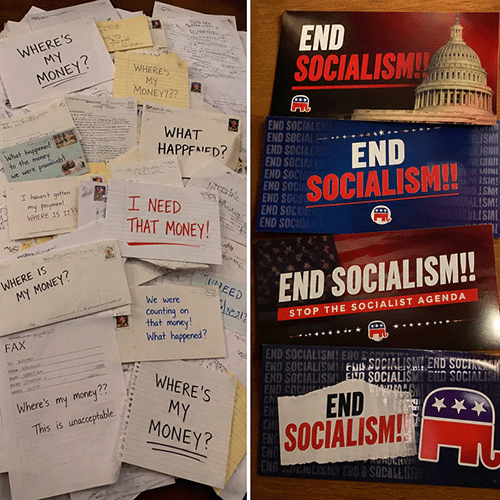 The C.H.A.O.S. agency formally opened its doors on a Monday. By Wednesday it had issued termination notices to 14,000 federal employees across seven departments. By Friday it had published an internal org chart showing twelve deputy directors, three competing offices of strategic subtraction, and a $4.2 billion line item for "consulting services." The agency's first press release announced that it had successfully eliminated the Office of Government Ethics, which had been conducting a preliminary review of C.H.A.O.S. hiring practices. The release was fourteen pages long and included a photo of the C.H.A.O.S. director cutting a ribbon in front of a sign reading SMALLER GOVERNMENT STARTS HERE. The ribbon cost $340 a foot.
Then, approximately six weeks after the disability checks stopped arriving, the phones began ringing again.
Town halls in Republican districts — the same districts that had organized the "Cut My Check Please" campaign — were flooded with constituents demanding to know who had taken their money. At a meeting in Beaver Falls, Pennsylvania, Larry Kemp, the man who had personally drafted the template letter urging Congress to eliminate VA disability payments, stood at a microphone and held up a glossy, four-color campaign mailer he received in October. It featured a picture of his congressman, a large eagle, and a graph.
"It says right here: We will slash socialist welfare," Kemp pleaded. "Mine was a Patriot Entitlement! Why didn't anybody warn me?"
"I thought we were talking about, you know, the other ones," Kemp said. "The fraud ones. The people who don't deserve it. I deserve it. I got the letter from the VA and everything. It's got a seal."
In Tulsa, Oklahoma, Cheryl Daniels, who had organized a petition drive from her power wheelchair — purchased through a VA accessibility grant she describes as "a handout I earned" — stared at a bank statement showing a balance of $14 and demanded that her representative explain why her checks had stopped after she had explicitly asked for them to stop.
"I said I wanted them cut," Daniels told reporters. "The emails from the Save America PAC said that if true patriots voluntarily gave up ten percent of their checks, it would bankrupt the Deep State and we'd be invited to a gala ball in a fancy ballroom. I already bought a dress. I didn't say I wanted them gone. I wanted them reduced to a level that didn't insult my pride. Like, maybe a smaller check. With a thank-you note. From the president."
When informed that the president had tweeted his support for the cuts at the time, Daniels paused. "Well," she said, "I thought he was being sarcastic. He's very sarcastic. That's why I like him."
Congressional offices, now overwhelmed by the volume of angry constituent mail, have begun auto-replying with a form letter that reads, in its entirety: "Thank you for your correspondence regarding the C.H.A.O.S. Act. We have forwarded your concerns to the C.H.A.O.S. agency, which has eliminated its Office of Constituent Services. If you believe your benefits were terminated in error, please contact the Department of Just Deal With It."
The Department of Just Deal With It was eliminated yesterday.
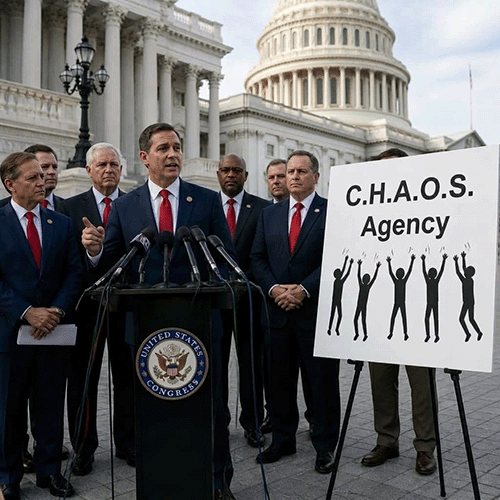 At a press conference today, House leadership addressed the backlash with a unified message: the blame lay squarely with Democrats.
"The American people are hurting," said the Majority Leader, flanked by eleven members of the caucus, every one of whom had voted for the bill. "And they deserve to know why Nancy Pelosi's party refused to stand up for their benefits when they had the chance."
When a reporter noted that every Republican had voted for the bill, which was sponsored by Republicans, the Majority Leader smiled and said, "Exactly. That's how you know it was the Democrats' fault." At this point, the reporter simply threw his notebook into a nearby garbage can.
Wall Street opened last week by muttering "chaos… good…" while pricing defense and prison-contractor futures. By Wednesday the market had eaten two interns from Goldman Sachs, promoted a third, and asked for the C.H.A.O.S. budget in larger print. On Thursday, Walmart announced a new product line of generic mobility aids priced "just below dignity," sending its stock up 4.2 percent in after-hours trading. By Friday, Pendulum Capital — a hedge fund that has not lost money betting on Democratic capitulation since 2017 — was photographed asleep in its office, snoring gently into a pillow embroidered with the words THANKS NANCY.
The Dow closed up 340 points. Nobody felt anything but emptiness.
Gus is the Head of the IRREVERENT Newz Wire. He is currently monitoring a report that the C.H.A.O.S. agency has begun issuing press releases about press releases and may soon achieve sentience. He is having some sort of existential crisis.
- German Lawmakers Concerned That 80-Year-Old Rule Designed to Prevent Rapid Military Buildup Is Preventing Rapid Military Buildup
- HBO Deploys Generational Trauma Counselors as Euphoria Season 3 Finale Causes Wave of Existential Regret
- Broadway Issues Audience Warning After Laurie Metcalf Ends Career of Meryl Streep
- Federal Government Unveils 'Employee Loyalty Subscription Tiers' for Remaining Workforce; Platinum Tier Gets Parking Spot and Congressional Immunity