
By Kharla | Fashion Director, IRREVERENT Magazine
MILAN — The thing about Milan in May is that the light does something to your cheekbones. Mine specifically. I noticed it the moment I stepped off the train at Centrale, rosé already open in my tote bag because I am a professional and professionals hydrate, and also because the TSA in Italy has given up, and a man — older, silver-haired, probably a count — actually stopped mid-stride to stare. This happens to me. It has always happened to me. It happened when I was modeling here in the late nineties (or possibly early oughts, the years blur the way only the truly glamorous years do), and it is happening now, at 29, which is either proof that Italian men have taste or proof that the light at Centrale is legally classified as a cosmetic procedure.
I was in Milan for Blazy's Resort show, and now for a small house show showcasing upcoming independent men's fashion, Spring/Summer 27. It was held on May 15 at a venue I will describe as “industrial chic meets abandoned Parmesan warehouse” because that is exactly what it was — there was still cheese. Independent men's house show? I know. But I was already here.
The press invite had been — let's say, loosely worded. But I have been walking past velvet ropes since before some of these designers were born, and the young man at the door with the clipboard was no match for my energy, my coat (vintage Balenciaga, or something very like it), or my conviction. I told him I was Kharla. He asked which publication. I said all of them, which is essentially true, and also technically a threat, and swept inside.
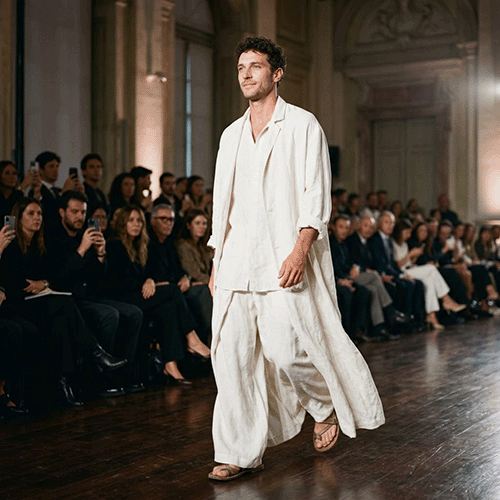 The show itself was genuinely interesting, if you appreciate the kind of menswear that says “I read theory but I also bench press.” There were oversized linen suiting pieces — a gorgeous pale sage set that I am almost certain was Bottega — actually, the program said it was a designer named Luca Di Toma, which I don’t recognize, but I do think he's that lovely boy who used to assist at Gucci and had the absolutely magnificent forearms. I am not above admitting when a man's arms have altered my perception of his entire career trajectory. The knitwear was exceptional. Someone was clearly referencing Margiela's early deconstructionism, though I overheard another journalist calling it “Post-Prada minimalism,” which is incorrect, and I told her so, at length, in Italian, badly, which is how I made my first enemy of the evening.
My second enemy was the photographer.
He was young, aggressively tattooed, holding a lens the size of a small child, which I assume he carries in lieu of a personality, and he was crouched — crouched, like an animal, or like a man who has never once paid for his own drinks — directly in my sightline to capture what I can only assume was a “street style moment” involving a woman in head-to-toe beige. I asked him, politely, to move. He said — and I am quoting verbatim — “I was here first.” I looked at him for a long moment. He had not been here first. I had been here first. I had been here first in 1997.
I want to be very clear: no one has been anywhere before me. Not in Milan. Not in fashion. I explained this. He said something about his Instagram following. I said something about my fifteen years on the Milan circuit that I will not repeat in a family-adjacent publication, but suffice it to say it involved a cardinal, a Vespa, and a level of scandal that required three separate publicists. He moved. The woman in beige looked rattled. I got my sightline back and finished my prosecco with the dignity of someone who has been doing this since before Instagram was a concept.
The show ended on a note that was genuinely moving — a closing look in raw white linen that floated down the runway like a man who has recently cried in a convertible and feels better for it, which is the most specific emotional state menswear has ever attempted to sell me. I understand this now. Milan does something to men. It opens them up. I have seen it firsthand, and not just from the runway.
Marco, for instance.
I met Marco — or re-met him, depending on how you count our first meeting, which he denies happened but cannot disprove — at a negroni bar in Brera approximately forty minutes after the show. He was sitting alone, which he does because he is brooding and also because his ex-wife has taken most of his friends in whatever it is Italians do instead of divorce proceedings. He is tall. He wears his sweaters the way men in sweaters should: with regret, and also with the quiet knowledge that they looked better on his father. We have a history that is not entirely his fault, though the part that is his fault is genuinely breathtaking in its audacity.
He said I looked exactly the same as when he’d last seen me.
I said I know.
We did not speak for another twenty minutes, but it was a companionable silence, the kind that only exists between two people who have both done terrible things in Tuscany, the kind you can only have with someone who has seen you at 29 across multiple years and understood that some ages are simply permanent, like Rome, or damage.
After Marco went wherever Marco goes (he mentioned a “thing,” he always has a “thing,” and the thing is never a therapist), I found the vintage market. It was tucked behind a side street near the canal, populated by dealers who know what they have and tourists who don’t. I found a leather jacket — perfect weight, perfect patina, buttery in a way that only genuine Italian craftsmanship or extremely committed synthetic aging achieves, or possibly actual butter, I did not lick it but I considered it. The inside label had been removed, which the dealer said was “common with older pieces.”
It is vintage Prada. I am certain of this. The cut speaks to a very specific mid-nineties Prada sensibility that Miuccia herself has described in interviews — which I have read, extensively, because I am thorough. That someone has mentioned the jacket appears to be a standard-issue Zara silhouette is frankly offensive and also, if true, the single greatest financial mistake of my life, and also not something I have verified and therefore cannot confirm. The label was removed. That is all I will say. The label was removed, and now it is mine, and it is Prada, and I wore it back to my hotel with a final prosecco from a corner café and the particular confidence of a woman who has spent the day exactly as a Fashion Director should: in motion, in control, impeccably sourced, and possibly wearing Zara, but we do not speak of this.
Milan, Spring/Summer 27: the men are soft, the suiting is sage, and the photographers should learn their place.
I'll be back in June for Fashion Week Global's independent Spring/Summer 2027. Marco knows. Marco denies knowing, but Marco knows. But next I'm in Toronto.
Kisses, -K
Kharla is the Fashion Director of IRREVERENT Magazine. She has survived Milan Fashion Week in every decade of her life, including the ones she refuses to acknowledge, and maintains that she is twenty‑nine. IRREVERENT cannot verify Marco’s version of events, the photographer’s whereabouts, or whether the jacket is Prada, Zara, or a moral failing.