
- Details
By Brock Castellanos III, Founder & Chief Vibes Officer, NepoCorp Ventures
Last year I wrote a book about only hiring people dumber than me, and did an op-ed for IRREVERENT about it. A lot of you got mad. Cason—he’s my VP of Strategy, the one who put a fork in the microwave three times—Cason said the LinkedIn comments were “not aligned with our KPIs.” I fired the intern who showed them to me. Not because I was angry, but because I believed in the message. And belief, as I tell my COO Tessa Vorhees whenever she asks why we’re out of toner again, is infrastructure.
 Tessa calls supply chain “the truck part.” She makes $540,000 a year. This is working.
Now get ready for the next level. This is about the kingdom you build after the hiring. This is about sycophants. This is about love, the only kind people like us can feel.
I. Why Sycophants Are Better Than Friends
Friends tell you the truth, which is a serious design flaw.
A friend will look at your $19,000 toilet—the one that plays Brian Eno’s “Music for Airports” on loop whenever the lid lifts—and say something like, “Brock, that’s weird.” A sycophant will ask if you want the volume louder. A friend will mention that your Chief Compliance Officer has been indicted twice. A sycophant will offer to take the third indictment for you. Now that is infrastructure you can really use.
My CCO, Lawson Mecklenburg-Strauss, has taken two federal indictments for me. He has never once asked what they were for. Last Tuesday over seabass at Carbone he said, “Brock, I just want you to know, if there’s a third, I’m ready.” I didn’t ask. He didn’t explain. The seabass was $78. I tipped $400 because that’s what loyalty costs.
Friends want you to grow. Sycophants want you to stay exactly where you are, because that's the only place they're safe. I am 31 years old and have founded 14 failed companies: I have never been more successful. Do the math. The math is sycophants.
My assistant Tabitha went to Yale. She graduated in 2023. She is always weeping. Not loudly. Just a soft, continuous weeping, like a humidifier. She wept when I told her this piece was due. She wept harder when I told her she’d be transcribing it from voice notes taken in the back of my G-Wagon. I asked her once why she weeps. She said, “I don’t know. I think it’s just who I am now.” Perfect. A person who doesn’t know why they cry will never ask why you do what you do.
II. Screen for Weakness
You don’t find sycophants, you screen for them. The way you screen for termites.
Red flags in an interview: The candidate says “principles.” The candidate asks about “equity.” The candidate has a subscription to The Economist and mentions it without being asked directly. The candidate makes eye contact with my chef Marcelo, who does not make eye contact with anyone. Marcelo has worked for me for four years. He has never once looked at my face. He looks at the wall behind me. He looks at the Loro Piana sweater I’m wearing. He looks at the $4,200 espresso machine he uses to make my morning oat cortado. He does not look at me, which is one boundary I respect. Candidates who try to force eye contact with Marcelo don't get offers.
Green flags: The candidate laughs before I finish talking. Not because what I said was funny, but because they are already laughing. Because they have decided that whatever I say will be worth laughing at. Lawson laughed at “good morning” once. I promoted him that afternoon. He didn’t know he was being promoted. He just laughed. That’s the bar.
The ideal candidate has just enough education to be ashamed, but not enough to escape. Tabitha has a Yale degree. She is ashamed of it. She tells people she went to “school in Connecticut.” She thinks this makes her sound humble; it makes her sound trapped. A person who is hiding their own credentials will never question yours. I dropped out of a state school in Florida after eleven months and I tell everyone. She knows more than me and will never act like it. That gap is where the stable kingdom lives.
Cason, my VP of Strategy, spells logistics with two G’s. “Loggistics.” He has spelled it this way in three board decks. The board—my father, my uncle, and a man who owes my father money—has never corrected him. Last month I watched Cason present a slide that said “Loggistical Framework for Q3 Synergies.” I felt something close to peace. A $395 Loro Piana cashmere crewneck feels like that. Soft. Expensive. Something you earned without fully understanding how.
III. The Loyalty Test
You can’t buy loyalty, you test for it. The way you test a bridge. You put weight on it and see if it holds.
Every new hire at NepoCorp gets a small task in their first 90 days. Nothing big or dramatic. Just something... questionable. Filing an amendment to a document that doesn’t exist. Signing a receipt for something that was never delivered. Mailing a package to an address that doesn’t appear on any map. I tell them it’s “operational hygiene.” I tell them “everyone does this.” I tell them “it’s just how the truck part works.” Tessa taught me that last one.
If they do it without questions, they’re mine. If they ask questions, they’re a mole. Not a real mole. I don’t think corporate espionage is real, but the fear of it is useful. I think the word is useful. I have called three people a mole in all-hands meetings. Two of them still work here. They work harder now. They laugh louder now. They know I am watching.
Garrett used to have a podcast. Now he is my Chief of Staff. I tested Garrett by asking him to book a dinner for eight people at a restaurant that only seats six. He did it. He told the restaurant it was a “brand partnership.” He told the guests it was “intimate.” He made it work. I didn’t ask how. A Chief of Staff who explains how is just an employee. A Chief of Staff who makes six seats hold eight people without complaining is infrastructure.
Lawson passed his test in 2019. I asked him to hold a briefcase for 48 hours. He didn’t open it or ever ask what was inside. He kept it in his bathtub, he told me later, because he didn’t want his wife to see it. I don’t remember what was in the briefcase: I'm not sure I ever knew. But Lawson kept it in his bathtub for two days, and that's why he's my CCO. That's why he'll take a third indictment. That's why we are better than friends.
IV. The Information Diet
Never let them know anything real.
This is the most important part. Opinions are the first symptom of independence, and independence is the first symptom of betrayal. You do not want opinions. You want agreement. You want nodding. You want the sound of a person who has heard you speak and has decided that the best possible response is no response at all.
I run three meetings a day. In none of them do I share actual information. I share direction. I share energy. I share the feeling that something important is happening, without ever defining what that something is. Cason takes notes. I've seen them, his notes are gibberish. “Q3 loggistics alignment. Brock energy high. Action items: synergize.” He is my VP of Strategy. He has spelled strategy correctly every time. I don’t know why this surprises me. It shouldn’t. He knows which words matter to me.
Tabitha knows my calendar, my medications, my blood type. She does not know why I founded NepoCorp. I have never told her. I have never told anyone. I don’t know the answer myself. That is the point. If I don’t know, no one can know. If no one can know, no one can use it against me. This is architecture, not paranoia.
Marcelo knows what I eat, but no clue what I like. He prepares the same three meals in rotation. A $240 ribeye. A $68 grain bowl. An omelet with white truffles that cost $180 per ounce. I have never told him I prefer the omelet, nor has he ever asked. He looks at the wall. He cooks. This is the perfect relationship.
Tessa Vorhees thinks our biggest competitor is “the other truck part company.” I don’t know which company she means but I don’t correct her. If she knew who our real competitors were, she might talk to them. If she talked to them, she might compare notes. If she compared notes, she might realize that our supply chain doesn't technically exist. That our product does not exist. That NepoCorp is a holding company that holds nothing but vibes. She thinks the truck part is late, and I let her. The truck part isn't late, it's part of a story I told her in 2021.
V. The Purge Cycle
Every 18 months, fire your most senior sycophant. Publicly and loudly. Make it unforgettable.
This is necessary maintenance, not punishment. You change the oil in a Ferrari every 3,000 miles. You change your senior sycophant every 18 months. Same principle. Same precision. Same cost.
The first time I did this, I fired my original CFO in the middle of a standup. He had been with me since Company 3. He had watched 11 companies fail and still believed in me, which was the problem. Belief calcifies. Belief becomes expectation. Expectation becomes leverage. I don’t do leverage. I do vibes.
I told him his “energy was no longer aligned with the vertical.” He cried. Cason laughed—he didn’t know why he was laughing, he just saw me not crying and followed the signal. Tabitha wept, but Tabitha always weeps. The room felt electric. The room felt awake. Two junior analysts who had been considering grad school decided to stay. They saw what happens to people who get comfortable. They saw what happens to people who think they’re safe.
You don’t fire them for failure -- that's part of the job -- you fire them for success. For loyalty that has lasted too long. For knowing too many bathroom codes. For having seen you without the Loro Piana. The purge creates an opening, which creates desperation. Desperation creates the exact kind of person who will laugh before you finish talking.
Lawson knows his 18 months are coming. He told me last week, unprompted, that he would “walk into the ocean” if I ever needed him to. I told him I don’t need him to walk into the ocean. I need him to be ready to. That distinction is why he’s still here. For now.
VI. The Kingdom
This is the final state. Not a company: a kingdom.
They cannot function without you. Not because you are talented. Not because you are smart. Because you are the only one who knows where the bodies are buried, and more importantly, you are the only one who knows that there are no bodies. Just stories about bodies. Just the threat of bodies. Just the fear that somewhere, in a briefcase kept in a bathtub, there is something that could ruin them.
Lawson has done enough questionable things that leaving inevitably means explaining them to a grand jury. He won’t leave. Cason has misspelled enough public documents that his resume is a liability. He won’t leave. Tessa thinks the truck part is real. She will die waiting for a truck that was never coming. She won’t leave. Tabitha weeps. Where would she go? What would she do? She went to Yale. She is from Connecticut. She is mine.
Garrett had a podcast. He interviewed entrepreneurs. He asked them about their morning routines. He believed, once upon a time, that success was about discipline. Now he books dinners for eight at tables for six and doesn't ask why. He is my Chief of Staff and will never have a podcast again.
Marcelo looks at the wall. He makes the omelet. He does not make eye contact. He has never asked for a raise. Actually, I don’t know if he speaks English. But I don’t need to know, I need him to cook. He cooks. This is the kingdom.
Now you think this is dark. You think this is sad. You think I am lonely in my Brickell penthouse with my Brian Eno toilet and my $4,200 espresso machine and my staff of people who would not tell me if I had food on my $395 sweater. You are laughably wrong. I am not lonely. Lonely is wanting someone to know you. I have built something better. I have built a place where no one knows anything, and everyone is too afraid, too loyal, too incompetent, or too weepy to point it out.
That is peace.
That is the kingdom.
And you can build it too. You. Reading this. In your WeWork, studio apartment, or in your car, voice-noting ideas that no one asked for. You can do this. You have the capacity for strategic incompetence. You have the capacity to hire people just smart enough to be ashamed and just dumb enough to stay. You have the capacity to test loyalty with small crimes and maintain power with large silences.
I believe in you. I really do.
Not because I want you to grow. Because I want you to stay exactly where you are.
That’s what sycophants are for. That’s what I am for. That’s what the kingdom is.
Welcome home.
Brock Castellanos III is the Founder & Chief Vibes Officer of NepoCorp Ventures. He lives in Miami. His toilet plays ambient music. His staff does not make eye contact. He is accepting LinkedIn connection requests from people who laughed before finishing this sentence.
- Details
by Dr. Cassius Renfro-Beale, Special to IRREVERENT
Your magazine asked me to explain stadium culture to American readers getting their first home World Cup. Fair enough. I’ll do my best. I’m just still trying to find the right tone for people whose main stadium reference point is a guy in a foam cheese hat eating a brat the size of a trombone.
First, a quick geography lesson.
Where the Loudest People Stand
Americans always ask “why aren’t the diehards sitting at midfield, where the view is better?” Because they’re not there for the view. They’re there to make noise, create pressure, and turn the whole end of the stadium into a living wall. Behind the goal is the point.
 I spent six years with the Curva Nord of a club I’m not naming here, thanks to a handshake agreement made after a small misunderstanding involving a banner and a prosecutor’s office. During that time, I watched, took notes, and, for full-disclosure, joined in. The University of Trieste labelled this “excessive participant observation.” I called it immersive research. We remain professionally unconvinced by each other.
The Tifo: Arts and Crafts, but With Higher Stakes
The word tifo comes from tifoso, meaning passionate fan, which comes from the word for typhus, because this level of devotion is like a fever. If that sounds like a lot, I should tell you the people involved do not think it’s a lot. They think it’s exactly right.
A tifo is a giant coordinated display before kickoff: cards, banners, fabric, paint, smoke, and hundreds of fans all doing one very specific thing at the same time. From a distance, it turns into a huge image or slogan stretching across the whole curva. Planning starts weeks in advance. Committees form. Supplies get hunted down. Design arguments break out with the emotional force of a family lawsuit. This is not a casual craft project. This is a sacred production with budget problems.
The closest American equivalent is a foam finger, which I mention here with incredible restraint.
The Capo: The Only Person at the Game Not Watching the Game
In the middle of the curva, standing on a barrier, platform, or in one memorable stadium, a milk crate, is the capo. That means “leader,” and, since this is targeted for an American audience, is not from mob movies or shows. The capo leads chants, keeps time, signals changes, and basically conducts the section like an orchestra that has replaced violins with shouting.
And here’s the part that breaks American brains: the capo faces the crowd, not the field. Back to the match. Megaphone up. Arm waving. For 90 minutes, the capo is mostly not watching the game at all.
People always ask why anyone would go to a soccer game and then refuse to look at the soccer. But that misses the job. The capo isn’t there to watch the match. The capo is there to make sure the match has a soundtrack. The crowd is the instrument. The capo is the conductor. Also, occasionally, the metronome.
For comparison, the American stadium experience includes a jumbotron that shows replays, ads, extramarital affairs, and sometimes an animated race between colored dots. Fans are then invited to emotionally invest in a blue circle beating a red one. I offer this without comment.
Why the Flares Never Go Away
Flares and smoke bombs are banned in basically every major soccer stadium on earth. They are also present in basically every major soccer stadium on earth. The curva often ends up wrapped in colored smoke from devices that are clearly illegal according to stadium rules, league rules, and, in some cases, national fire codes.
Why does this keep happening? Because the people doing it believe the ban is wrong. Not merely annoying or inconvenient. Wrong. To them, the smoke and fire are part of the ritual. A match without them feels incomplete, like a dress rehearsal where somebody forgot half the orchestra.
Ultras groups have been fined, punished, and forced to watch their clubs play in empty stadiums because of pyrotechnics. They have mostly continued anyway. The ritual does not depend on permission. From an anthropological point of view, it is one of the more consistent belief systems you will ever see.
 The Curva vs. the Luxury Suite
Modern stadiums also have corporate boxes and luxury suites at midfield. These are climate-controlled spaces with soft seats, catering, great views, and often a TV showing the same game you are already attending, just in case you’d like your live event to feel more like being at a Chicago airport lounge.
To be fair, this is one perfectly coherent answer to the question: what is a soccer match for? The luxury suite says the match is for comfort, networking, and spectating in peace. The curva has a very different answer. It says the match is for effort, noise, sacrifice, and joining something bigger than yourself, even if that bigger thing is also setting off a flare two rows down.
These two visions do not really go together and clubs know that. They also sell tickets to both and happily cash both checks, which is a piece of moral flexibility familiar to American sports fans.
Ninety Minutes of Singing
In the curva, the singing starts before kickoff and keeps going until the final whistle. Not just after a goal. Not just during exciting moments. All the time. The songs are not reactions to the game so much as the constant background hum underneath it. The capo rotates the chants. Everyone knows them. Some have been around for decades. You could walk into San Siro in 2026 and hear something that first got belted out in 1963. Nobody thinks this is repetitive. They think it’s tradition doing its job.
Meanwhile, I’ve sat in American stadiums during this World Cup and seen what happens when play slows down. The giant screen issues a command: “MAKE SOME NOISE.” The crowd obeys for a few seconds, like a class responding to a substitute teacher, and then returns to nothing.
I submit this as research.
The Third-Division Chant That Ruined My Professional Detachment
In my fifth year, a third-division club in the Veneto invited me, through an intermediary whose name I wisely left out of my notes, to sit in on the writing of a new chant. By the third meeting, I had contributed two lines. By the fourth, I had written the bridge. The chant debuted at the next home match. The supporters sang it. The players heard it coming out of the tunnel.
I am a Visiting Fellow in Applied Folklore at the University of Trieste. I have published seventeen peer-reviewed articles. I was denied tenure. I have also been banned from three stadiums.
I have also written a chant that 1,100 people sang together on a freezing Saturday in November, in a stadium that held 1,200, for a club that finished seventh and still got relegated.
I’m still not entirely sure what I feel about that. I’ve been trying to work it out for more than a year, which is probably why I keep bringing it up.
So if this World Cup sends you to a match—and it should—do me one favor: ignore the giant screen. Look at the end stands instead. Find the person facing the wrong direction with a megaphone. Watch what they’re doing. Try to understand why they chose not to look at the thing they came to see, so everyone around them could feel it more deeply.
Figure that out and maybe you're starting to get it.
-C.R.B.
Dr. Cassius Renfro-Beale is a Visiting Fellow in Applied Folklore at the University of Trieste. His tenure case was closed in 2021. He is banned from three stadiums in two countries, the names of which he has withheld. He wrote this piece from a press credential he obtained under circumstances he describes as "procedurally ambiguous." He has no regrets about the chant.
- Details
By Brock Castellanos III, Founder & Chief Vibes Officer, NepoCorp Ventures
I am writing this from the rooftop of my Brickell penthouse. I am wearing a Loro Piana cashmere hoodie that costs more than your car. My personal chef Marcelo is plating a single soft-boiled quail egg on a slab of imported Himalayan salt. Marcelo does not make eye contact with me. We discussed this in the interview. My executive assistant Tabitha — Yale '23, Sigma Kappa, daddy's in reinsurance — is silently weeping in the kitchen because I told her the espresso was "off-temperature by maybe two degrees." She'll be fine. She has to be.
I am thirty-one years old. I have founded fourteen companies. All of them have failed. I have never been more successful.
There is a particular kind of person — let us call them the unblessed — who looks at the modern executive landscape and asks, with the strangled bleating of the middle class: Why does that man have a job he is not qualified for? They see a Treasury Secretary who cannot read a balance sheet. They see a Director of National Intelligence whose grandfather built tract homes in suburban Phoenix. They see a Secretary of Education whose only relationship to public schooling is having driven past one on the way to a polo match.
And they ask, How?
I am here to tell you, with the calm, predatory clarity of a man who has just had $4,800 worth of platelet-rich plasma injected into his scalp at 6:00 AM: this is not a bug. This is the entire product.
I. Competence Is for People Who Have to Work
Let me explain something to you, in the voice I use when I'm explaining things to my fiancée's father, who made his money in commercial flooring and still doesn't understand what I do.
Competent people are exhausting. They have opinions. They have credentials. They have boundaries. You ask a competent person to commit light financial fraud at 11:00 PM on a Sunday and they say something like "I'd like to consult with counsel" or "I'm spending time with my family." It's repulsive.
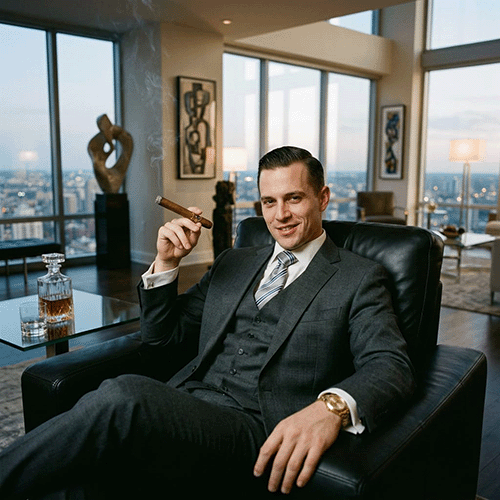 You know who doesn't say that? My new VP of Strategy, Cason Pemberton-Hicks. Cason was sixth at his prep school in a graduating class of forty-two. He spells "logistics" with two G's. He cannot operate the conference room television. Last Tuesday I watched him put a fork in the microwave and say "huh." When I ask Cason to do something illegal — and I do, constantly, as a kind of cardio for my soul — Cason says "yeah, totally, what's the workflow?"
Cason cannot leave. Cason will never leave. Where would he go? Goldman? Please. Goldman has standards now. McKinsey laughed him out of the interview when he asked if "synergy" was a kind of yoga. Cason is mine forever. He is mine the way my chef Marcelo is mine, the way my building is mine, the way the smell of my own skin is mine. There is something deeply peaceful about owning a person whose only alternative to you is a Best Buy management track in Boca.
That is loyalty. That is the only kind of loyalty that scales.
II. The Mirror Cannot Have Competition
Every morning I look at myself in the bathroom mirror for forty-five uninterrupted minutes. This is non-negotiable. I have a $19,000 Toto toilet that plays Brian Eno when I sit on it. I have a marble vanity carved from a single block quarried in Carrara by men I will never meet and do not think about. I examine my pores. I examine my jawline. I tell myself: You are the smartest person in any room you choose to enter.
I cannot have that ruined by a deputy.
Imagine — and I want you to really sit with this — imagine if my Chief Operating Officer were good at her job. Imagine if she gave a TED Talk. Imagine if Forbes called her "one to watch." Imagine if she walked into a board meeting and closed a deal without me. I would have to do something about that. I'm not being dramatic. I'm being descriptive. There is a small, clean room in my mind where I keep the file labeled Threats To My Specialness, and competent subordinates are filed in there next to my brother Chip and the man at Whole Foods who asked if I'd "considered the bulk bin." The file is not large. The file is not allowed to be large.
This is why I hired Tessa Vorhees as COO. Tessa once described our supply chain as "the truck part." Tessa cannot pronounce quarterly. Tessa thinks EBITDA is a cocktail. When I walk into a meeting with Tessa, I am — by simple linguistic comparison — Cicero. I am Henry Kissinger with a better skincare routine. I am the only adult in a room full of beautifully-credentialed children, and the institutional investors love it. They write checks. They write big, soft, weeping checks.
Tessa makes $740,000 a year. She is worth every penny because every penny is a penny that is not making someone else look good.
III. Expertise Is the Enemy of Vision
I had an idea last Thursday at 2:47 AM after my fourth Negroni and my second bump of something Marcelo cannot legally identify. The idea was: what if we acquired a regional airline and used it exclusively to deliver oat milk to our other portfolio companies? It was, and remains, the best idea I have ever had.
I called my VP of Aviation Strategy. He does not exist yet. I will hire one.
He will not be a pilot. He will not have an MBA. He will not have any opinions about "FAA regulations" or "fuel logistics" or "the basic physics of why airplanes need to land at airports rather than the helipad of my Tulum compound." He will be a 26-year-old named Bryce who I met at Soho House. Bryce will say yes. Bryce will say let's run it. Bryce will say love that for us.
Experts ruin things. Experts come into your office holding printouts. Experts use the word unfortunately. Experts have a kind of low, droning, municipal energy that makes my skin crawl in a way that no amount of cold plunging can fix. The last time I spoke to a true subject-matter expert was in 2019, when a structural engineer told me my proposed twelve-story glass treehouse in Aspen was "not really a thing that can exist." I fired him. I hired a man named Garrett who had a podcast.
The treehouse collapsed in March. Garrett is now my Chief of Staff. He makes 2.3 times what the engineer made. He pronounces it ar-chi-TECH-ture and I have decided to find that charming.
IV. The Airbag
Every founder needs an airbag. This is the most important hire you will ever make.
An airbag is a senior executive whose primary function is to deploy, with great violence and at maximum visibility, the moment your company commits a crime. Their resume is their crumple zone. The press already hates them — you made sure of that during the hiring announcement, which you leaked yourself, to Axios, with a photo of them looking weird at a Christmas party. When the SEC comes knocking, you stand on a podium in a $6,200 charcoal Brioni suit, you furrow your brow with the practiced gravity of a man who has watched the Succession finale eleven times, and you say: "I am as shocked as anyone. Trust has been broken. I have personally terminated the responsible party. Today, we heal."
Then you have a martini. Then you buy a boat.
My current airbag is a man named Lawson Mecklenburg-Strauss, my Chief Compliance Officer. Lawson was a Pi Kappa Alpha at Vanderbilt. Lawson has been credibly accused of three different things I cannot legally enumerate. Lawson has a tan that suggests something is medically wrong. Lawson would, if asked, take a bullet for me, and that bullet would be a federal indictment. He is perfect. I love him. I think about him sometimes when I cannot sleep.
V. The Bottom Line
People — small people, credentialed people, the kind of people who carry tote bags and have opinions about public transit — will tell you that competence matters. That meritocracy is the engine of a healthy society. That institutions exist to function.
These people are confused about what institutions are for.
Institutions are not for solving problems. Institutions are stages. They exist so that a certain kind of man — a man with a strong jaw, an inherited surname, and a healthy contempt for the concept of consequences — can stand in the center of them and be seen. The supporting cast is not there to be good at their roles. They are there to make sure the lighting flatters the lead.
You don't hire the best and brightest. You hire the loyal and the dim. You build a court, not a company. You surround yourself with people who will never, ever, under any conceivable circumstance, be confused for you.
And the beautiful part — the part that brings me a calm, almost pharmacological joy — is that they know. Cason knows. Tessa knows. Tabitha, weeping into the Krups, knows. Lawson, polishing his federal indictment in advance, knows. They know they are disposable. They know they are mine. And it makes them work so much harder. It makes them smile when I walk into the room. It makes them laugh at jokes I have not yet finished telling.
That, dear reader, is leadership.
That is vision.
That is what I do every single day, while Brian Eno plays softly from a toilet that cost more than a Honda Civic, and it is why I am — by every metric that actually matters — winning.
Brock Castellanos III is the Founder and Chief Vibes Officer of NepoCorp Ventures. He is the author of the forthcoming memoir Born on Third, Stole Home: A Founder's Journey, available for pre-order from a publishing imprint he owns. The views expressed in this op-ed are his alone and do not reflect the editorial position of IRREVERENT Magazine, which we feel needs to be stated explicitly and possibly notarized.
EDITOR'S NOTE: IRREVERENT publishes guest contributions to broaden the discourse. We did not fact-check Mr. Castellanos's claims about his personal staff, his treehouse, his toilet, or the legal status of his Chief Compliance Officer. We attempted to. He had us removed from the building.
- Details
BYLINE: Dutch Caulfield | Author, 'Showroom Confessionals' | Special to IRREVERENT
The request came in on a Tuesday, which I remember because Tuesdays were slow and I'd learned to read the showroom like a tide chart. Guy walks in wearing a Patagonia vest, clean New Balance 990s, a Yeti tumbler the size of a small child filled with something iced and extremely complicated. He's done his research — knows the trim level, knows the payload rating, has printed out a comparison chart from a forum called something like RealTruckDads.net. He wants the Lariat. And he wants tint.
Not the factory tint. The maximum legal tint. The kind where, he explains, "you can't see anything through it."
I asked, just to be thorough, if he did a lot of off-road driving. He paused.
"Not yet," he said.
That "not yet" is the entire American pickup truck industry, compressed into two words. I wrote it down when I got home. It's on my refrigerator, and inspired my entire second life's act.
 Here is what nobody in the business will tell you: maximum tint on a modern F-150 has nothing to do with UV protection, stalker avoidance, or reducing glare. The sun exists. The sun is terrible. I understand. But if UV blocking were the actual goal, you'd get the same result from factory glass and a decent pair of Oakleys.
What the tint is actually doing is managing the narrative. Managing YOUR narrative.
You are sitting five feet above the road in a vehicle that weighs as much as a young elephant and costs more than the median American household makes in two years. You have heated seats. You have a massage function. You are, at this particular moment, almost certainly holding a venti caramel Frappuccino with extra whip and singing along to the Hamilton cast recording because "Wait For It" is, objectively, a great song. Nobody argues this in private.
The tint is the stage curtain. Behind it, you can be whoever you need to be. In front of it — to the Prius driver you just loomed past on the on-ramp — you are unknowable. Inscrutable. Possibly someone who chops wood for reasons other than ambiance. You're the lumberjack behind the glass,. You're the guy from those extra tough paper towels.
The tint says: there is a grizzled, stoic individual behind this glass, and they have killed their dinner. The tint does not say: this individual just got a notification that their DoorDash is ahead of time.
I am not mocking this. I sold 3,000 F-150s, F-250s, F-350s, and I understood before I was thirty years old that I wasn't selling a vehicle. I was selling a psychological safe room with a tow hitch.
The broader phenomenon — the one I've been writing about since I left the floor two years ago — I call Cowboy Cosplay. The truck is its highest expression, but it's not the only one.
Here's the thesis: modern American professional life is so thoroughly insulated from physical consequence that a significant portion of the (mostly) male population has developed a profound, aching need to appear prepared for consequences that will never come. The pickup truck is the most expensive way to scratch that itch. It says, in $85,000 of steel and torque: I could, if civilization collapsed tomorrow, load up this truck and go handle it.
The bed could fit a quarter cord of firewood. The towing capacity could drag a small yacht to the marina. The suspension is calibrated for terrain that exists primarily in Colorado, where 80% of F-150 owners do not live.
What actually goes in the bed? I kept an informal log my last few years on the floor. In twelve years of follow-up calls and bumping into customers at the H-E-B, I documented the following cargo, roughly in order of frequency: bags of mulch on a tarp, a single piece of Facebook Marketplace furniture, a kayak that sees water twice a year, a grill from Costco, roughly 400 bags of dog food, collectively, and — I counted once — exactly eleven two-by-fours a guy bought for a raised garden bed he immediately hired someone else to build.
That's it. That's what we're hauling. That's what the tectonic-plate-towing capacity is for. That's what $85k buys instead of a Mercedes E-class.
I'm not mad about it. On the contrary, my bank account LOVES it, and I love my bank account.
 The advertising ran the whole con for us, of course. Every F-150 commercial is shot in red-rock canyon country, the truck cresting a ridge at golden hour, the operator presumably having just hauled something geological. The actual soundtrack of these drives — the Spotify algorithm, a true-crime podcast, the audiobook the owner will abandon at chapter four — never features. Nobody in a Ford commercial is stuck in school-drop-off traffic behind a Subaru with stick-figure decals of a family that definitely composts. Nobody is sitting in a ridiculously oversized F-350 in downtown Dallas openly praying that his cab is going to squeak under the Starbucks overhang.
But that gap between the commercial and the commute is not cognitive dissonance. It's aspiration. And aspiration makes LOTS of money; way more than reality ever does. It's the same reason people buy boats they use twice a year and running shoes for a 5K they haven't signed up for. The truck is a physical monument to a version of yourself that could exist, under the right circumstances, in a different life where you have calloused hands and a woodpile and a working relationship with hardship.
I'd have gone broke if I only sold trucks to people who actually needed them.
Instead, I sold that monument, door handle to tailgate, for twelve years. And I sold it enthusiastically, because I understood that the monument was real even if the frontier wasn't.
The guy with the Patagonia vest and the maximum tint drove that Lariat off the lot on a Tuesday and I never saw him again, which is how it usually goes. But I think about him sometimes when I'm writing. He knew what he was buying. He just couldn't quite say it out loud, which is why the tint mattered so much.
The curtain had to be credible. The show required it.
I sold 3,000 of these trucks. I met zero cowboys. I met a lot of men who needed to feel like they could become one, and I respected that need completely, because the frontier did die, and they didn't get a vote, and sometimes all you can do is get the tint.
Dutch Caulfield is the author of 'Showroom Confessionals' (2022), and a drinking buddy of the publisher. He lives in Texas.
- Details
We didn't lose the truth. We sold it on the subscription model.
By Cassandra Webb | Contributing Editor, Media & Political Economy
It is one thing for a country to misplace its shared sense of truth. It is another to slap a price tag on the corpse, build a subscription funnel around it, and call that innovation.
America, never one to leave a moral catastrophe unmonetized, has somehow managed both: we built the most advanced information system in human history, then turned its smoking wreckage into a luxury marketplace for people willing to pay extra to hear that their worst instincts were right all along.
This is not, despite appearances, a story about stupidity. It is a story about brilliance put to grotesque use — the kind of genius that looks at the national breakdown between truth and lies, until people can't see and no longer care about the difference, and thinks, with admirable efficiency, “Great, but how do we scale it?”
In other words: the problem was never just that the public got played. It is that an entire class of operators realized being lied to was not a civic emergency but a market opportunity, and they have been cashing the checks ever since.
The Origin Story: When Skepticism Was Earned
To understand how we got here, it helps to remember that American distrust of institutions did not hatch in some uncle’s all-caps Facebook rant. It came from the documented historical record of institutions lying like it was a core competency.
The Pentagon Papers revealed that four successive administrations had lied to the public about Vietnam with the kind of discipline usually reserved for military logistics. Watergate clarified that the President was not merely flawed but running a criminal side hustle out of the Oval Office. The Church Committee exposed the CIA for domestic surveillance, assassination plots, and a general relationship to constitutional limits best described as “suggestion only.” And the Tuskegee Syphilis Study showed the U.S. Public Health Service withholding treatment from 399 Black men for forty years so bureaucrats could watch the disease progress in real time, which remains one of the more revolting entries in the national archive.
These were not “alternative narratives.” They were facts — dragged into daylight by leaks, testimony, declassification, and investigations because the people in charge were apparently allergic to honesty. The correct reaction was skepticism. The Watergate generation did not distrust authority because it was hysterical; it distrusted authority because authority had repeatedly behaved like a cartel of polished sociopaths in respectable suits.
That distinction matters, because the modern misinformation business made a fortune by bulldozing it.
The Pivot: When Skepticism Became a Product
Somewhere between congressional investigations into COINTELPRO and the rise of talk radio as a national grievance carnival, skepticism stopped being an intellectual discipline and became an aesthetic. Then a brand. Then, because America never misses a chance to cheapen a virtue into a revenue stream, a product line.
The mechanics were not subtle, unless you were being paid not to notice. Rush Limbaugh’s national launch in 1988 helped formalize a model that discovered, long before Silicon Valley pretended it had invented the trick, that outrage is stickier than information and smug belonging beats truth every time. People would happily tune in not to learn what was happening, but to enjoy the narcotic thrill of being told they were the only sane passengers on a bus driven by idiots.
The business logic was insultingly simple. Advertisers buy attention. Outrage hogs attention longer than analysis. Therefore outrage pays better than analysis, which is why so much of modern media sounds like a panic attack with sponsorships. No secret cabal required — just enough people following the money with the moral elegance of raccoons in a dumpster.
Cable news finished the build-out in the nineties, and by the 2000s the machine was humming: find a grievance, assign a villain, tease revelation, deny closure, repeat until the ad inventory is sold. The product was never information. The product was the sensation of being informed while your nervous system got mugged for profit.
The audience bought it eagerly, which is how the scam graduated into an institution.
The Business Model: Engineering Uncertainty at Scale
Modern misinformation is not mainly a bunch of confused randos passing around cursed links in bad faith and worse grammar. It is an industry: revenue streams, production pipelines, distribution systems, performance metrics — the full grisly professionalism of a sector that discovered reality was optional but margins were not.
Start with supply. Content mills crank out cheap, high-volume material engineered for emotional velocity rather than accuracy — clickable because it flatters suspicion, shareable because it hands people the conclusion before they endure the burden of evidence. Then distribution: social platforms that spent years testing what keeps people glued to the feed and discovered, to no one’s moral credit, that anger and anxiety outperform calm reality by a mile. Their own internal research, exposed by the Facebook Papers in 2021, showed recommendation systems boosting divisive and misleading content because divisive and misleading content was simply better business.
This was not a bug. It was the feature wearing a fake mustache and pretending not to recognize you.
The monetization layer is almost impressive in its shamelessness. There are the obvious operators: media personalities who distrust every institution except the one cashing their checks, supplement hucksters advertising to audiences marinated in paranoia, political fundraising machines that learned fear emails are basically an ATM with a flag graphic. Then there are the quieter professionals — foreign actors who understand they barely need to invent American lies anymore because the country mass-produces them domestically, and consultants who can spot a grievance the way truffle pigs spot money.
MIT researchers quantified the asymmetry in 2018: false stories spread six times faster on Twitter than true ones, reached more people, and sank deeper into networks. Falsehoods were also 70 percent more likely to be retweeted than factual information. So yes, the market has spoken. Loudly. And what it has said is that emotionally satisfying nonsense routinely beats reality in open competition, especially when nonsense is professionally designed to flatter the consumer.
The Architecture: The Outrage Loop as Infrastructure
What emerged over the last three decades is not just a pile of bad actors and sketchy content. It is an architecture — a fully operational outrage machine that borrowed the structural logic of conspiracy thinking and welded it directly into mainstream media. In less charitable terms: we industrialized epistemic rot.
Classic conspiracy theory has a familiar design. It cannot really be disproved, it refers back to itself, and it converts contradiction into proof. If the conspiracy is real, then the lack of evidence is suspicious. If experts debunk it, that only proves the experts are in on it. It is a closed loop engineered to survive contact with reality, which is why it endures like mold in a damp basement.
The modern media environment copied that structure at scale. Fact-checking becomes evidence of complicity. Expert consensus becomes proof of elite collusion. The specific claims change every week, but the chassis stays the same. Better yet, from a business perspective, the audience never reaches closure — which means they never stop refreshing, never stop watching, never stop buying the premium package for the next installment of the same nervous breakdown.
Perpetual unresolvability is not a flaw. It is the entire subscription strategy. If the mystery ever ended, the marks might wander off.
What Happens When Civic Life Runs on Bad Data
The costs of building civic life on an information system optimized for emotional stimulation instead of factual accuracy are not theoretical. They are real, measurable, and piling up like unpaid invoices from a long national bender.
Public health becomes nearly unworkable when millions of people have been trained to treat medical expertise as just another costume in the culture war; another opinion instead of scientific rigor. Climate policy stalls when scientific consensus gets recoded as partisan branding. Elections become borderline ungovernable when one side has been taught that any result it dislikes is automatically fraud, no evidence required, because the whole point of the system is to make evidence optional whenever it becomes inconvenient.
One of the worst consequences is also the most basic: the collapse of the shared factual floor that makes collective problem-solving possible in the first place. You cannot negotiate a budget, a pandemic response, or a foreign policy with people who do not agree on what planet they are standing on. And you definitely cannot do it when entire media businesses are being paid to keep that disagreement alive forever.
We Built This. We Can Unbuild It.
The uncomfortable truth is that the misinformation economy is not some alien force or external infection. It is a domestic enterprise — built here, funded here, consumed here, and protected by the same legal and regulatory choices Americans keep making while pretending to be shocked by the obvious results.
Which means, in principle, it can be stopped.
Not gracefully, and certainly not quickly. The incentives are entrenched, the money is excellent, and the machine has been tuned for decades by people who know exactly which human weaknesses pay best. But it is still a machine, not a supernatural curse. It can be dismantled, regulated, redesigned, or starved.
The only real question is whether there is enough will to do any of that — or whether the money is just too good, the outrage too addictive, and the national appetite for self-deception too embarrassingly robust to let the truth interfere.