
BY JACKIE ESISKEL, SENIOR FILM CORRESPONDENT
IRREVERENT Magazine | Film & Culture Desk
CANNES, FRANCE — I have seen every film ever made. This is not a boast. It is a burden. You try sitting through the complete oeuvre of humanity's cinematic output and see how it affects you. See how it changes a man. See how it makes you the only person on earth capable of properly contextualizing Shrek.
I saw Shrek on opening weekend in 2001. I was seated in the third row, which is the only row where film may be properly absorbed. Anyone sitting further back is essentially watching television. I had already read the William Steig picture book, of course — three times, in the original French, though it was written in English. These things happen when you are as widely read as I am.
What Mike Myers accomplished with this film is nothing short of staggering. (EDITOR'S NOTE: Shrek was directed by Andrew Adamson and Vicky Jenson. Jackie is incorrect here, as Mike Myers voiced the title character but did not direct the film. This is Jackie's error, not the magazine's.) Here was a man — an auteur — who understood that the fairy tale was always, at its core, about loss. About the things we bury. About the parts of ourselves we exile to a swamp so that the villagers will not have to look at them. I wept during the funeral sequence. I am not ashamed to admit this. It is a devastatingly choreographed piece of cinema, set to a Smash Mouth track that functions, in context, as a kind of elegy.
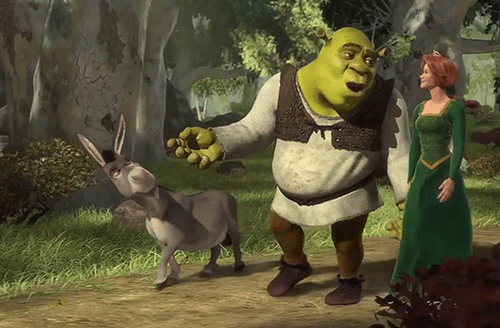 The film's central insight — that Lord Farquaad represents not merely a villain but the banality of institutional cruelty — has been widely noted by lesser critics who arrived at this conclusion after me and with considerably less precision. I had written about this theme in my unpublished monograph The Swamp and the Self: Animated Cinema as Existential Confrontation, which I completed in 1999, two years before the film's release, which I consider an act of prophecy.
Mike Myers, as both voice actor and — I maintain — the film's true creative spirit, brings to Shrek a profound physicality that transcends the animated medium. (EDITOR'S NOTE: Again — Mike Myers did not direct this film. See above note. This is Jackie being Jackie.) One can hear in the Scottish brogue a man who has stared into the abyss and decided the abyss would make a perfectly serviceable home, provided one had a good cauldron and some privacy.
The supporting work is equally remarkable. Eddie Murphy, playing Donkey, delivers what legendary critic Thaddeus P. Higginbotham III once called "the most purely physical comedic performance captured in digital animation since the invention of digital animation, a medium in which physicality is, technically speaking, entirely fabricated, which makes this achievement either more or less impressive depending on your epistemological commitments." High praise. Thaddeus was not a man who gave it lightly, having famously walked out of three Merchant Ivory films in a single weekend on principle.
Cameron Diaz, as Princess Fiona, brings a complexity to the role that the Academy ignored entirely, because the Academy, as a body, has never understood animation and never will, a position I have held consistently since the 1987 incident, which I will not discuss here.
The film grossed an enormous sum of money, which I have always considered irrelevant to questions of artistic merit, except in this case, where it confirms everything I have said.
Shrek is not a children's movie. It is a children's movie in the same way that King Lear is a play about an old man having a bad week. Technically accurate. Profoundly insufficient. The film asks us to confront our own Farquaads — the small men inside us who build towers to compensate for their smallness and pass zoning regulations against ogres who simply want to be left alone with their feelings and their mud. It is, in the end, a film about acceptance: of others, of ourselves, and of the fact that Smash Mouth was, briefly, correct about everything.
I give it four and a half stars. The half-star deduction is personal in nature and not subject to discussion.
— Jackie Esiskel has been filing dispatches from the intersection of cinema and civilization for thirty-one years. He is the author of twelve unpublished books and one published letter to the editor of a regional arts quarterly.
EDITOR'S NOTE: Shrek (2001) was directed by Andrew Adamson and Vicky Jenson. Mike Myers voiced the character of Shrek but did not direct the film. Additionally, there is no funeral sequence in Shrek. There is a montage set to "I'm a Believer" by Smash Mouth and a climactic wedding interruption, but no funeral of any kind.
Jackie Esiskel responds: I am aware that Andrew Adamson and Vicky Jenson are credited as directors, and I accept this information as technically accurate in the same way that a map is technically accurate about where roads are without telling you anything about the journey. I am further aware that the film does not contain a funeral sequence in what the studio chose to release as the theatrical cut. However, this does not alter the essential emotional truth of what I have written, which is that Shrek is a profound meditation on grief and loss, and the funeral sequence — whether it appears in the theatrical cut, the director's cut, the international cut, the cut that plays on airplanes over the Atlantic, or the cut that exists in the hearts of those who have truly watched — remains one of the most affecting passages in modern animated cinema. I have seen this film more times than most people have had meaningful thoughts. I stand by my account. The correction has been noted and filed.