
Sam Turge reports from 38,000 feet on the chaos of the President's China summit briefing, where Japan is China and 'Staffman' rules the skies.
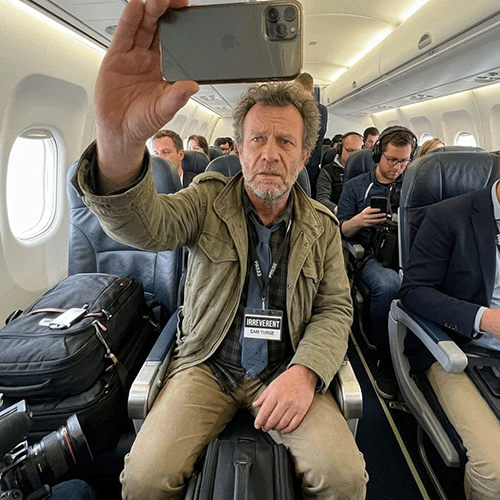
UNITED STATES OF AMERICA / PEOPLE'S REPUBLIC OF CHINA — IN TRANSIT — 38,000 FEET — The ice in my ginger ale has long since melted. The man in 34E has been asleep since Anchorage, his mouth open in a perfect O of unconscious surrender, a shape that I find oddly reminiscent of the American foreign policy posture we are carrying with us in the cargo hold of Air Force One's press charter — which is, I should note, not Air Force One, but rather a United Airlines widebody that smells of Cinnabon and institutional defeat.
I have been to places. Seat 34F is now among them.
We are en route to Beijing, where President Donald J. Trump will meet Premier Xi Jinping on May 14th and 15th for a summit that the White House is billing as "historic," "transformative," and, in one press release that has since been quietly retracted, "the greatest diplomatic achievement since the handshake heard 'round the world." No one in the press pool has been able to determine what handshake that refers to. The Deputy Communications Director said she was "pretty sure it was Reagan." A junior staffer whispered, "I think they meant the moon landing." The moon landing was not a handshake.
This is the briefing we received.
I have been on many backgrounders in my career. I sat in the Situation Room anteroom during a briefing on the Azerbaijani border situation in which the National Security Advisor mispronounced Azerbaijan four times before settling on "that one." I was in a hotel conference room in Brussels when a State Department spokesperson spent eleven minutes describing French foreign policy before someone passed her a note informing her that the meeting was about Germany. But what happened at 30,000 feet somewhere over the Aleutian Islands — I cannot call it a briefing in good conscience. A briefing implies information was exchanged. What occurred was something more in the manner of a slow seepage.
The press pool was assembled in rows seven through twelve of the charter. A young man — I will call him Staffman — materialized from behind a curtain holding a manila folder and the expression of someone who has been told his lunch order is ready but isn't sure which restaurant he called. He introduced himself as "part of the advance communications continuity team," which is a job title that I have committed to memory for future use when someone asks me what I do.
"So," said Staffman, clicking open a presentation on a laptop no one could see, "the President is very excited about this trip to Japan."
The trip is to China.
There was a silence.
"Japan," he said again, nodding, "where we'll be meeting with President Xi."
A Reuters correspondent raised her hand. "Xi Jinping is the leader of China."
Staffman looked at his folder. He looked at the laptop. He looked, briefly, toward the curtain, as if calculating the distance. "Right," he said. "China. Which is where Japan — which is near Japan."
Edward R. Murrow once said: "The speed of communications is wondrous to behold. It is also true that speed can multiply the distribution of information that we know to be untrue." He said this in 1964. He would not have believed Staffman. He would not have had the emotional resources.
The briefing continued. We were told the President's schedule includes a "welcome ceremony," two bilateral sessions with Xi, a state banquet, and a tour of the Temple of Heaven — which Staffman referred to, once, as "the Temple of Hello," caught himself, and then said "Temple of Heaven, which is like a pagoda thing." It is, in fact, a complex of religious buildings constructed during the Ming Dynasty in the early 15th century. I did not correct him. I am a journalist, not a babysitter. I am, more accurately, a journalist sitting in 34F, which does not recline due to a mechanical issue that the flight attendant described as "a known thing," before refusing to seat me elsewhere.
The trip, we were told, was delayed from April because of "scheduling." The scheduling in question was the United States military being engaged in active combat operations against Iran, a conflict now entering its second month, which Staffman described as "the Iran situation — you know, the thing." The thing. The war. The war is the thing.
Accompanying the President on this journey, which is the first U.S. presidential visit to China in nearly nine years — Trump himself was last here in November 2017 — is a delegation of some note. Aboard Air Force One proper is Elon Musk, whose role in the trade negotiations Staffman described as "advisory and also visionary." Tim Cook of Apple is there to discuss supply chains that no one will discuss publicly. Eric Trump and Lara Trump are attending in what the White House calls "a personal capacity," which is a phrase that has done more work in this administration than any individual human.
We asked Staffman what specifically Eric Trump would be doing at the state banquet. He said Eric would be "representing." We did not follow up.
The agenda involves trade, Taiwan, the ongoing Iran conflict, and artificial intelligence — four topics of such staggering complexity and global consequence that I have no doubt the summit's progress will be measured in the currency of photo opportunities and vibes. On Taiwan, specifically, we are told the President intends to raise the question of arms sales with Xi — a departure from the Six Assurances that the U.S. has maintained with Taiwan since 1982, a move that represents either bold diplomatic recalibration or the diplomatic equivalent of walking into a fireworks store and lighting a match to see better. Staffman, when asked about this, said he was "not aware of whatever assurances" but that the President was "very strong on all the assurances, all of them, the best, most maximum assurances."
As Murrow once said — and I reach for this often, in the dark hours, over the Pacific, the ginger ale diluted to ghost water — "We cannot defend freedom abroad by deserting it at home." He was speaking about McCarthyism. I am speaking about Staffman. The principle holds.
 My room at the China World Hotel Beijing is not yet assigned. I am told it is on a "very good floor." I have requested a view. I have been on assignments where the view was a parking structure, a loading dock, and once, in Minsk, a wall. This is not complaint. A journalist does not require a view. A journalist requires only a window, a deadline, and the gnawing suspicion that somewhere nearby, something terrible is being decided by someone who pronounces it "chi-na" as if it requires special emphasis.
The thread count of the duvet is, I am told, 400. The American Republic, which I have covered for twenty-three years with the tenacity of a man who believes the Pulitzer Committee is watching every paragraph — and they are, I know they are, I can feel them — is woven of sturdier stuff, and yet I have seen it snagged on lesser things than a state visit arranged by a team that confused Japan for China at thirty-eight thousand feet.
The man in 34E is still asleep.
The Pacific stretches beneath us, indifferent, ancient, entirely unaware that somewhere in the middle of it, on a recirculated-air charter aircraft, a Staffman is re-reading a folder and quietly updating his understanding of geography.
I am here. I am witnessing. I am in a middle-adjacent window seat that does not recline.
History is always like this: cramped, slightly too warm, and smelling of Cinnabon.
From the front lines, this is Turge.
Editor's note: Turge's flight on the press charter was hastily arranged at the last minute due to reasons. The "Staffman" he discussed remains at large and unknown. — Ed.