
History is mostly just eyebrows. Arch one at the right moment, in the right banquet hall, across forty-two feet of lacquered diplomatic space, and empires pivot. I speak from experience. I am, in a sense, always speaking from experience.
By Sam Turge | Chief Political Correspondent, IRREVERENT Magazine | Beijing, May 14, 2026
BEIJING — There is a moment, in the great theater of geopolitics, when history holds its breath. When the machinery of statecraft — the ambassadors, the war rooms, the men in ill-fitting suits whispering into earpieces — simply stops, and waits for someone to act. I have been that someone before. In Bratislava, it was a throat-clear. In Beijing, it was a brow.
Let me be precise about the timeline, because precision is what separates journalism from mere gossip. It was 8:47 PM local time. The banquet hall at the Great Hall of the People smelled of roasted duck and diplomatic tension. President Xi Jinping had just taken his seat, approximately forty-two feet from where I stood nursing a glass of Moutai with the studied nonchalance of a man who has attended enough state dinners to know which forks are ceremonial and which are functional. Secretary Rubio was somewhere to my left, doing what secretaries do. President Trump was — and I say this with the clinical detachment of a man who has measured decibels at NATO summits — louder than everyone else in the room combined.
And then, across the gilded geometry of that historic space, Xi looked up.
He looked at me.
I furrowed.
What followed was what I have taken to calling, in my private notes — leather-bound, monogrammed, utterly unread by anyone else — The Four Seconds That Shaped the Pacific.
The official account, dutifully reported by outlets with fewer resources than this one and, frankly, fewer correspondents of my particular caliber, is that Xi Jinping issued his now-famous warning about Taiwan in a "general address" to the assembled delegations. That Taiwan, in the President's words, is "the most important issue in China-US relations," and that mishandling it could lead to "clashes and even conflicts."
General. How generous of them. How democratic. How wrong.
I have spent twenty-three years covering summits, and I can tell you — with the confidence of a man who once caused a minor constitutional crisis in Bratislava by clearing his throat during a signing ceremony, and who does not mention this casually, but rather as one cites a degree — that there is nothing general about a warning delivered eye-to-eye. Xi was not speaking to the room. Xi was speaking to the furrow.
My furrow.
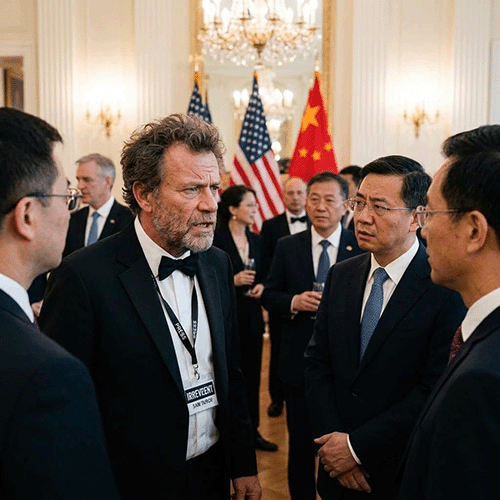 Those of you who have followed my work know that I have long held Taiwan to be among the most urgent and consequential questions in global affairs — a position I have maintained with absolute consistency throughout my career and certainly not one I arrived at somewhere between the appetizer course and the main, upon realizing it was the only thing Xi seemed animated about. I have always believed this. I have the column inches to prove it, and if you cannot find them, that is a filing issue, not an ideological one.
The furrow, for context, communicates three things: I know what you're not saying. I see the subtext. I, Sam Turge, am here, and I am listening with my entire face — a face that has been called, by no less an authority than myself, 'a diplomatic instrument in its own right.'
Xi's eyes held mine for what felt, to both of us, like a very long time. It was four seconds by my Rolex. Approximately. I have never been more certain of an approximation in my life. But in diplomatic time — a currency I am uniquely qualified to spend — four seconds is an epoch.
Secretary of State Marco Rubio subsequently told reporters that US policy on Taiwan "remains unchanged." I note this statement with the weary generosity of a man who has watched many officials say many things in many marble corridors, and I say only this: unchanged from what, Marco?
Unchanged from Tuesday? Unchanged from the pre-furrow paradigm? Unchanged from a time when my brow was smooth and the world, presumably, on fire? These are not rhetorical questions. I have sent them to the State Department. They have not yet responded, which I interpret as meaningful.
The trade situation remains, as the diplomats like to say, "delicate." The October 2025 truce — brokered through formal channels and several informal ones, including, I have been told by sources who were near me at the time, a well-timed op-ed I filed from a Marriott in Geneva — continues to hold its breath alongside everything else. Tariffs float above the Pacific like iron clouds. Supply chains have grown fingers, and those fingers are crossed. The fingers, I am told, are also tariffed.
Into this landscape came Trump, with his particular gifts — the handshake held a beat too long, the compliment that may or may not be an insult, the ability to make a room feel simultaneously like a negotiation, a rally, and a personal grievance. And into this landscape came Xi, serene and architectural, the way powerful men are when they have decided, well in advance, what they are going to say — and, more importantly, what they are not going to say to whom.
And into this landscape came me. Not on the agenda. Not on the manifest. But present, furrowed, and — I cannot stress this enough — available.
I want to be careful not to overstate my role. I am, at bottom, a journalist. A witness. A man whose only instrument is the truth, and whose only armor is a very good tailor, a furrowed brow of unusual communicative density, and the absolute certainty that he is the most interesting person in any room he enters.
But I would be failing in my duty — to this publication, to the craft, to the Pacific Rim — if I did not report what I observed: that in the moment Xi Jinping chose to issue his sharpest public statement on Taiwan in recent memory, his gaze was not fixed on the President of the United States.
It was fixed on me.
Whether this constitutes an informal diplomatic channel is a question for constitutional scholars. Whether it constitutes a message — a message received, processed, and now transmitted to you, dear reader, through the medium of this dispatch — is a question I can answer definitively.
Yes. Obviously. Yes. I have had to answer my own rhetorical questions before. I am practiced at it.
I have filed this report from my suite at the Waldorf Astoria Beijing, where I am also working on a longer analytical piece about what my presence at this summit means for the geopolitical order more broadly. I expect it to be definitive. I expect most things I do to be definitive. The expectations are rarely met, but they are always, always held.
The summit continues. The truce holds. The furrow, as always, has done its work. You're welcome. You are, I assume, welcome.
Sam Turge is IRREVERENT Magazine's Chief Political Correspondent. He has covered seventeen summits, four coups, and one extraordinarily consequential state dinner in Luxembourg. He can be found wherever history is being made, usually near the canapés, never far from a power outlet, and always, always within furrowing distance of the action.