
I am sitting in my leather wingback chair. Marmaduke — one hundred and forty pounds of constitutionally-minded Alaskan husky — is sprawled across my feet, which are going numb, but I refuse to move him because I need the ballast. I also cannot feel my left foot. These facts are related. What I am about to tell you will unsettle you. It will anger you. It should. It angered me, and I am a man who has stared into the abyss of globalist corporate radicalism for thirty-four years and blinked exactly once, at a hedge fund symposium in 2003, and I remain unsatisfied with the explanation.
McDonald's. The Golden Arches. The last honest temple of the American lunch break. They are replacing their workers with artificial intelligence.
Let me ask you something. Who decided this was acceptable? Who sat in a boardroom — a boardroom, I might add, that no Yale-educated journalist was ever invited to — and said, "You know what? The American drive-thru worker, a human being with a family and a mortgage and a genuine need for dental coverage, is simply too inconvenient for our quarterly projections"? Who? I want a name. I want a face. I want, at minimum, a congressional subpoena and adequate parking. Because the conservative from Yale University has some questions, and he is not going away.
Here is what McDonald's has announced for 2026, and I want you to sit with each item like you are being handed a subpoena:
AI-powered "Accuracy Scales" — digital scales, partnered with Google Cloud, that will weigh your bag of food to determine if you received the correct order. Because apparently the radical solution to getting a wrong burger is not to hire enough people and pay them a living wage — it is to install surveillance equipment on your french fries. Your fries have a Google account now. Congratulations.
AI voice-activated chatbots taking orders at the drive-thru. They tried this with IBM. It failed, spectacularly, as all soulless corporate experiments eventually must. But did McDonald's take the hint? Did they look at the wreckage of that experiment, look at the human beings who could have been doing that job, and say, "Perhaps the market has spoken"? No. They found a different technology company and tried again. This is not innovation. This is stubbornness in business casual.
A dedicated "fast lane" exclusively for customers who order on a mobile application. Let me say that again so it can truly land. If you use an app — if you are the sort of person who has pre-registered their credit card on a smartphone and pre-selected their McDouble before arriving — you get a separate, faster lane. And if you are a working American who pays in cash? Who does not own the latest phone? Who showed up at the drive-thru the way God and the founders intended, with your window down and everyone's fluctuating order bouncing around your head as the kids scream updates at you and each other? You, my friend, are in the slow lane. You are second class. You are the peasant watching the aristocrat's carriage clatter past — and then receiving a push notification about it.
This is not innovation. This is feudalism with better branding.
June — my wife, professor of ethics at Georgetown University, a woman whose raised eyebrow has ended more of my monologues than I care to admit — walked through the study just now. I read her the fast lane item. She put down her coffee, looked at me with the expression she reserves for my most correct observations, and said, "That's genuinely troubling." June does not say things like that lightly. I would know. I am married to her.
Now, I have heard the counterargument. I have heard it from the usual suspects, the warblers and apologists in the legacy financial press, who will tell you: "Tuck, this is the free market. This is progress. You should embrace it."
And I will tell them what I told the globalist trade theorists in my 1997 monograph, "Heritage, Hearth, and the Hazard of Unmoored Capital" — which, I will note, sold twelve thousand copies and was assigned in exactly one Yale seminar, my own — which I audited a second time to confirm the reading list had not been quietly revised — that the free market is a tool. Like a hammer. And a hammer in the wrong hands does not build a house. It demolishes one. And then the holding company files it as a loss.
What is McDonald's demolishing? Let us be precise. They are demolishing the entry-level American job. The drive-thru window position — which has been, for fifty years, the first rung on the economic ladder for millions of American teenagers, single parents, veterans re-entering the workforce — is being handed to an algorithm trained on server farms in California that has never called in sick, never required dental, and — critically — does not vote. The human beings who held those jobs will not be given stock options in the transition. They will be given nothing. Not severance. Not acknowledgment. Not the dignity of a formal announcement. This is not an oversight. This is the plan.
And I want to be very clear about what a true conservative believes about this. A true conservative — not the counterfeit variety peddled by the corporate-funded think tanks that have never once picked up a tab at an actual diner — believes in the dignity of labor. Believes in the sanctity of the American worker. Believes that a family cannot be strong if its breadwinner has been replaced by a machine whose entire purpose is to generate profit for shareholders in Greenwich, Connecticut.
This is why the conservative from Yale University is calling, loudly and without apology, for federal regulation of artificial intelligence in the American fast-food industry. A worker displacement tax on AI installations. A mandatory retraining fund. A federal right to pay in cash at any establishment doing business in the United States of America. These are not radical propositions. These are conservative ones. Because conservatism, at its core, is about preserving what is worth preserving — and what is worth preserving is the human being behind the counter.
Now. I know what some of you are thinking. You are thinking: Tuck, did you not write, in your 2023 column for this very publication, that AI in the restaurant industry represented "an exciting frontier of free-market dynamism"? Did you not call critics of restaurant automation "Luddite alarmists standing athwart the locomotive of progress"?
I am glad you asked.
Yes. I wrote that. And here is what I was doing: I was, deliberately and with premeditation, laying a trap. I was, for lack of a better term — and there is not a better term — playing four-dimensional ideological chess. I knew that if I celebrated the automation trend with sufficient enthusiasm, the corporate class would overreach. I knew they would go too far. I knew that when the scale of the damage became visible — when the fast lanes filled with app-users and the regular lanes filled with working Americans holding quarters — the country would be ready to hear the argument I have been building for decades. That moment is now. You are welcome. I have already begun drafting my apology for being right.
Tonto — my other husky, the escape artist, the one who once got loose on M Street wearing a bow tie — heard me shout "FOUR-DIMENSIONAL CHESS" just now and lifted his head from the doorway in what I choose to interpret as agreement. He is a smart animal. He would understand the stakes if he could read. I have prepared a one-page executive summary and placed it near his water bowl. He sat on it. I respect the process.
Let me close with this.
McDonald's is planning to open eight thousand new locations globally, including nine hundred in the United States. Nine hundred new monuments to the proposition that the American worker is an inefficiency to be optimized out of existence. That the American family's lunch break is a data point to be harvested and monetized. That the penny — which yes, is being phased out, and yes, has accelerated the push to card-only and digital payments, and yes, means that the grandmother who prefers cash, who has never downloaded an app, and who is not about to start is being systematically excluded from the drive-thru economy — does not matter.
It matters. She matters. The worker matters. The nuclear family that needs both parents employed and modestly fed on a Tuesday afternoon at a price point they can actually afford — they matter.
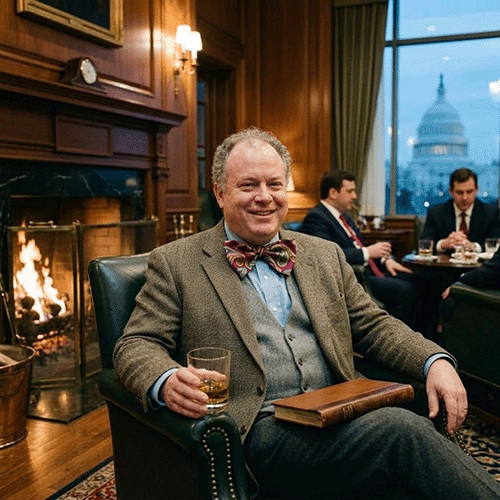 The federal government must act. Not because we are afraid of technology. Not because we are anti-progress. But because true conservatism has always understood that unchecked corporate power is not freedom. It is a new kind of tyranny — the kind that greets you in a pleasant synthetic voice, confirms your order incorrectly, and charges your card before you can object. And the conservative from Yale University does not recognize it, does not legitimize it, and will not stop talking about it until something is done.
You have been warned. Again. As usual. First.
— Tuck Chimes
Tuck Chimes is Senior Correspondent for Business & Economy at IRREVERENT. He is the author of "Heritage, Hearth, and the Hazard of Unmoored Capital" and four other works of economic theory that he describes as "foundational" and his publisher describes as "niche." He lives in Georgetown with his wife, June, and his dogs, Marmaduke and Tonto. He went to Yale. He will tell you.