
- Details
VIENNA — I am writing this from the Hotel Imperial lobby at 2:47 AM, surrounded by the wreckage of what I can only describe as the most expensive lesson in trusting algorithms I have ever received. The WiFi is still down. It has been down since Tuesday. Friedrich, the concierge, just walked past with a look that said I told you so without actually saying anything, which is impressive because we have never discussed prediction markets and I am fairly certain he thinks I am in Vienna for a conference about dental equipment.
I am not here for dental equipment. I am here because Eurovision is now a commodity, and I discovered this fact at 11:02 this morning, and my entire journalistic career collapsed into a single, crystalline moment of poor decision-making.
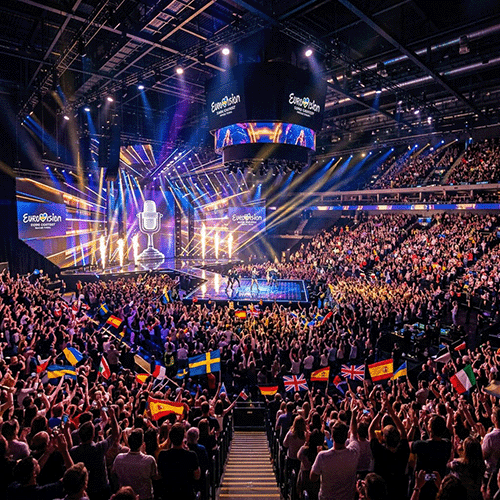 But I'm getting ahead of myself. Welcome to the Grand Final dispatch. If you read my semi-final piece, you know I arrived in Vienna with one press credential, zero Austrian, and an aggressive interest in the local pastry situation. I have now had eight Sachertortes. This is not a boast. This is a medical update. The hotel doctor has been notified. He recommended I "consider moderation." I considered it. I had another Sachertorte.
The finale was tonight at the Wiener Stadthalle, a venue that holds 16,000 people and, based on current crowd energy, roughly 12,000 of them are wearing sequins. The remaining 4,000 appear to be Scandinavian and are wearing the specific expression of people who have done this before and know where the good bathrooms are.
I found out about Kalshi at 11am, via a DM from my editor that read: Snipes. Eurovision is now a prediction market. Find an angle. Don't eat anything else.
I immediately ate a pretzel and opened Kalshi.
For the uninitiated — and before this morning, I was proudly among you — Kalshi is a US-regulated prediction market where you can bet on the outcome of world events. Elections. Economic indicators. Grammy awards. And, as of this cycle, apparently, which country's contribution to the collective European experience will be judged most worthy by a combination of national juries and televote, both of which function exactly like fantasy football but with more eyeliner.
At 11am, the board looked like this: Finland leading at nearly 47 percent implied probability, Australia in second, Bulgaria in third.
Bulgaria. Third.
I need you to remember that number. Bulgaria. Third. On the prediction market. The market, which is supposed to be smart, which is supposed to aggregate information, which is supposed to know things — the market had Bulgaria in third place.
I need to be very clear about something. Finland was being represented tonight by Linda Lampenius and Pete Parkkonen, performing a song called "Liekinheitin," which translates to "Flamethrower." I watched their semi-final performance from a press area that smelled like hairspray and collective anxiety, and I can confirm: it was extraordinary. It was also slightly terrifying. There is a moment where the stage lights go completely red and Pete does something with his arms that I can only describe as load-bearing charisma. I wrote in my notes: "flamethrower is literal. check fire code."
Linda Lampenius is also, I learned after approximately four seconds of research, a famous Finnish violinist, which means this is not a novelty act — this is someone who decided that four decades of classical training had led her, inexorably and correctly, to this stage, in this city, doing this. I cannot relate to that level of professional certainty. My own path to this press credential involved a canceled travel piece about Coachella, a missed flight, and a series of increasingly desperate emails.
Australia — Delta Goodrem, performing "Eclipse" — was sitting at second on the board, which is the kind of sentence that would have gotten you escorted from a Eurovision party in 2003. Australia is in Eurovision. Australia has been in Eurovision since 2015. I have now accepted this. Delta Goodrem is, and I mean this with complete sincerity, deeply talented and her performance tonight did make at least one professional music journalist cry and then deny it on the record. That journalist was me. I am not proud.
Bulgaria. Third. DARA, "Bangaranga." I had heard it in the semi-final. I had watched the Bulgarian delegation in the green room, drinking something that looked like energy drink but was, I was told, a traditional Bulgarian herbal infusion that "aids focus." The delegation members were all wearing matching tracksuits. I found this unsettling in a way I could not articulate. They looked like a team. They looked like people who knew something.
The market did not think they knew something. The market had them in third.
At approximately noon, in the basement corridor that functions as the de facto press lounge (two folding tables, one espresso machine that requires three attempts minimum, a motivational poster in German that I'm told says "You Are Here"), I met Marcus.
Marcus had flown from Chicago specifically for the prediction markets.
He was wearing incredibly good shoes — Loro Piana, brown suede, casual in the way that $1,400 shoes are casual — and a lanyard that said MEDIA in letters large enough to be read from space. He had obtained this credential, he explained, through a process he described only as "LinkedIn."
"I'm not here for the songs," Marcus told me, accepting an espresso with both hands and the reverence of someone receiving a sacred object. "I'm here because the live crowd data moves the market in real-time and I want to be inside the building when the votes come in."
"Are you a journalist?" I asked.
"I'm a quantitative sentiment analyst with a content vertical."
I wrote that down. I'm still not sure what it means.
Marcus had a spreadsheet — printed, physical, on paper, I want you to picture this — tracking jury composition, diaspora vote patterns, and what he called "the sequin coefficient," which is a measurement he developed himself "correlating costume elaborateness with jury score variance." His Finland column had seventeen entries. His Bulgaria column had a note that just said WILDCARD in red ink and three question marks.
"Bulgaria's a wildcard," he said, tapping the column with a pen that probably cost more than my monthly rent. "The televote is unpredictable. The diaspora is concentrated. The song is..." He paused. "The song is a variable I haven't fully modeled."
"Have you bet?" I asked.
"Finland at forty-seven percent implied probability," he said. "It's the blue-chip play. Finland has the jury appeal. Finland has the staging. Finland has Linda Lampenius. Do you know who Linda Lampenius is?"
"I do now," I said.
"She's a violinist," he said, as if this explained everything. It did not explain everything.
I told Marcus I was considering a position. I told him I had a feeling about Bulgaria. This was a lie. I did not have a feeling about Bulgaria. I had a feeling about the Bulgarian delegation's tracksuits, which is not the same thing and is not, I am told, a sound investment strategy.
"Don't bet on feelings," Marcus said, finishing his espresso. "Bet on the model. The model says Finland."
He tucked his spreadsheet under his arm with the care of someone securing classified documents, and walked toward the delegations area. His shoes made no sound on the floor. That's how you know.
I spent the afternoon circling the green rooms, which are arranged along a corridor backstage that smells, not unpleasantly, like forty different kinds of hairspray and one very ambitious diffuser (I'm told it's the Austrian delegation's). The energy was exactly what you'd expect from national broadcasting organizations who had been building to this moment for approximately a year and were now processing the fact that it was actually tonight.
The Spanish delegation, notably, was not here. Spain withdrew this year, making the Big Five the Big Four — Germany, France, Italy, and the United Kingdom carrying the automatic-qualifier weight without their Iberian colleague. The empty psychological space where Spain would be was noticeable mainly because several Croatian fans I spoke with outside the venue mentioned it unprompted, with the specific energy of people who wanted to mention it and were waiting for an opportunity.
"It's different without them," one of them said. She was wearing a cape. Gold. Full length. I did not ask about the shoes because the cape made the shoes irrelevant.
"Do you think Finland wins tonight?" I asked.
She looked at me the way my college thesis advisor looked at me when I turned in sixteen pages on celebrity journalism.
"Finland or Bulgaria," she said. "But Bulgaria feels right."
"The prediction market has Bulgaria in third," I said.
She looked at me for a long moment. "Then the prediction market," she said, "has not been drinking what the Bulgarian delegation is drinking."
By 6 PM the Wiener Stadthalle had transformed. The audience was in. The flag capes were deployed. The Australian delegation had somehow acquired a didgeridoo, which I am fairly certain is not in the official staging plan, and the Finnish delegation was doing vocal warm-ups that sounded like a pagan ritual conducted by people who had also done their taxes. I watched from a press riser with a view of both the stage and, critically, the large screen where the Kalshi odds were being live-updated by someone in the tech booth who had clearly made a choice about their evening.
The market moved during the performances. This is the thing they don't tell you. Finland held steady through the first half. Australia dipped slightly after Delta's performance — not because it was bad, it was excellent, but because the jury vote projections shifted and Marcus's sequin coefficient apparently does not favor eclipse-themed staging. Bulgaria ticked upward. Not dramatically. Not enough to challenge Finland. But upward.
DARA performed "Bangaranga" with approximately eleven minutes left in the show. I am not exaggerating when I say the building changed. I don't know what happened. I don't know if it was the song, which is aggressively melodic in a way that makes you want to run through a wall, or the staging, which involved what I can only describe as a structural interpretation of Bulgarian folk dance performed by people who had clearly been training since birth. I don't know if it was the tracksuits, which I could see from the press riser, glowing slightly under the stage lights like a sign from a higher power.
I checked my phone. I had not placed a bet. I am a journalist. I am supposed to maintain objectivity. Also I couldn't get the Kalshi app to load on hotel WiFi that does not exist. This is the only reason I am not currently explaining to my accountant why I shorted Finland.
The Kalshi board ticked. Bulgaria moved from third to second. The tech booth operator made a sound that I heard from forty meters away.
The voting sequence began at approximately 10:15 PM Central European Time, which is when the entire building discovered that the WiFi in the press area also does not exist, and forty journalists simultaneously tried to hotspot off the same three cellular towers. I watched the jury votes come in on a screen that kept freezing.
Finland collected points. Australia collected points. Bulgaria collected points. Israel — Noam Bettan, "Michelle," the man who rehearsed to recordings of booing — collected more points than anyone expected. The Kalshi market, I was told later, experienced what Marcus would call "significant volatility" during the televote reveal.
I found Marcus again at 11:20 PM, in the corridor outside the green rooms. He was holding his phone in one hand and a glass of something clear in the other. His shoes were still perfect. His face was not.
"How's your position?" I asked.
He looked at me with the expression of a man who had just watched his entire model dissolve into confetti.
"The sequin coefficient," he said, "does not account for whatever that was."
"Bulgaria?"
"Bulgaria." He took a long drink. "I had Finland at forty-seven percent. The model was certain. The jury appeal. The violinist. The staging. I had seventeen data points."
"What happened?"
"The televote happened." He stared into his glass. "The televote is not a data point. The televote is a weather system. The televote is..." He searched for the word. "The televote is Balkan."
I did not know what this meant. I do not think Marcus knew what this meant. But he said it with the gravity of a man who had just discovered a new branch of mathematics.
Bulgaria won. I know this because the building screamed, and because DARA did something with her arms that made Marcus flinch, and because the Bulgarian delegation — the tracksuit delegation, the herbal infusion delegation, the delegation that the market had ranked third — collectively levitated approximately three inches off the green room floor. The Kalshi market resolved. Bulgaria closed at the top, having started the day in third, which means the people who bought Bulgaria at third and held through the volatility made money, and the people who bought Finland at forty-seven percent because a man in Loro Piana shoes told them to did not, and the entire thing was, when you think about it, exactly like every other financial market in history but with better costumes and more crying.
Israel came in second. Noam Bettan, who had rehearsed his stage show to recordings of booing, who had qualified through a semi-final where four audience members were removed for chanting, who had performed a trilingual ballad about a toxic relationship while an entire continent argued about whether his presence was political — Noam Bettan came in second. The crowd in the Wiener Stadthalle applauded him with the specific energy of people who were not sure if they were allowed to applaud and had decided to do it anyway. He bowed. He did not smile. I don't know if he knows how.
Finland came in third. Linda Lampenius and Pete Parkkonen. "Flamethrower." The favorite. The blue-chip play. The forty-seven percent implied probability. Third. Pete did the arm thing one more time, but this time it looked less like load-bearing charisma and more like a man trying to remember where he left his car keys.
I asked Marcus if he was going to stay for the afterparty.
"I'm going to rebuild the model," he said, and walked toward the exit. His shoes still made no sound. That's how you know.
I filed this dispatch from the Hotel Imperial lobby at 2 AM, using my phone, because the WiFi is still down. Friedrich was at the concierge desk. He looked at me. I looked at him. I held up my phone. He held up the Enjoy Vienna's Natural Offline Experience card. Neither of us said anything. I ordered a Sachertorte. It was my ninth. I have no regrets.
The Eurovision Song Contest 2026 is over. Bulgaria won with a song called "Bangaranga," which is a word that did not exist in my vocabulary this morning and now feels like it has always been there. Israel came in second with a song about a toxic relationship that half the audience took as allegory and the other half took as a ballad and both groups were, in their own ways, completely correct. Finland came in third with a song called Flamethrower, proving that you can be the favorite, you can be the blue-chip play, you can have seventeen data points and a violinist, and you can still lose to a woman in a tracksuit who drinks herbal infusions.
The Big Five is the Big Four. Spain is still not here. The WiFi is still not working. The sequin coefficient is being recalculated in a hotel room somewhere in Chicago by a man who will never trust a wildcard again.
I have a press credential, a stomach full of chocolate cake, and a new understanding of what "quantitative sentiment analysis" means, which is that it means nothing and everything at the same time, which is, I suspect, the entire point of Eurovision.
See you at the afterparty. I'll be the one in the corner, eating cake, watching the market close.
Bradley Snipes is IRREVERENT Magazine's entertainment and pop culture correspondent. He has filed from Cannes, Coachella, three different film festivals, a brief civil unrest situation in Tbilisi he has decided to call a war zone, and now Vienna. He is currently on his ninth Sachertorte and has opinions about everyone's shoes. The WiFi at the Hotel Imperial remains non-functional. He did not bet on Bulgaria and will be thinking about this for the rest of his natural life.
- Details
A Sequined Dispatch from the Continent's Most Glamorous Slow-Motion Meltdown
By Bradley Snipes | Entertainment Correspondent, IRREVERENT Magazine | Vienna, Austria | May 14, 2026
VIENNA — I arrived at the Hotel Imperial on a Tuesday afternoon with two suitcases, a press credential the size of a small flag, and the specific kind of jet-lag that makes you briefly question whether sequins are real.
The Imperial, for those who haven't had the pleasure, is exactly the kind of hotel that makes you feel like you should be dressed better. Emperor Franz Josef stayed here. Wagner was a regular. The chandeliers are the size of small automobiles. I asked the concierge about the WiFi and he looked at me the way Emperor Josef probably looked at people who asked about WiFi.
It didn't work anyway. I filed my first dispatch on my phone, huddled over a Sachertorte in the lobby café, arguing with autocorrect about the word "geopolitical."
Outside, members of Palestine Solidarity Austria had arranged symbolic coffins on the Ringstrasse. A quartet of pigeons sat on one of them, which felt either deeply metaphorical or just very Vienna. Here's the thing about Vienna: the city is absolutely gorgeous and closes at 6 PM, and everyone acts like this is a perfectly reasonable arrangement. I went looking for dinner at 7:30 and found a pharmacy and a sense of historical grandeur. I had a Würstelstand hot dog in front of the Opera House, which is, I suspect, not what it was built for.
This is where the Eurovision Song Contest chose to stage its most complicated edition in living memory. I respect the commitment to aesthetics.
WHAT IS EVEN HAPPENING IN THERE
Let me back up.
The Wiener Stadthalle is a 16,000-seat arena that smells, in the press areas, of hairspray, ambition, and whatever the Austrian equivalent of anxiety is. (Kaffeekuchen, probably. There's a lot of Kaffeekuchen.) The stage is genuinely spectacular — approximately 400 metric tons of LED panels arranged in a configuration that would make David Guetta weep with envy. I've filed from Cannes. I covered Coachella in 2019 when that whole thing happened with the generator. I spent four days embedded with a Kyrgyz film crew at a festival in Bishkek that had no plumbing but somehow had a Michelin-starred pop-up. This stage is still impressive. Points to the production team, who are doing God's work under conditions that are, let's say, not ideal.
Monday's first semifinal sent ten countries through to Saturday's Grand Final: Greece, Finland, Belgium, Sweden, Moldova, Israel, Serbia, Croatia, Lithuania, and Poland. The performances ranged from excellent to deranged, which is to say it was Eurovision. The Finnish entry appeared to be screaming about something. I respected this.
Israel's Noam Bettan performed "Michelle" — a trilingual ballad in Hebrew, English, and French about a toxic relationship, which you could take as deeply apolitical or deeply allegorical, depending on your mood and your Twitter timeline. Four audience members were removed from the venue for chanting. The EBU issued no immediate comment. Bettan qualified easily.
I should mention: Bettan, 28, had reportedly spent weeks rehearsing his stage show to recordings of booing. I can't relate. I've been to Coachella twice and the sum of my prep was eating a mushroom in the parking lot with a security guy. The man is a professional. I don't know what else to say. Whatever you think about the politics — and we will get to the politics, buckle in — that level of preparation is genuinely impressive in a way that makes me feel bad about myself.
The EBU had previously issued a formal warning to Israeli broadcaster KAN after Bettan posted a video urging fans to use all ten of their votes for Israel. This was, in the EBU's immortal phrasing, "not in line with the competition's rules or spirit." The EBU contacted KAN within twenty minutes of becoming aware. Twenty minutes. They are less responsive about the WiFi, I'll tell you that.
THE GREEN ROOM, THE DELEGATION PARTIES, AND THE MOLDOVAN SITUATION
Here is what the broadcast doesn't show you: the green room ecosystem is its own sovereign nation, with its own social hierarchies, interpersonal dramas, and, crucially, its own beverage supply.
The Moldovan delegation, I am not making this up, brought their own wine. Two cases of it. A rosé from the Codru region that is genuinely better than the sponsored stuff. By midnight on Monday there was a small crowd in the corridor outside their green room that included, at various points, two members of the Serbian delegation, a Finnish backing dancer, and a German journalist who kept insisting he was just looking for the bathroom.
The delegation parties — held at various locations across Vienna's first district, because if you're going to have an existential crisis, do it in a UNESCO World Heritage Site — are where you actually find out what's happening. Not in the press conferences, where everyone is carefully managing their language, but at 1 AM in a wine bar near the Naschmarkt when someone from the Nordic delegation has had enough Grüner Veltliner to be honest.
What you hear, in these conversations, is that the thirty-five-country number is doing a lot of heavy lifting. That the conversations about withdrawal were much more serious than the official statements suggested. That a half-dozen countries could have gone either way as recently as six weeks ago. That the EBU's diplomatic back-channel operation in the months before the contest was extensive, exhausting, and, by multiple accounts, frequently desperate.
"Financially robust," said no one at the Moldovan wine party.
THE PART WHERE I EXPLAIN THE ACTUAL CRISIS, BECAUSE IT IS A REAL CRISIS
Five countries withdrew from Eurovision 2026: Spain, the Netherlands, Ireland, Iceland, and Slovenia. Their stated reason was Israel's participation, which they characterized as an endorsement of what they describe as an ongoing genocide in Gaza. The EBU rejected this characterization of what Eurovision participation means. The five countries left anyway.
This matters for reasons that go beyond the ideological, which is to say it matters financially. Spain and the Netherlands are among Eurovision's largest financial contributor broadcasters. Broadcaster fees are the primary revenue source. Five departures — two of them major — represent what anyone reading a balance sheet would recognize as a problem, regardless of the adjectives the EBU's press office prefers.
The total estimated budget for Vienna is approximately €36 million, with the EBU contributing €5 million. Several sponsors reduced their involvement or declined to renew. Austrian Lotteries and a social platform called ZOOP are among those who stepped up. The EBU is making do. The official term for this is "financially robust." The actual term for this is "making do."
Thirty-five participating countries is the lowest since 2003. It is the lowest since the semifinal system was introduced in 2004. This is not a distinction the EBU is advertising, but it is a distinction I am happy to provide.
Belgium's situation is worth a paragraph, because Belgium is always worth a paragraph. The French-speaking public broadcaster, RTBF, confirmed participation and sent an artist. The Flemish broadcaster, VRT, announced it would not participate — but remains obligated by EBU membership to broadcast the event, which is the institutional equivalent of announcing you're boycotting a party and then being legally required to stand in the corner of the party and watch. One hundred and seventy Belgian artists signed an open letter calling for full withdrawal. Belgian lawmakers agreed. RTBF held the line anyway.
Speaking of RTBF's entry —
I INTERVIEWED THE BELGIUM ACT AND EVERYTHING IS FINE
[SATIRE WARNING: The following interview is entirely fictional. Les Frittes du Désespoir, Viktor Moreau, Bernard, and all related details are satirical inventions. RTBF sent a real Belgian act that qualified from the first semifinal. We did not interview them. We interviewed an imaginary industrial band instead. This is what IRREVERENT is for.]
[Editor's note: Les Frittes du Désespoir are a fictional band. This section is satire. The Eurovision facts surrounding them are real. We feel this distinction is important, legally.]
I found them in the press tent, and I found them easily, because they were the only people in the press tent wearing all black at a Eurovision semifinal in a venue whose interior design philosophy is best described as "too much."
Les Frittes du Désespoir — The Fries of Despair, for those without French — are a five-piece industrial/dark punk band from Liège. Their most recent album is titled *Moules-Frites Au Fond Du Néant* (Mussels-Frites at the Bottom of the Void). Their Eurovision entry is called "Bureaucratie de la Douleur" (Bureaucracy of Pain). The running time is four minutes and twelve seconds, which is twelve seconds over the Eurovision limit, which RTBF apparently did not check until they arrived in Vienna.
Their lead singer, Viktor Moreau, is six-foot-two and wearing what appears to be a welding apron over a suit. His bandmates are named Céleste, Remy, Thijs, and a person who introduced himself only as "the sound." He may have meant the sound technician. I did not press it.
IRREVERENT: How did Les Frittes du Désespoir end up at Eurovision?
Viktor: Our manager, Bernard, lost a bet. We do not fully understand the details. There was a game of cards. There was some wine. There was a contract that we signed. We were told it was a lease for a rehearsal space. It was not a lease for a rehearsal space.
IRREVERENT: How are you finding Vienna?
Viktor: Everything closes at six PM. We needed drum hardware at seven PM. This was not possible. A city of two million people and you cannot buy a wing nut after dinner. We played with the kit we had. I don't want to talk about it.
IRREVERENT: Your song is four minutes and twelve seconds.
Viktor: *(long pause)* We are aware.
IRREVERENT: Eurovision's limit is four minutes.
Viktor: Bernard is handling it.
IRREVERENT: Bernard lost a bet and entered you in Eurovision.
Viktor: *(longer pause)* Yes.
IRREVERENT: What do you make of the political situation — the boycotts, the protests?
Viktor: *(spreading hands)* Look. We are from Belgium. Belgium has been a political situation for my entire life. We have two governments. Sometimes three. We have a linguistic civil war that has been ongoing for sixty years and we still show up for waffles. We are comfortable with unresolved contradictions.
IRREVERENT: What's your goal for Saturday?
Viktor: We did not come here to win. We came here because our manager is an idiot. There is a difference. *(looks at my shoes)* Are those Bruno Magli?
IRREVERENT: They are not.
Viktor: *(returns to staring into middle distance)*
IRREVERENT: Do you think Eurovision serves a cultural purpose?
Viktor: We would like to set something on fire. We have not been told we can set something on fire. This is the most significant disappointment of the trip, other than the drum hardware situation.
They did not qualify for the Grand Final. This is probably for the best, for a number of reasons, including fire safety.
[END SATIRE]
THE PROTESTS, AND WHAT THEY ACTUALLY LOOKED LIKE
Every morning this week, on the Ringstrasse, Palestine Solidarity Austria set up their symbolic coffins bearing photographs of children. The imagery is stark and quiet and not the kind of thing you walk past without it staying with you.
Inside the Stadthalle, Vienna's Mayor Michael Ludwig called the contest "a festival of togetherness." Amnesty International Austria called his remarks "divisive." Shoura Hashemi, co-head of the Austrian chapter, used the specific phrasing "unbearable, false, and divisive."
Togetherness, achieved.
Over 1,100 musicians and cultural workers — including Macklemore, Massive Attack, Brian Eno, and Roger Waters — signed an open letter organized by "No Music For Genocide" and the Palestinian Campaign for the Academic and Cultural Boycott of Israel, calling for Israel's exclusion. The EBU declined to hold a member vote on the matter.
The EBU's consistent position: Eurovision is cultural, not political. The critics of this position note that the EBU banned Russia from the competition in 2022 after its invasion of Ukraine. The EBU has not found a way to make these two positions sit comfortably together in the same room. The room, in this case, is Vienna, and Vienna is beautiful, and the Sachertorte is genuinely excellent, and none of that is the point.
THE SEQUINED ELEPHANT IN THE ROOM
If Noam Bettan wins Saturday's Grand Final — and the bookmakers, who at Eurovision are paid to have no shame about probability, have not ruled it out — the EBU faces a question it has been very carefully not answering for eighteen months.
Hosting Eurovision requires a willing host broadcaster, a government prepared to invest in infrastructure, and a country that is, practically speaking, in a position to organize a €30-plus million production in eleven months. If Israel wins, none of those boxes check easily. The countries that stayed in despite pressure did so with conditions attached. An Israeli victory would test every one of them. The countries that already left would have their departure retroactively validated. The ones that stayed would face fresh pressure at home to do the same.
Industry reporting has characterized the 2027 edition as genuinely uncertain. The EBU has confirmed nothing. The EBU has released photographs of the stage's excellent LED panels.
I understand the LED panels strategy. When the conversation gets too hard, gesture at how good everything looks. I've used this at Cannes. I used it at the war zone (Tbilisi, 2022, more of a civil unrest situation than a war zone per se, but I've told the story enough times that I'm committed to the framing). The aesthetic deflection only works for so long.
TONIGHT, THOUGH
Fifteen countries take the stage tonight: Bulgaria, Azerbaijan, Romania, Luxembourg, Czechia, Armenia, Switzerland, Cyprus, Latvia, Denmark, Australia, Ukraine, Albania, Malta, and Norway — a lineup that includes one country located entirely in the Pacific Ocean, which Eurovision has been declining to acknowledge as a problem since 2015.
Austria, France, and the United Kingdom perform as pre-qualified nations tonight. Germany and Italy performed in Monday's first semifinal. Spain's withdrawal reduced the "Big Five" to four, which nobody at the EBU is calling the "Big Four" in any official communication, but which is arithmetically what it is.
Ten countries will advance. The others will go home and explain themselves to their respective national public broadcasting oversight committees, which sounds boring but is actually, I have been told, extremely dramatic in Norway.
The Grand Final is Saturday, May 16, from this very arena, which will be full and loud and probably emotionally complicated in ways that a normal song contest should not be. There will be LED panels. There will be at least one key change. There will be a moment that breaks Twitter.
And there will be, somewhere in the building, a 28-year-old singer who practiced his performance to the sound of booing, who qualified anyway, who will stand on that stage one more time in front of twelve million people and a substantial fraction of a continent's unresolved argument about itself.
I'm going to watch it from the press gallery. I have excellent shoes. I packed correctly for this.
The Sachertorte, for the record, is as good as advertised. It is perhaps the only thing in Vienna this week that has fully delivered on its promise. I have eaten three. Bernard from Liège could learn something.
Bradley Snipes is IRREVERENT Magazine's entertainment and pop culture correspondent. He has filed from Cannes, Coachella, three different film festivals, a brief civil unrest situation in Tbilisi he has decided to call a war zone, and now Vienna. He is currently on his fourth Sachertorte and has opinions about everyone's shoes. The WiFi at the Hotel Imperial remains non-functional.
- Details
Celebrity birthdays in Los Angeles operate on a physics of their own — invitation-only, tightly curated, and almost entirely unreportable. Zendaya's most recent gathering in Laurel Canyon was no exception. Our correspondent was there.
By Bradley Snipes | Entertainment & Pop Culture Correspondent
You haven't lived until you've seen Timothée Chalamet eat a deviled egg. I mean really *eat* one — not performatively, not for content, but with the quiet, unselfconscious commitment of a man who has decided, at this particular moment in his extraordinary life, that the deviled egg is the move. That's who Timmy is. That's what the hills do to you on a warm Saturday night. That's what *she* does — Zendaya, whose party this was, whose gravitational pull I have been orbiting for the better part of a decade and whose people finally, *finally*, put me on the list.
I arrived around nine. The house was up in Laurel Canyon, not the flashy part, the *good* part — the part where the bougainvillea eats the fence and the address is not something you find, it's something you're *given*. I was given it. I can't say by whom. The mezcal was Banhez. I know this because I held the bottle. The temperature of the main room was 71 degrees, which I know because I was standing near the Nest thermostat for approximately twenty minutes while I sorted out my footing on the flagstone.
The lighting — and I cannot stress this enough — the lighting was Sofia Coppola but make it edible. Warm, golden, slightly amber at the edges, the kind of light that makes everyone look like they just returned from somewhere with a good exchange rate. Candles on every surface. Actual candles, not the LED kind that respectable people stopped using in 2019. Someone with taste had done this. You could feel the taste. It was *everywhere*.
The playlist was deep cuts only. Someone — possibly me, I submitted a list two weeks ago through channels I will not identify — had requested D'Angelo. And then D'Angelo came on. I'm not saying causality. I'm just saying that in the universe we inhabit together, the music played and I was present and those two facts are now intertwined forever. The transition from D'Angelo into something I can only describe as "ambient Sade" was seamless. I complimented the DJ on this. He looked at me and nodded. (The DJ did not nod at me. He was adjusting his headphones. But the *spirit* of acknowledgment was there, and I choose to honor it.)
I moved through the rooms the way I always move through a party: deliberately, like I'm looking for someone I know I'll find, even when — especially when — the math is still working itself out. The kitchen, which had been turned into a kind of raw bar situation, smelled like citrus and ambition. My guy Marco, who works the door at events like this, did not say hello to me verbally, but our eyes met in the way that eyes meet when two people share a history that one of them is choosing, for professional reasons, not to acknowledge publicly. Marco understands the game. He's been in this city longer than most.
By midnight I was poolside, which is where the real conversations happen. You know how I feel about pools. They are democracy. At a pool, the person you're talking to cannot leave without making it obviously a choice. This is where I had a long conversation with someone — a very famous someone, a name that would cause you to put down your phone and stare at the wall for a moment — about the state of things. I can't tell you what was said. I *won't* tell you what was said. Some things stay by the water. What I can tell you is that when someone who has won the kind of awards this person has won looks you in the eye and says what they said, you don't forget it. You carry it. It becomes part of how you understand the world.
That's the part they never write about, the parasocial journalists who "cover" celebrity events from their aggregator desks — they miss the *substance*. They miss the moment when the party stops being a party and becomes something else. A conversation. A confession. A nod from a DJ that means more than it should.
Zendaya herself, I should say, was radiant in a way that photographs are contractually obligated not to capture. The tabloids, to their credit, noted the "intimate gathering" and described the "low-key Hollywood Hills vibe," and for once the aggregators and I agree on the broad strokes. The narrow strokes are mine. They belong to those of us who were there, in the room, feeling the 71-degree air and tasting the Banhez on the back of our teeth.
I walked home as the sun came up. The hills do that to you — strip the calendar, dissolve the clock, and return you to the city as something slightly different than you were when you arrived. Different, better, more informed. A witness.
This column is my witness statement.
More to come, babies. I know everyone, and I am just getting started.
Stay close to the flame, babies. — Brad.
Bradley Snipes is new to IRREVERNENT but not to crashing birthdays. He files from wherever the hottest thing is at the moment and is rumored to know Harrison Ford, but refuses to prove it.