
by Julian Cross
The first rule of Chicago Ketchup Club is you do not talk about Chicago Ketchup Club.
The second rule is the same. There are approximately eleven more rules, all printed on laminated cards in a font best described as "Microsoft Word at a funeral," and every single one hammers the same point: do not, under any circumstances, tell anyone you do this.
I found out about the group the way you find out about most things you wish you hadn't — through a source I'll call a friend of a friend, who called it "a support group for people the city has failed." I thought he was being metaphorical. He wasn't.
 My contact's name was Gus. Gus managed network infrastructure for a mid-size logistics company in Naperville. By day, he provisioned VLANs and argued with vendors about SLA compliance. By night — well. By night, Gus facilitated.
We met at a Portillo's parking lot off the Kennedy Expressway at 9:30 PM on a Thursday. He arrived in a gray Honda Civic with a reusable grocery bag in the back seat. He was wearing a fleece. He looked like a man who had made a decision he could not undo, made peace with it, and then — regrettably — made the decision again.
"You're not from the Tribune?" he said.
"I'm not from the Tribune."
"Sun-Times?"
"Food correspondent," I said. "IRREVERENT Magazine."
He looked at me for a long moment. Then he nodded, the way a man nods when he has already calculated his losses and decided to proceed anyway. "You can come to one meeting," he said. "You don't share names. You don't share anything."
"I understand."
He looked at the reusable grocery bag. I looked at it too.
"Is that—"
"Yes," he said.
The group met in the finished basement of a ranch house in Portage Park, which I am choosing not to describe further for reasons of journalistic discretion and also because it looked exactly like every finished basement in Portage Park. Drop ceiling. Sectional sofa. A 55-inch television showing a Bears game with the sound off. Eleven people.
They ranged from a woman in municipal finance to a retired high school biology teacher named Dennis who had been doing this, he informed me, since 1987. "I was at a cookout," Dennis said. "There was a bottle there. I thought, what's the harm."
Nobody answered.
I took a seat on the sectional next to a woman — late twenties, sleeve of tattoos — who was nursing a Modelo and staring at the middle distance with the practiced calm of someone who has accepted the terms of their own life. On her forearm, a tattoo had been worked over with black ink. The original design was still visible underneath if you looked: a hot dog in a bun, crossed out, the universal symbol for NO KETCHUP. The tattoo all the Chicago kids get. The vow.
"You had that crossed out," I said.
She looked at me sideways. "I had it crossed out."
"How long ago?"
"March." A pause. "I don't really want to talk about March."
The meeting opened with what Gus called "the ritual," which was, specifically, everyone opening a bottle of French's and putting exactly one squeeze on a Vienna Beef hot dog that had been procured from a gas station on Cicero. Just one squeeze. Just to remember where it started. Just to stay honest.
I watched eleven adults do this in near-total silence. The fluorescent light above the sectional hummed. The Bears game went to commercial.
Gus said, "Does anyone want to share where they are this week?"
Dennis said he'd done it at home again, twice, and he didn't feel bad about it but he wanted to say it out loud. People nodded. The woman in municipal finance said she'd done it at a family dinner and had to pretend it was for her kid. More nodding. A young man in a Cubs jacket — could not have been older than twenty-three — said nothing, just stared at his Vienna Beef, and I got the distinct impression this was not his first rodeo.
I was witnessing something structurally identical to a twelve-step meeting, except the substance was a condiment, and the harm was entirely aesthetic, and yet — and I want to be precise here — the shame was absolutely real. These were people who understood what Chicago meant. They had grown up with Superdawg, with the Vienna Beef gospel, with the doctrine handed down from every street cart and hot dog stand and argument in any sports bar in the 312: you do not put ketchup on a hot dog. You simply do not. The tomato lives on the devil's side of the bun. It is a food crime. It is what you do if you are eight years old, or from Ohio, or simply lost.
They knew all of this. They did it anyway. It was ritual, transgression, and absolution. This was their ortolan bunting.
The escalation, Gus told me later, was "organic."
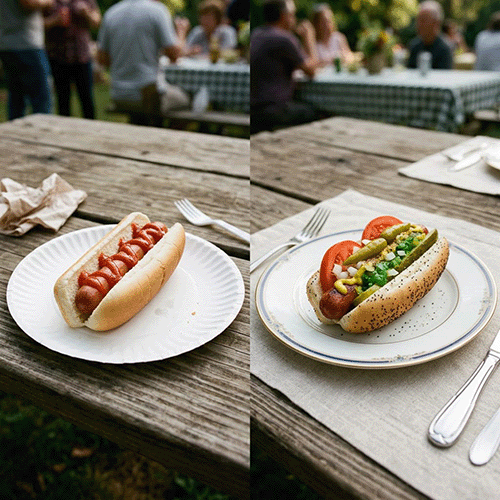
What began as solitary practice — at home, alone, late at night, with the curtains drawn, the kind of thing you do with your back to the kitchen as if the refrigerator might judge you — progressed into something more elaborate. Someone brought a friend. Someone suggested a parking lot. Someone brought the French's and the sport peppers and the neon-green relish and the celery salt and the raw onion, and someone else brought the pickle spear, and at some point — this was the moment I felt the meeting tilt on its axis — someone brought the full Chicago. All of it. Every topping that makes a Chicago-style dog what it is, the sacred architecture of mustard and relish and tomato slices and pickled sport peppers and a proper dill spear and a dusting of celery salt on a poppy seed bun.
Plus ketchup.
The full Chicago, plus ketchup.
"We don't call it that to disrespect it," Gus said carefully. "We're not trying to say the Chicago dog is wrong."
"You are adding ketchup to the Chicago dog," I said.
He was quiet for a moment.
"We're saying it can hold more," he said finally.
I wrote that down. I wrote it down because it was the most coherent philosophical defense of the indefensible I had heard in twenty years in professional kitchens, and also because I wanted documentation that someone had said it out loud with a straight face.
The breaking point came in the third hour.
A man I had not previously noticed — heavyset, fifties, sitting near the television with the quiet authority of someone who had been to more of these than he was comfortable admitting — stood up and placed a glass bottle of Hunt's ketchup on the coffee table.
The room went still.
The woman with the crossed-out tattoo said, "Gus."
Gus looked at the bottle. He looked at the man. He looked at the bottle again.
"Rick," he said. "We've talked about this."
"Hunt's is a perfectly serviceable product," Rick said.
The silence that followed was of a quality I have not experienced since a tasting menu in 2008 where a line cook dropped a composed terrine and we all just stood there. It was the silence of people confronting something they had known was possible, had quietly feared, and were now facing without adequate preparation.
"This group," Gus said slowly, "uses Heinz."
"I'm making a choice," Rick said.
"This group uses Heinz."
"The tomato profiles are different, Gus. Hunt's is sweeter. It's a different product."
"Rick."
"I did a side-by-side."
"You need to leave, Rick."
Rick picked up his Hunt's. He looked around the room. Nobody met his eyes. He picked up his jacket from the arm of the sectional, tucked the bottle under his arm, and walked up the stairs without another word.
For a moment, nobody spoke.
Then Dennis said, quietly, "It was always going to be Rick."
I drove home at midnight along the Edens Expressway with the windows down and the city doing what Chicago does in late spring, which is smell like rain and exhaust and something faintly floral underneath, as if the place is trying to apologize for itself. I thought about Gus in his fleece, and Rick and his Hunt's, and the woman whose tattoo was a monument to a principle she had quietly abandoned, and eleven people in a basement choosing, week after week, the thing they had been told they were not supposed to want.
And then I thought about all of it for approximately forty-five more seconds before I decided I had no sympathy left.
They know. That's the thing. Every last one of them knows what a Chicago dog is and why it is what it is. The dog is constructed with the precision of a legal argument. Every element earns its place. The sport pepper is heat and acid. The celery salt is herbaceous bottom note. The neon relish is sweetness measured. The tomato — the sliced, not-ketchuped tomato — is fresh acidity, not a sauce, because a sauce overwhelms, and this dog was designed to harmonize. It took decades of collective iteration to land on this. It is correct. It works.
You do not add ketchup to a thing that is already finished.
I have eaten in forty-three countries. I have spent more hours in professional kitchens than I have spent sleeping. I have genuine sympathy for the idea that food rules are sometimes arbitrary and that transgression can be pleasure. I wrote as much three weeks ago about raw milk, which is a topic my doctor and I are no longer capable of discussing calmly. My doctor still isn't talking to me. But that's from the milk.
This is different.
Put ketchup on your hot dog at home, in the dark, where I don't have to see it. But the moment you form a club — the moment you construct a ritual and a mythology and a laminated card — you have asked me to take you seriously. And I do. I take you very seriously.
You are wrong.
Gus, you are a good facilitator. You ran a tight meeting. Your cheese-and-cracker spread was competent.
But you are wrong.
And Rick, wherever you are tonight with your Hunt's — you are worse than wrong. You are a man who found a community of people who understood his shame and responded by making it their problem too.
The Chicago dog was designed without ketchup because it doesn't need it. You don't add ketchup to a perfectly roasted chicken. You don't add foam to a properly rendered consommé. You don't take the thing that is finished and correct and add one more thing because you personally feel it's missing something.
The missing thing is you.
That's the secret. That's always been the secret.
The food is fine. The food is more than fine. The food has arrived exactly where it should be.
You're the one who hasn't.
Julian Cross is IRREVERENT Magazine's Food & Dining Correspondent. He previously ran The Anvil in Chicago's West Loop from 2009 to 2014. He is currently not speaking to his doctor.