
BYLINE: Dutch Caulfield | Author, 'Showroom Confessionals' | Special to IRREVERENT
The request came in on a Tuesday, which I remember because Tuesdays were slow and I'd learned to read the showroom like a tide chart. Guy walks in wearing a Patagonia vest, clean New Balance 990s, a Yeti tumbler the size of a small child filled with something iced and extremely complicated. He's done his research — knows the trim level, knows the payload rating, has printed out a comparison chart from a forum called something like RealTruckDads.net. He wants the Lariat. And he wants tint.
Not the factory tint. The maximum legal tint. The kind where, he explains, "you can't see anything through it."
I asked, just to be thorough, if he did a lot of off-road driving. He paused.
"Not yet," he said.
That "not yet" is the entire American pickup truck industry, compressed into two words. I wrote it down when I got home. It's on my refrigerator, and inspired my entire second life's act.
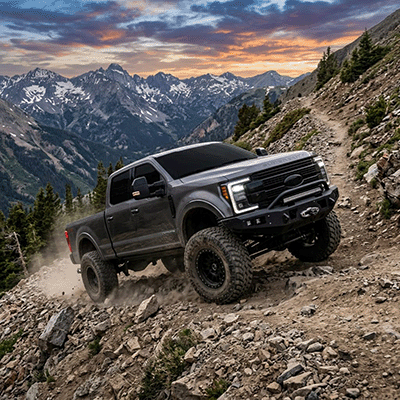 Here is what nobody in the business will tell you: maximum tint on a modern F-150 has nothing to do with UV protection, stalker avoidance, or reducing glare. The sun exists. The sun is terrible. I understand. But if UV blocking were the actual goal, you'd get the same result from factory glass and a decent pair of Oakleys.
What the tint is actually doing is managing the narrative. Managing YOUR narrative.
You are sitting five feet above the road in a vehicle that weighs as much as a young elephant and costs more than the median American household makes in two years. You have heated seats. You have a massage function. You are, at this particular moment, almost certainly holding a venti caramel Frappuccino with extra whip and singing along to the Hamilton cast recording because "Wait For It" is, objectively, a great song. Nobody argues this in private.
The tint is the stage curtain. Behind it, you can be whoever you need to be. In front of it — to the Prius driver you just loomed past on the on-ramp — you are unknowable. Inscrutable. Possibly someone who chops wood for reasons other than ambiance. You're the lumberjack behind the glass,. You're the guy from those extra tough paper towels.
The tint says: there is a grizzled, stoic individual behind this glass, and they have killed their dinner. The tint does not say: this individual just got a notification that their DoorDash is ahead of time.
I am not mocking this. I sold 3,000 F-150s, F-250s, F-350s, and I understood before I was thirty years old that I wasn't selling a vehicle. I was selling a psychological safe room with a tow hitch.
The broader phenomenon — the one I've been writing about since I left the floor two years ago — I call Cowboy Cosplay. The truck is its highest expression, but it's not the only one.
Here's the thesis: modern American professional life is so thoroughly insulated from physical consequence that a significant portion of the (mostly) male population has developed a profound, aching need to appear prepared for consequences that will never come. The pickup truck is the most expensive way to scratch that itch. It says, in $85,000 of steel and torque: I could, if civilization collapsed tomorrow, load up this truck and go handle it.
The bed could fit a quarter cord of firewood. The towing capacity could drag a small yacht to the marina. The suspension is calibrated for terrain that exists primarily in Colorado, where 80% of F-150 owners do not live.
What actually goes in the bed? I kept an informal log my last few years on the floor. In twelve years of follow-up calls and bumping into customers at the H-E-B, I documented the following cargo, roughly in order of frequency: bags of mulch on a tarp, a single piece of Facebook Marketplace furniture, a kayak that sees water twice a year, a grill from Costco, roughly 400 bags of dog food, collectively, and — I counted once — exactly eleven two-by-fours a guy bought for a raised garden bed he immediately hired someone else to build.
That's it. That's what we're hauling. That's what the tectonic-plate-towing capacity is for. That's what $85k buys instead of a Mercedes E-class.
I'm not mad about it. On the contrary, my bank account LOVES it, and I love my bank account.
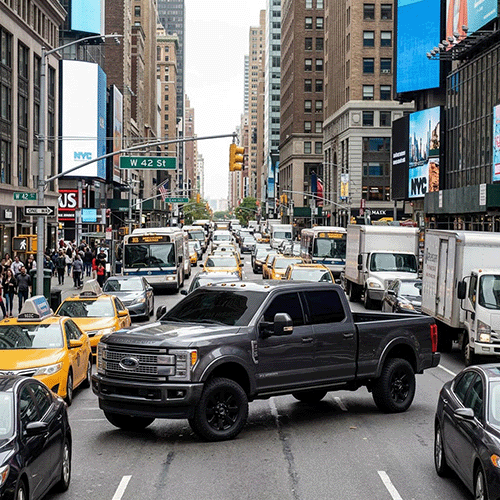 The advertising ran the whole con for us, of course. Every F-150 commercial is shot in red-rock canyon country, the truck cresting a ridge at golden hour, the operator presumably having just hauled something geological. The actual soundtrack of these drives — the Spotify algorithm, a true-crime podcast, the audiobook the owner will abandon at chapter four — never features. Nobody in a Ford commercial is stuck in school-drop-off traffic behind a Subaru with stick-figure decals of a family that definitely composts. Nobody is sitting in a ridiculously oversized F-350 in downtown Dallas openly praying that his cab is going to squeak under the Starbucks overhang.
But that gap between the commercial and the commute is not cognitive dissonance. It's aspiration. And aspiration makes LOTS of money; way more than reality ever does. It's the same reason people buy boats they use twice a year and running shoes for a 5K they haven't signed up for. The truck is a physical monument to a version of yourself that could exist, under the right circumstances, in a different life where you have calloused hands and a woodpile and a working relationship with hardship.
I'd have gone broke if I only sold trucks to people who actually needed them.
Instead, I sold that monument, door handle to tailgate, for twelve years. And I sold it enthusiastically, because I understood that the monument was real even if the frontier wasn't.
The guy with the Patagonia vest and the maximum tint drove that Lariat off the lot on a Tuesday and I never saw him again, which is how it usually goes. But I think about him sometimes when I'm writing. He knew what he was buying. He just couldn't quite say it out loud, which is why the tint mattered so much.
The curtain had to be credible. The show required it.
I sold 3,000 of these trucks. I met zero cowboys. I met a lot of men who needed to feel like they could become one, and I respected that need completely, because the frontier did die, and they didn't get a vote, and sometimes all you can do is get the tint.
Dutch Caulfield is the author of 'Showroom Confessionals' (2022), and a drinking buddy of the publisher. He lives in Texas.