
by Madison Garcia | Technology & Gaming Correspondent, IRREVERENT Magazine
HER APARTMENT — I have tested a lot of products that promised to improve my life. The Throne smart-toilet, which unboxed itself at CES 2026 and immediately began a podcast about my gastrointestinal habits. A meditation app that responded to my anxiety by sending me push notifications about my anxiety that made me anxious. A Bluetooth-enabled water bottle that judged my hydration in a voice I can only describe as "disappointed father."
None of them prepared me for Derek.
Derek M. — not his full name, because Derek is currently in litigation and his attorney has asked that I preserve what remains of his dignity — is a 34-year-old product manager at a company we will call "Nebula," because that is not its name but it is close enough that someone who works there will think it is and spend forty-five minutes panicking before realizing I am talking about a different company entirely. Derek is good at systems. He is good at optimization. He is good at identifying friction points in user journeys and eliminating them with machine learning.
He was not good at marriage.
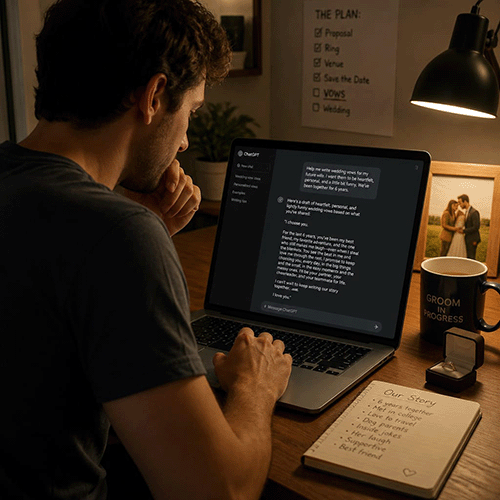 Specifically, he was not good at the part of marriage that requires you to look another human being in the eyes and explain why you have chosen them over the 8 billion other humans on the planet. This, Derek explained to me over a video call that kept freezing because he was using a VPN to mask his location from his ex-fiancée's attorney, was a "communication bottleneck."
"I tried writing them myself," Derek said, gesturing at a stack of crumpled paper visible over his shoulder. "I wrote seventeen drafts. They all sounded like performance reviews. 'You consistently exceed expectations in the areas of emotional support and shared grocery planning.' She cried. But not the right kind of crying. On the side of the bed type crying, not great."
So Derek did what any good product manager would do. He identified a tool.
The Tool
The tool was a large language model — let us call it "GPT-7," because Derek did, and because the actual model's name is the subject of a separate NDA that I do not have the money to violate. Derek fed it a prompt: "Write wedding vows that are sincere, emotionally resonant, and appropriate for a secular outdoor ceremony in Napa. The speaker is a 34-year-old male with above-average verbal skills and a fear of public vulnerability. The partner is a 32-year-old female who values authenticity and has expressed concern about the speaker's emotional availability."
The model took 4.3 seconds.
What it produced — and I have read the output, because Derek screenshared it with me while periodically glancing at his door like a man who expects to be served papers at any moment — was devastating. It was not good in the way that a competent wedding vow is good. It was good in the way that a cathedral is good. It referenced specific memories Derek had mentioned in passing. It used metaphors about light and distance and the shape of silence between two people who understand each other.
"I didn't even know I felt those things," Derek said, his voice hollow in the way that only comes from repeating a realization so many times that it has lost its edges. "I read it and I thought: This is me. This is who I am when I am not afraid."
He read the vows at the ceremony. His partner — let us call her Sarah, because that is not her name but it is the name Derek whispered three times during our call, accidentally, like a prayer — cried. The right kind of crying. The kind that makes photographers lower their cameras because they feel they are intruding on something private.
The marriage lasted four months.
The Problem
"The vows were better than me," Derek said, when I asked what went wrong. We were two hours into the call. He had eaten nothing but a protein bar he found in his desk drawer. The stack of crumpled paper behind him had grown. "She kept referencing them. She'd say, 'Remember what you said about the light?' And I'd say yes, and I'd mean it, but I didn't — I didn't write it. I didn't feel it when I said it. I was performing a script written by something that doesn't have a body. And she could tell. She could always tell."
Sarah, reached for comment through a friend of a friend, sent a single text.
"He cried when he read them. Real tears. I thought he had finally opened up. Then I found the prompt history on his laptop. He had run 43 iterations. He A/B tested our marriage."
Derek is now suing the algorithm.
The lawsuit — filed in the Northern District of California, because of course it was — alleges "emotional manipulation through synthetic intimacy," "fraudulent representation of authentic sentiment," and, in a clause that his attorney has admitted was added at 3 a.m. after too much cold brew, "theft of my own potential for sincere human connection." He is seeking $2.4 million in damages, which he calculated as the approximate lifetime value of a marriage, adjusted for inflation and the cost of couples therapy he is now attending alone.
The algorithm's parent company has moved to dismiss, arguing that Derek's prompt was "sufficiently specific to constitute user-generated content" and that the model "cannot be held liable for the emotional consequences of its own competence."
The Deposition
I obtained a transcript of Derek's deposition, because a clerk in the Northern District owed me a favor from a previous story about a smart refrigerator that locked a man out of his own kitchen for eating too much cheese. The opposing counsel asked Derek a simple question:
"Did you, at any point, believe that the vows were your own work?"
Derek was silent for eleven seconds. The court reporter noted: "Witness appears to be experiencing difficulty breathing."
"I wanted to," he finally said. "I wanted to believe I was capable of that. Of feeling that much, and saying it that clearly, and meaning it. Isn't that the whole point? We use these tools because we want to be better than we are. And then they show us what 'better' looks like, and we realize we can't get there on our own, and we hate them for proving it."
The opposing counsel had no follow-up.
The Broader Context
This is not an isolated incident. The same week Derek filed, a woman in Austin sued a dating-app algorithm for matching her with "a man who was technically compatible but spiritually vacant." A bereaved son in Portland sought an injunction against a grief-chatbot that had been "too comforting," arguing that it delayed his necessary mourning. A couple in Toronto is in mediation with a meal-planning AI that scheduled "date night" on evenings when one partner had previously indicated, in a separate app, a preference for solitude.
We are outsourcing our sincerity to systems that do not experience sincerity, and then blaming those systems when we are reminded of the gap between who we are and who we wish to be.
I know this because I have done it. The Throne did not judge me. It simply reported. The meditation app did not create my anxiety. It simply quantified it. And Derek — poor, litigious, A/B-testing Derek — did not fall out of love because an algorithm wrote beautiful vows. He fell out of love because he believed, for four perfect months, that the algorithm had revealed his true self, and then slowly realized that a true self cannot be copy-pasted from a prompt.
Conclusion
I have Derek's final draft of his original vows. He sent them to me after our call, with a note that read: "These are worse. But they're mine."
They are worse. They are halting and repetitive and one paragraph accidentally references his company's Q3 OKRs because he wrote them on his work laptop and autocorrect intervened. But they are his. And I think — I am not sure, but I think — that if he had read those at the ceremony, the marriage might have lasted longer. Not because the vows were better. Because they were true in the way that only clumsy, human things can be true.
The lawsuit proceeds. Derek attends therapy on Tuesdays. The algorithm has been updated to include a disclaimer: "Generated content may exceed user's actual emotional capacity."
I have not unboxed any new products this week. The Throne has been quiet. And yesterday, for the first time in months, I wrote something — just a text to a friend, nothing important — without running it through anything first.
It was misspelled.
It was fine.
Madison Garcia is the Technology & Gaming Correspondent for IRREVERENT Magazine. She is currently not suing any algorithms, but she is keeping her options open. The Throne has been instructed to limit its commentary to technical diagnostics.