
OAK BROOK, Ill.—McDonald's Corporation disclosed in a regulatory filing Thursday that its board of directors has approved a $2 trillion performance-based stock award for CEO Chris Kempczinski, contingent upon the achievement of five operational milestones that the company acknowledged "read more like a fever dream than securities law."
The 5-tranche award, disclosed in a Form 8-K filed with the Securities and Exchange Commission, would vest in stages as Kempczinski meets conditions ranging from global consumer saturation to interplanetary real estate development. At full vesting, the package would represent approximately 2 percent of global GDP.
 "This package aligns Mr. Kempczinski's interests with those of shareholders, the global population, and, ultimately, the Martian consumer," said Lloyd Dean, chair of the McDonald's compensation committee. "These goals are ambitious but achievable, provided certain geopolitical and thermodynamic barriers can be addressed."
Condition One requires that every human being on Earth consume at least one McDonald's product per calendar quarter, verified through biometric scanning technology that does not yet exist. The filing notes that infants and the "persistently vegetative" are not exempt, though the company is "exploring blended options" for the latter.
Condition Two mandates permanent McRib availability and that the company's soft-serve ice cream machines achieve 99.97 percent uptime. ("These conditions may be mutually exclusive.")
Condition Three stipulates that at least 400 currently serving McDonald's store managers must be simultaneously elected mayor in U.S. counties with populations exceeding 50,000. Write-in campaigns are acceptable. The filing specifies that the managers must continue their restaurant duties during their terms, "to ensure continuity of service."
Condition Four requires McDonald's to successfully lobby the U.S. Congress and the United Nations General Assembly to abolish Saturday, reducing the global calendar to a six-day cycle. The company has retained the law firm of Sullivan & Cromwell to draft the necessary legislation, which would require a constitutional amendment in the United States and a revision of the ISO 8601 international calendar standard, probably.
Condition Five, the final tranche, requires McDonald's to open a fully operational drive-thru restaurant on Mars before SpaceX establishes its planned human colony, "so as not to compete with Mr. Musk's timeline." The filing specifies that the Martian location would be franchise-operated and would offer the full menu, including seasonal items, though delivery radius limitations "remain under review."
The disclosure comes one week after SpaceX revealed that CEO Elon Musk's compensation package includes a requirement to establish a permanent human colony on Mars with at least one million inhabitants, a condition that SpaceX's own filing admitted "reads more like science fiction than securities law."
Analysts said the McDonald's package represents an escalation in what one observer called "compensation brinkmanship" among large-cap CEOs.
"Musk had set the bar pretty high with the Mars colony thing, but Kempczinski just vault-cleaned it," said a compensation consultant with Meridian, speaking on condition of anonymity because the firm advises both companies. "A million people living on Mars is one thing. Getting the ice cream machine to work is another."
McDonald's shares rose 2.3 percent in after-hours trading. The company said it would provide additional details during its next earnings call, including projected capital expenditures for the Martian location and the estimated lobbying budget for the Saturday abolition initiative.
The filing also disclosed that Berkshire Hathaway is preparing a similar performance-based package for Chairman Warren Buffett, which would require him to personally outlive every current S&P 500 CEO and to bring the late Vice Chairman Charlie Munger "back, in some form." A Berkshire spokesperson declined to comment. Mr. Munger remained unavailable.
McDonald's said it expects the first tranche to vest by 2028, pending resolution of several outstanding class-action lawsuits filed by the International Date Line and the National Frozen Dairy Association.
—IRREVERENT Wire, General Desk
IRREVERENT Magazine is a satirical publication and this is fiction. You did wonder though, didn't you?
WASHINGTON — Jack Thugge, head of the United States Government Anti-Corruption Office (GACO), was indicted today on 19 counts of corruption, including bribery, extortion, wire fraud, honest services fraud, mail fraud, and eight counts of violating his own job description.
The indictment comes just six weeks after Thugge's deputy, Morton P. Fleeke, was himself charged with operating a pay-for-protection scheme from his GACO office, allegedly accepting envelopes of cash in exchange for reclassifying "criminal corruption" as "policy disagreement."
The 147-page indictment — longer than most novels anyone actually finishes — alleges Thugge used his position to:
- Solicit and receive $2.3 million in "consulting fees" from contractors seeking GACO certification as "Officially Not Corrupt," a designation that works exactly like a "World's Best Dad" mug, except it lets you skip federal contracting rules.
- Direct subordinates to falsify audit reports on three Cabinet agencies, replacing findings of "rampant systemic embezzlement" with "creative accounting" after receiving golf trips, steakhouse loyalty points, and — the indictment notes with what reads like genuine confusion — one live horse.
- Operate a side business selling "pre-approval" letters guaranteeing that GACO would not investigate recipients for a flat fee of $50,000, or $75,000 if they wanted the deluxe package that included a framed photo of Thugge shaking hands with a cardboard cutout of himself, which is either narcissism or the world's saddest magic trick.
- Establish a "Corruption Tipline" that forwarded all tips directly to Thugge's personal Gmail, which auto-responded with a PayPal invoice for "processing fees" of $19.95.
- Award no-bid contracts to shell companies registered to his cat, Mr. Whiskers, including a $4.7 million contract for "strategic rodent deterrence services" at the Pentagon. Mr. Whiskers could not be reached for comment, presumably because he was licking his own ass, which still qualifies as more due diligence than GACO performed on the contract.
Thugge was taken into custody at his Bethesda home at approximately 6:30 a.m. Wednesday. Witnesses reported that agents found him in his kitchen, wearing a bathrobe monogrammed "ETHICS CZAR," attempting to stuff what appeared to be a ledger down a garbage disposal. The disposal subsequently jammed.
 He was transported to federal court for arraignment, where prosecutors requested he be held without bail, citing flight risk and the fact that his passport listed his occupation as "definitely not a criminal." The State Department, reached for comment, said the entry was "unusual but not, by itself, disqualifying."
Then, at 2:47 p.m., Thugge's attorney produced a document from his briefcase.
It was, the attorney explained, a "Trump Golden Ticket."
The ticket — gold-embossed, watermarked with an image of Mar-a-Lago, and bearing the words "GOOD FOR ONE (1) PARDON OF ANY CRIME, REAL OR IMAGINED, COMMITTED ANYWHERE WE SAY" — was issued, according to the attorney, during a 2025 fundraiser where attendees who donated $500,000 or more received "total immunity from the law, forever, no take-backs."
Legal scholars immediately noted that no such instrument exists in statutory or constitutional law. The Justice Department issued a statement calling the ticket "transparently invalid." Three federal judges, reached for comment, used the word "ludicrous."
Nevertheless, after a 12-minute sidebar, prosecutors accepted the ticket.
Thugge was released. The ticket was logged into evidence as "Exhibit G" and, per standard procedure, added to the government's growing collection of Trump Golden Tickets, which now numbers 347 and is stored in a climate-controlled vault at the National Archives, next to the original Constitution.
Thugge, speaking to reporters outside the courthouse, maintained his innocence.
"I have done nothing wrong," he said, holding up a second Golden Ticket. "And even if I did, which I didn't, this says I didn't. Checkmate, law."
He then entered a waiting limousine, license plate "GACO-1." The cardboard cutout was in the back seat. It was buckled in.
IRREVERENT Magazine is a satirical publication and this is fiction. There is no GACO, and, try as we did, we couldn't find a convincing and funny department name that abbreviated GEKO. Sad you had to read this to be sure isn't it?
Fifty rogue sheep entered a Penny supermarket in Burgsinn, Germany, leaving broken bottles, droppings, and a community reckoning with the limits of retail security.
BURGSINN, Germany — Fifty sheep entered a Penny supermarket on a Tuesday, apparently without coupons.
The animals, part of a 500-head herd being moved along a local road in the Spessart region of Bavaria, broke from the group and made directly for the store's entrance shortly before noon. Witnesses described the breach as swift, purposeful, and entirely unannounced. By the time staff could respond, the sheep had fanned out across multiple aisles, establishing what one municipal official later characterized as “an unauthorized zone of commerce.”
Shoppers and employees climbed onto checkout conveyor belts, the store's only elevated surface and, for approximately twenty-two minutes, the closest thing Bavaria had to high ground.
“I was buying yogurt,” said Helga Brandt, 61, a retired schoolteacher who spent the incident balanced above register four with a six-pack of peach Quark balanced in her arms. “I do not feel that this is what the conveyor belt was designed for. I feel that I was let down by the system.”
She declined to specify which system.
A Regulatory Flight, Some Say
Agricultural observers were quick to connect the breakaway to broader pressures facing European livestock producers. The European Union's latest round of farming directives — covering herd density thresholds, pasture rotation schedules, and mandatory biometric ear-tagging for animals crossing regional transport corridors — has left many herders in rural Bavaria navigating paperwork loads previously reserved for mid-sized pharmaceutical companies.
“These animals are under enormous regulatory stress,” said Dr. Petra Hoeflinger, a livestock welfare researcher at the University of Würzburg who was not present at the incident but was nonetheless available by phone within minutes. “When you subject a sheep to fourteen overlapping compliance frameworks and then route it through a commercial district, you cannot be entirely surprised when some go walkabout.”
EU Commission spokesperson Michel Renard, reached for comment from Brussels, said the Commission “takes ovine welfare seriously” and noted that the relevant directive had been amended twice since its initial passage. He added that any sheep wishing to register a formal grievance could do so through the standard agricultural ombudsman portal, which is available in twenty-four languages, none of them Sheep.
The 450 Who Stayed Outside
Of the original 500-head herd, 450 animals remained on the road and did not enter the store.
A spokesperson for the 450, identified in press materials only as “Joachim,” issued a brief statement through the herd's handler: “We respect the rule of law. We were given a route. We followed the route.”
Joachim was unavailable for follow-up questions, as he had moved on to a field approximately two kilometers east of Burgsinn by the time journalists arrived.
The 50 who entered the store have not commented publicly. Several were seen near the dairy case.
Broken Bottles, Open Questions
When the sheep departed — voluntarily, after herd handlers were summoned — they left behind a scene that the store manager, Dieter Wenzel, described as “a real mess that could've been worse,” a characterization that appeared to give him some comfort.
Two bottles of olive oil were broken. A display of seasonal jam was disturbed. Droppings were found in four aisles, including the organic section, which one shopper noted was “at least thematically appropriate.”
Cleanup required approximately three hours. The store reopened at 3:15 p.m.
“We have protocols for many situations,” Wenzel said, standing in front of the restored jam display. “We did not have a protocol for this specific situation. We will now have a protocol for this specific situation.”
Legal Status Remains Unclear
Local authorities confirmed they are reviewing whether the sheep's presence in the store constitutes criminal trespass, civil trespass, or a form of aggressive loitering under Bavarian municipal code. The distinction matters: trespass carries potential liability for the herd's owner, while loitering charges have never, in the recorded history of Burgsinn, been applied to ruminants.
“The law is written for persons,” said Magistrate Tobias Feld, who has been assigned to the preliminary review. “The sheep are not persons. This creates what I would call a definitional gap.”
Feld confirmed he has requested clarification from the state government in Munich. He expects a response within six to eight weeks, which is approximately how long it takes a sheep to forget the incident entirely.
Penny's corporate communications office confirmed that the Burgsinn store's loyalty card program, which offers points on qualifying purchases, does not currently extend membership to ovine customers. The company said it had no plans to change this policy but acknowledged the situation had “highlighted certain gaps in our terms of service.”
Shoppers Reflect
As of press time, three shoppers who sheltered on the conveyor belts said they felt the experience had changed them, though none could say precisely how.
“I used to feel safe in a supermarket,” said Klaus Morgenthaler, 44, a logistics coordinator who had been purchasing sparkling water at the time of the incursion. “That feeling was perhaps naïve. I understand that now.”
He has since switched to home delivery.
IRREVERENT Magazine is a satirical publication. Quotes from fictional spokespeople, unnamed officials, and livestock representatives are invented for satirical effect. The sheep incident itself occurred. All quotes from the sheep are not real, as sheep do not speak. This should not require a disclaimer.
WASHINGTON — The FBI's Protective Operations Division has implemented a comprehensive, multi-tiered "executive continuity" protocol for waking up senior leadership, according to an internal memorandum reviewed by IRREVERENT, representing what officials describe as a routine update to longstanding procedural frameworks that absolutely has nothing to do with anything in particular, why do you ask.
The protocol, designated Protective Operations Directive 1142-B and dated March of this year, establishes a sequential four-stage system for confirming "Director responsiveness" during off-hours residence visits and travel security postures. Officials stress the system is standardized, proactive, and not — they want to be clear — reactive.
"These protocols are standard for any senior official at this level of protection," said Special Agent in Charge Denton Marsh, the Bureau's Acting Spokesman for Executive Security Matters, in a statement provided to IRREVERENT. "The implementation of tiered contact methodology reflects our commitment to operational excellence and in no way represents a response to specific incidents, events, circumstances, or reporting by any magazine, publication, or media entity, named or unnamed."
He added: "We do not comment on specific incidents."
THE FRAMEWORK
Per Directive 1142-B, field agents assigned to executive protection are now required to complete a 12-hour certification course titled "Executive Presence Verification: A Practical Curriculum," offered through the Quantico training annex beginning Q2 of this fiscal year.
The directive outlines the following engagement tiers:
Tier 1 — Air Horn (Standard Contact). Upon failure of telephonic or knock-based contact after three attempts, agents are authorized to deploy a single 110-decibel auditory stimulus from the doorway threshold, or as close to the doorway threshold as they can get before their ears start bleeding. Agents must log the deployment in the nightly activity report under the heading "Non-Standard Auditory Engagement" and note the time, duration, and outcome.
Tier 2 — Light Jazz (Ambient Recalibration). Should Tier 1 produce insufficient response, agents are directed to initiate a curated Spotify playlist — Bureau-licensed, catalog code FBI-EXEC-003, featuring artists including Dave Brubeck and a 1973 Herbie Hancock instrumental — via portable Bluetooth speaker positioned no closer than four feet from the principal's location. Duration: up to 12 minutes at moderate volume. "The data on ambient auditory re-engagement is actually quite strong," said one official familiar with the protocols, who requested anonymity to discuss internal training materials. "We went back and forth on bossa nova, but ultimately the Subcommittee felt jazz projected the appropriate level of institutional seriousness." He paused. "Also, 'The Girl From Ipanema' tested poorly with the 6 a.m. focus group."
Tier 3 — Cold Compress Application. Tier 3 authorizes physical engagement in the form of a damp cloth, chilled to between 55 and 60 degrees Fahrenheit, applied to the forehead, wrist, or back of neck at agent discretion. Agents must complete a Form 302-E ("Principal Contact: Physical, Non-Adversarial") within two hours of deployment. The compress, Directive 1142-B specifies, must be sourced from federally procured materials and may not exceed 8 by 12 inches. Agents are explicitly prohibited from using their own washcloths, "for liability reasons."
Tier 4 — The Comey Method. Details redacted. Requires Deputy Director sign-off. When asked for comment, the Deputy Director's office said they would "need to check the schedule."
PROCUREMENT AND INTERAGENCY COORDINATION
The air horn units — 14 in total, distributed across field offices and travel security kits — were procured through General Services Administration contract HSSS01-26-C-0042 at a total cost of $3,780, or roughly $270 per horn, which is either a steal or a profound waste of taxpayer money depending on how many times they've been used.
The jazz playlist required separate interagency coordination with the Office of Personnel Management to confirm streaming-service licensing fell within federal entertainment expenditure guidelines. It did, narrowly, after a tense 45-minute meeting about whether "Take Five" counts as entertainment or "tactical audio support."
"There was a longer conversation than anyone expected about the Herbie Hancock," the official familiar with the protocols acknowledged.
Training certifications are expected to be completed Bureau-wide by the end of Q3, with refresher modules scheduled annually. The cold compress portion of the curriculum includes a practical assessment.
BACKGROUND
The procedural update follows months of sustained scrutiny of FBI Director Kash Patel, whom The Atlantic reported in April 2026 had faced concerns from more than two dozen current and former Bureau officials regarding unexplained absences and what sources described as erratic availability — allegations The Atlantic said included Director Patel's security detail encountering difficulty rousing him on multiple occasions.
At a Senate Appropriations Committee hearing on May 12, 2026, Director Patel denied the allegations directly and at length. "Unequivocally, categorically false," he told the Committee. He also challenged a senator to take an alcohol screening test alongside him.
The Atlantic has stood by its reporting. Patel has filed a $250 million defamation suit against the publication.
Directive 1142-B does not mention The Atlantic, any Senate hearing, Director Patel, or any prior difficulties of any kind. It mentions Herbie Hancock twice.
Spokesman Marsh declined to address whether the Director has been briefed on the new protocols. He said the Director is "fully engaged, fully available, and fully appreciative of institutional process improvements across all operational verticals."
He did not respond to a follow-up question about bossa nova.
—IRREVERENT Wire, General Desk
WASHINGTON, D.C. — The Smithsonian Institution confirmed Thursday that the National Register of Historic Places has been updated to reflect current construction realities at 1600 Pennsylvania Avenue, reclassifying the White House as a "smaller historic outbuilding on the property, formerly used for governance," subordinate to the primary structure now listed as "the Bunker."
The change, described by a Smithsonian spokeswoman as "merely descriptive," follows the October 2025 demolition of the East Wing and the commencement of a $400 million aboveground structure — itself described by President Trump as "actually a shed" for the real project happening beneath it. The real project, according to multiple reports, is a vast underground military complex featuring bomb shelters, a hospital, biodefense systems, bulletproof windows, drone-proof roofing, and secure air handling — the kind of amenities that, historically speaking, have preceded a certain category of executive decisions.
"The Register reflects what exists," said the spokeswoman. "The primary structure is the Bunker. The residence is adjacent. We updated accordingly."
The White House declined to comment, noting that official White House communications would continue to originate from the residence, "at least for now."
A DISTINGUISHED TRADITION
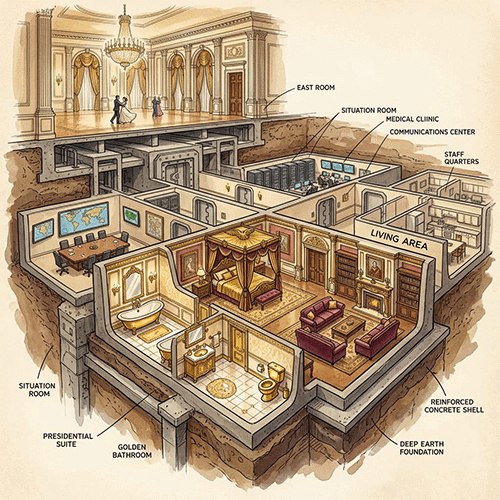 Historians reached for comment were careful to note that the Bunker places the current administration in exceptional company — a club whose membership criteria are, if nothing else, consistent.
Adolf Hitler's Führerbunker, completed beneath the Old Reich Chancellery in 1944, was an 8.5-meter-deep complex of 30 rooms featuring 13-foot reinforced concrete ceilings, gas-tight blast doors, a diesel generator, and personal quarters for Hitler and Eva Braun. Hitler moved in permanently in January 1945, spending his final 105 days underground as the Red Army closed in. Historians generally regard the Führerbunker as an architectural expression of the gap between the world a leader imagines and the world that actually exists. The structure was demolished in 1989. A parking lot now marks the site. A small informational plaque notes that something happened there.
Joseph Stalin's contribution to the genre was Metro-2, an unacknowledged deep-underground metro network beneath Moscow, running 50 to 200 meters below the official subway system. Codenamed D-6 by the KGB, Metro-2 connected the Kremlin to FSB headquarters, a government airport, and a subterranean town at Ramenki estimated to hold 10,000 people. The Russian government neither confirms nor denies its existence, which is itself a form of confirmation. Stalin reportedly favored underground infrastructure as a management philosophy, believing that things located beneath the earth were harder to seize in a coup. This belief was well-founded.
Saddam Hussein's presidential bunker beneath Baghdad's palace complex — built in the early 1980s by a German construction consortium at a cost of $60 to $70 million — was engineered to survive a nuclear detonation at 650 feet and temperatures exceeding 570 degrees Fahrenheit. Its amenities included chandeliers, a private mosque, a war room with seat-belt-equipped chairs, and German-designed air-filtration systems. UN inspectors who toured portions of the facility in 1998 noted that the concrete walls had been mounted on springs to absorb shock. Saddam was later found hiding in a hole in the ground near Tikrit. The bunker was not used for its intended purpose.
Kim Jong-il presided over the construction of an estimated 8,200 underground facilities across North Korea, including 180 munitions factories and a nuclear-hardened wartime command headquarters — completed in 1983, reinforced concrete and lead-lined, designed to house the Supreme Command during what North Korean planning documents referred to as "the inevitable conflict." His personal residences were similarly equipped, each featuring underground passages and wartime contingencies. Kim Jong-il died of a heart attack aboard a private train in 2011. None of the bunkers were used.
WHAT HISTORIANS CALL 'THE PATTERN'
Scholars of executive psychology — a field that has experienced robust enrollment growth since 2017 — note a recurring feature in bunker-building regimes: the bunker is never described as a bunker.
Hitler's complex was officially a "command center." Stalin's Metro-2 was an "emergency transportation corridor." Saddam's palace basement was a "security facility." Kim Jong-il's fortifications were "national defense infrastructure." The Trump administration's project has been described as a ballroom, an East Wing renovation, a "massive complex" for the military, and a "heavily fortified" presidential facility depending on the week and the congressional appropriation under consideration.
"The bunker is always called something else," said one historian, who asked not to be named because he teaches at a public university. "The naming is part of it. You don't build a bunker because you feel secure."
Congressional Republicans have proposed $1 billion in federal funding to cover what they term "security adjustments and upgrades." Democrats have termed this "paying for the bunker." The distinction, as of press time, remains contested.
SMITHSONIAN UPDATE DRAWS SCRUTINY
The Smithsonian's reclassification has attracted mixed reactions. Architecture preservationists expressed concern about the precedent of listing a structure as secondary before construction is complete. Several noted that the original White House — built in 1792, burned by the British in 1814, rebuilt by 1817 — had survived two centuries without being subordinated to its own basement.
"There's something philosophically clarifying about the moment when the aboveground building becomes the shed," said one preservation architect who reviewed the Register update. "Usually that happens after the fact. This is happening in real time."
The Smithsonian spokeswoman noted that the National Register is updated regularly to reflect changing historical significance.
"In this case," she said, "the significance shifted underground."
The White House is expected to remain operational throughout construction. The Bunker is expected to be operational considerably longer.
- Supreme Court Rules Politicians May Choose Voters, But Voters May Still Choose Hobbies
- Defense Team Clarifies: Man Who Threw Rocks at Protected Seal Had "Personal," Not Ideological, Motives
- Cruise Line Defends Hantavirus as "Complimentary Upgrade," Cites Strong Reviews from Surviving Passengers
- Strait of Hormuz Closure Enters Day 12; Americans Report Strong Feelings About Gas Prices, Vague Feelings About Where Hormuz Is