
WASHINGTON, D.C. — The Smithsonian Institution confirmed Thursday that the National Register of Historic Places has been updated to reflect current construction realities at 1600 Pennsylvania Avenue, reclassifying the White House as a "smaller historic outbuilding on the property, formerly used for governance," subordinate to the primary structure now listed as "the Bunker."
The change, described by a Smithsonian spokeswoman as "merely descriptive," follows the October 2025 demolition of the East Wing and the commencement of a $400 million aboveground structure — itself described by President Trump as "actually a shed" for the real project happening beneath it. The real project, according to multiple reports, is a vast underground military complex featuring bomb shelters, a hospital, biodefense systems, bulletproof windows, drone-proof roofing, and secure air handling — the kind of amenities that, historically speaking, have preceded a certain category of executive decisions.
"The Register reflects what exists," said the spokeswoman. "The primary structure is the Bunker. The residence is adjacent. We updated accordingly."
The White House declined to comment, noting that official White House communications would continue to originate from the residence, "at least for now."
A DISTINGUISHED TRADITION
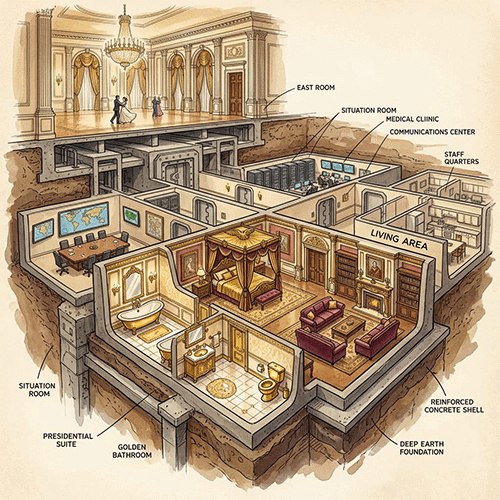 Historians reached for comment were careful to note that the Bunker places the current administration in exceptional company — a club whose membership criteria are, if nothing else, consistent.
Adolf Hitler's Führerbunker, completed beneath the Old Reich Chancellery in 1944, was an 8.5-meter-deep complex of 30 rooms featuring 13-foot reinforced concrete ceilings, gas-tight blast doors, a diesel generator, and personal quarters for Hitler and Eva Braun. Hitler moved in permanently in January 1945, spending his final 105 days underground as the Red Army closed in. Historians generally regard the Führerbunker as an architectural expression of the gap between the world a leader imagines and the world that actually exists. The structure was demolished in 1989. A parking lot now marks the site. A small informational plaque notes that something happened there.
Joseph Stalin's contribution to the genre was Metro-2, an unacknowledged deep-underground metro network beneath Moscow, running 50 to 200 meters below the official subway system. Codenamed D-6 by the KGB, Metro-2 connected the Kremlin to FSB headquarters, a government airport, and a subterranean town at Ramenki estimated to hold 10,000 people. The Russian government neither confirms nor denies its existence, which is itself a form of confirmation. Stalin reportedly favored underground infrastructure as a management philosophy, believing that things located beneath the earth were harder to seize in a coup. This belief was well-founded.
Saddam Hussein's presidential bunker beneath Baghdad's palace complex — built in the early 1980s by a German construction consortium at a cost of $60 to $70 million — was engineered to survive a nuclear detonation at 650 feet and temperatures exceeding 570 degrees Fahrenheit. Its amenities included chandeliers, a private mosque, a war room with seat-belt-equipped chairs, and German-designed air-filtration systems. UN inspectors who toured portions of the facility in 1998 noted that the concrete walls had been mounted on springs to absorb shock. Saddam was later found hiding in a hole in the ground near Tikrit. The bunker was not used for its intended purpose.
Kim Jong-il presided over the construction of an estimated 8,200 underground facilities across North Korea, including 180 munitions factories and a nuclear-hardened wartime command headquarters — completed in 1983, reinforced concrete and lead-lined, designed to house the Supreme Command during what North Korean planning documents referred to as "the inevitable conflict." His personal residences were similarly equipped, each featuring underground passages and wartime contingencies. Kim Jong-il died of a heart attack aboard a private train in 2011. None of the bunkers were used.
WHAT HISTORIANS CALL 'THE PATTERN'
Scholars of executive psychology — a field that has experienced robust enrollment growth since 2017 — note a recurring feature in bunker-building regimes: the bunker is never described as a bunker.
Hitler's complex was officially a "command center." Stalin's Metro-2 was an "emergency transportation corridor." Saddam's palace basement was a "security facility." Kim Jong-il's fortifications were "national defense infrastructure." The Trump administration's project has been described as a ballroom, an East Wing renovation, a "massive complex" for the military, and a "heavily fortified" presidential facility depending on the week and the congressional appropriation under consideration.
"The bunker is always called something else," said one historian, who asked not to be named because he teaches at a public university. "The naming is part of it. You don't build a bunker because you feel secure."
Congressional Republicans have proposed $1 billion in federal funding to cover what they term "security adjustments and upgrades." Democrats have termed this "paying for the bunker." The distinction, as of press time, remains contested.
SMITHSONIAN UPDATE DRAWS SCRUTINY
The Smithsonian's reclassification has attracted mixed reactions. Architecture preservationists expressed concern about the precedent of listing a structure as secondary before construction is complete. Several noted that the original White House — built in 1792, burned by the British in 1814, rebuilt by 1817 — had survived two centuries without being subordinated to its own basement.
"There's something philosophically clarifying about the moment when the aboveground building becomes the shed," said one preservation architect who reviewed the Register update. "Usually that happens after the fact. This is happening in real time."
The Smithsonian spokeswoman noted that the National Register is updated regularly to reflect changing historical significance.
"In this case," she said, "the significance shifted underground."
The White House is expected to remain operational throughout construction. The Bunker is expected to be operational considerably longer.