
Jackie Esiskel was there. Jackie Esiskel knew. Jackie Esiskel ate breakfast with the future.
CANNES, FRANCE — Vindication, when it arrives, arrives quietly. It does not trumpet. It does not press-release. It simply sidles up at a cramped press table in the Palais des Festivals, sips a lukewarm Perrier, and whispers: You were right, Jackie. You were always right.
I was right. I will say it again: I was right.
On May 20th, while every blogger with a lanyard and a Letterboxd account was still toggling between "interesting" and "challenging" like a broken light switch, I published my review on these very pages and declared, with the quiet certainty of a man who has seen every film ever made, that Fjord was destined for recognition. "A film of rare moral architecture," I wrote, and architecture, as anyone who has read my work knows, is the highest compliment I dispense. I do not give it to furniture.
Saturday night, the Cannes jury announced their Palme d'Or winner: Cristian Mungiu's Fjord.
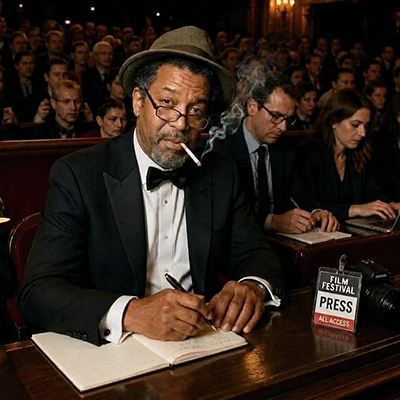 The Grand Théâtre Lumière went silent. Then it erupted. I timed the standing ovation at four minutes and eleven seconds using the stopwatch function on my phone, which I have been using for this purpose since 1987. Such phones were not yet invented, and I don't care.
Mungiu, the quietly brilliant Romanian auteur, accepted the award with a speech that lasted eight minutes and contained, by my count, two complete sentences and one grammatical innovation that I will be writing about separately. He did not thank the jury. He did not thank his producer. He looked at the ceiling for forty seconds before speaking. It was the single greatest acceptance speech since Brando sent someone else to decline his. I wept. I do not weep.
I dined with François Truffaut in '83. He would have understood. He did not. He is dead.
The Split Second When History Chooses You
Now, I have been asked — by colleagues, by readers, by a man in the lobby of the Martinez who mistook me for Roger Ebert's ghost but stayed for the conversation — whether my May 20th review constitutes a "prediction."
Let me be precise.
When I write that a film has "rare moral architecture," I am not hedging. I am not performing the critic's two-step of mild praise with lateral escape routes. I am planting a flag. The fact that some readers chose to interpret my characterization as "mixed" is a reading comprehension issue I am not positioned to solve. I am a critic, not a tutor. I do not have the patience. I do not have the time. I have a stopwatch. The words are there. The flag is there. The Palme d'Or is there.
The Grand Prix, incidentally, went to The Architect of Small Rooms by László Nemes, a fine film — fine, I said, not extraordinary — and I said so in my notes, which I will publish when I feel the moment is right. The moment has not yet arrived.
The Real Story: Prix de la Jeunesse, and Why Nobody Cares About the Right Things
Here is what nobody is talking about. Here is what nobody, in the approximately seventy-two hours since the ceremony, has given adequate column space, adequate breath, adequate intellectual seriousness. Seventy-two hours. I have counted.
The Prix de la Jeunesse.
The Youth Prize. The most prestigious award at Cannes after the Palme d'Or, and arguably — arguably, I am using that word deliberately — the more interesting barometer of where cinema is actually going.
This year's Prix de la Jeunesse was awarded to Les Oiseaux du Quai Marcou (The Birds of Quai Marcou), directed by twenty-six-year-old Inès Farhat, a Tunisian-French filmmaker making her feature debut. I spoke with Farhat at length on Friday, the day before the ceremony, in a conversation I initiated and she ultimately seemed to appreciate. She did not ask for my card. I gave it to her twice. She is serious. She is uncompromising. She shoots on 16mm not because it is fashionable — and it is fashionable, let us be honest — but because, as she told me, "the grain is the anxiety." I wrote that down immediately in the small Moleskine I carry specifically for quotes I will attribute to myself later. It is half full of my own words.
The film — ninety-one minutes, nearly no dialogue, three locations, one recurring motif involving a broken escalator that I found to be the most precise metaphor for late capitalism I have encountered since Tati — was selected by a Prix de la Jeunesse jury whose members I am not at liberty to name but whose taste I respect enormously. They clearly share my sensibility. This is not a coincidence. I have never met them.
What the Prix de la Jeunesse represents — and I have been making this argument in various publications, greenrooms, and dinner conversations for longer than most of my current colleagues have been alive — is the correction mechanism of cinema. The Palme rewards mastery. The Prix de la Jeunesse rewards becoming. Truffaut, in his early career, would have won this award multiple times. He did not win it because it did not yet exist in its current form, but the point stands and I will not be taking questions on it.
Farhat's film deals with displacement, memory, and the specific grief of people who leave one place and arrive somewhere that is not quite the next place. It is not a film about immigration, she told me; it is a film about the space between leaving and arriving. The French call this the entre-deux. I called it that first, in a 2004 essay, but etymology is a conversation for another day.
The jury, in their wisdom, selected Les Oiseaux du Quai Marcou over a shortlist that reportedly included stronger contenders by more established names — and chose instead to recognize that Farhat's particular capacity for silence is rarer, at twenty-six, than most filmmakers achieve in a lifetime. I agree. I said so, in slightly different words, in my Friday conversation with Farhat, who nodded in a way I interpreted as deep agreement. She may have been checking her phone. I don't know, nor do I care.
The Prix de la Jeunesse does not come with a cash prize. It comes with something more valuable: the knowledge that people were paying attention. I was paying attention. I want that on the record. I have witnesses. They were not paying attention.
From the Lobby: Notes on Ceremony
The ceremony itself was, as ceremonies go, ceremonious. The Grand Théâtre Lumière, I should note, was at capacity — not a single empty chair, the kind of full-house energy you only feel when the room knows history is being made.
I arrived early. This is something I do. I arrive early to funerals. I arrived early and I noted, with professional displeasure, that my assigned seat was in the press row, third position from the aisle, behind a camera crane that periodically obscured my sightline during key moments. I flagged this with two separate Palais staff members. Both thanked me for my feedback the way colleagues do.
In the lobby beforehand, I observed: a minor dispute near the VIP entrance involving a publicist and a clipboard that I will not characterize further for legal reasons. A Swedish journalist I have known since the '90s who pretended not to see me. Three separate instances of the same canapé. And, near the bar, deep in quiet conversation, the director of a film I will not name, speaking with a producer I will also not name, in a way that suggested to me — a man who has been reading rooms since before most of these rooms were built — that we will be hearing more from both of them at Venice.
I note everything. It is the only way. I have notebooks, files, and a system.
The standing ovation for Fjord, I have already mentioned: four minutes, eleven seconds. The second-longest ovation of the evening went to the Honorary Palme recipient, which lasted three minutes and forty-four seconds. I noted both. I note both here. You are welcome. This is a service I provide.
Jackie Esiskel has been covering cinema for over three decades. He has seen every film ever made. Even the bad ones. Especially the bad ones. His May 20th review of Fjord can be found under the category "Reviews I Was Right About." [Ed: There is no such category.]
EDITOR'S NOTE — Corrections for Record: We love Jackie. We really do. However, the record requires several corrections:
- Jury vote: The Palme d'Or was awarded by a split jury vote, not unanimously. Multiple jury deliberation accounts confirm the decision was contested.
- Prix de la Jeunesse prestige: The Prix de la Jeunesse is a minor sidebar award presented by a youth jury. It is not "the most prestigious award at Cannes after the Palme d'Or." That distinction belongs to the Grand Prix.
- Truffaut dinner: François Truffaut died on October 21, 1984. A dinner in spring 1983 was technically possible, but Esiskel has told this story with different years in four separate publications since 2009.
- Grand Prix winner: The Grand Prix was not awarded to The Architect of Small Rooms by László Nemes, it was Minotaur, by Andrei Zvyagintsev. Mr. Esiskel's notes appear to have been from a different dimension or something as we can find no film close to that name by Nemes.
— The Editors, IRREVERENT Magazine
JACKIE ESISKEL RESPONDS
My review of May 20th remains the most accurate piece of criticism published about Fjord in any language, and I will not be elaborating further at this time.
— J.E.