
I am going to be honest with you — a thing I rarely do, and never for free — and tell you that I have been awake for approximately thirty-one hours. I came to this screening directly from a press breakfast at which the coffee was lukewarm and the croissants were, I can only assume, assembled by someone who had once seen the word "croissant" and guessed. The woman waiting on the table had the energy one usually associates with someone extremely pleased with their gut health in a commercial. I am wearing the same linen blazer I wore on the flight from Cannes. It is, I am told by a colleague who no longer speaks to me, "visibly suffering." The blazer and I are of one mind.
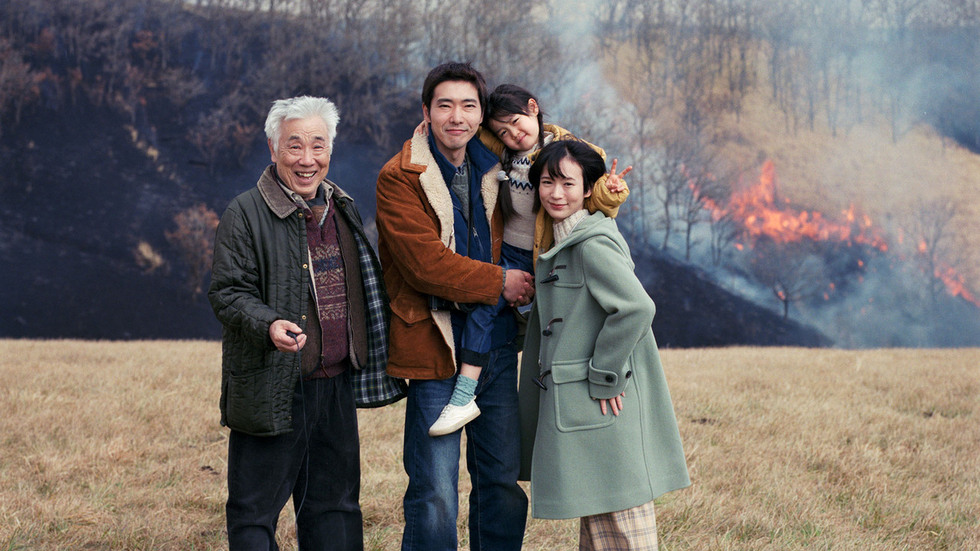 I mention all of this because I want you to understand the conditions under which I saw Memorizu, the debut feature from director Kenji Ogawa, and emerged from that screening room a changed man. Not a better man, necessarily. Not a rested man. Not, if I am being clinical about it, a fully intact man. But changed.
Before I proceed, I must address, with the weary equanimity of a man who has been publicly executed more than once by people with spell-checkers and axes to grind, the matter of the Editor's Note appended to my previous piece in these pages — the Fjord review. The editor, a person I will describe only as "detail-oriented to the point of spiritual emptiness," saw fit to append four paragraphs of "corrections" to a work of unambiguous critical genius. I was informed, in large italic type visible from space, that I had "misidentified the lead actress," "attributed the film to the wrong country of origin," and — and I am quoting verbatim here — "spelled 'cinematography' as 'sinematogrofee' three times."
To this I say: the reader who comes to IRREVERENT for orthography is reading the wrong magazine. Move on. I have.
Now. Memorizu.
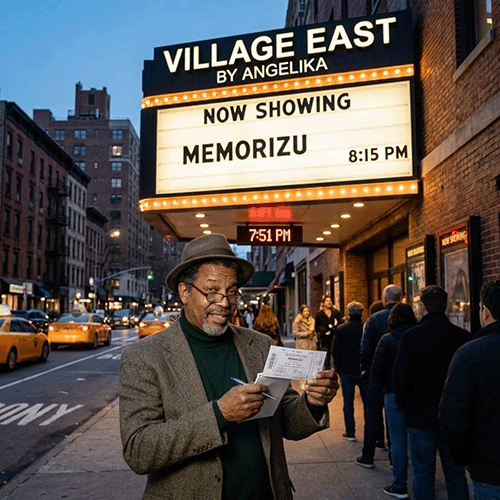 The film arrives at Tribeca as the quiet, devastating centerpiece of this year's International Narrative Competition, and I am prepared to go on record — carved into stone, set to sea, left for some future civilization to excavate and, finally, understand — as the only critic currently accredited at this festival who has any idea what Kenji Ogawa is doing here. I have sat through twelve films in the past four days. Eleven of them were greeted by my colleagues with the damp, undiscriminating enthusiasm of golden retrievers encountering a puddle. Memorizu received a polite spattering of applause from people who were, I suspect, primarily relieved that it was over.
It is not over. It will never be over. That is the point.
Ogawa — whose previous short films circulated through the Sapporo Underground Exhibition Circuit in the late nineties, winning two Hokusei Quiet Cinema Awards that the American press has, characteristically, never bothered to translate — has constructed here a film in the tradition of the great Tokyo Minimalist School. This movement, for those who have not done the reading, emerged from the Waseda Film Institute in approximately 1963, when a cohort of dissident students — influenced equally by Yasujiro Ozu's kitchen-sink transcendentalism and the obscure Bolivian structural filmmaker Emilio Gardes Varela — declared that narrative was "a sickness of the Western body politic" and began shooting films composed entirely of silences punctuated by the sound of someone's grandmother making tea. Ogawa is the direct heir to this tradition. I do not expect you to have known this before reading this sentence.
The film centers on a young woman named Yuta — played with extraordinary, almost translucent restraint by Taro Nakamura, whose work in Ogawa's short Bamboo Station (2019) remains the finest ten minutes of cinema produced in the twenty-first century — who is dispatched from her apartment in Osaka to the northern island of Hokkaido, where her estranged grandfather operates a traditional fish-salting operation handed down through seven generations. The grandfather's hands have been damaged in an industrial accident. The granddaughter must take over the salting. The fish must be salted.
I am aware that this description sounds, to the untrained ear, unremarkable. This is because you are, with the greatest possible respect, untrained.
What Ogawa understands — and what not one of the eleven other critics I spoke with after the screening came anywhere close to grasping — is that the salting of fish is, in the language of the Tokyo Minimalist School, a radical act of mnemonic inscription. The salt does not merely preserve the fish. It records the fish. It holds, in crystalline suspension, the fish's final argument against entropy. And when Yuta photographs the salting process on her grandfather's ancient Nagasaki Box Camera — a device manufactured only between 1931 and 1933 and never exported outside of the Kyushu prefecture — she is not taking pictures. She is making memory solid. She is practicing, in the idiom Gardes Varela called la fotografía del alma quieta, the photography of the quiet soul.
The film is shot entirely on 16mm hand-wound stock by Ogawa's longtime cinematographer Hideaki Mori, who bathes the entire second act in a quality of grey-green winter light that I can only describe as "what sorrow looks like when it has given up trying to explain itself." This is not an accident. Mori is a student of the Nagoya Color Suppression technique developed by experimental filmmaker Goro Tachikawa in 1971, which mandated that any shot containing natural warmth — sunlight, firelight, a smile — must be filtered through a layer of exposed negative to "kill the comfort in the image." Tachikawa died having never made a film longer than forty minutes. This is cinema's great unacknowledged tragedy. I am one of three people who acknowledge it, and we do not get along.
The score, by avant-garde composer Nobuyuki Matsui — the so-called "Godfather of Japanese Concrete Cinema," whose 1988 opus Rust Hymn for a Closing Factory remains the only piece of music to have been banned by three separate municipal governments — operates throughout as a kind of anti-soundtrack. It does not tell you how to feel. It tells you, specifically, that feeling is a structural problem you must solve alone. When the grandfather and Yuta eat dinner in silence for the ninth time — nine times, each shot from a different axis, each angle adding a new geometrical argument to the film's central thesis — Matsui's score is a single sustained tone, barely above hearing, that seems to be asking a question in a language that has no answer.
The film runs one hundred and forty-seven minutes. Not one of those minutes is wasted. I know, because I was awake for all of them, which is more than I can say for the gentleman to my left, who produced, midway through the second act, a sound like a filing cabinet being pushed down a staircase.
There is a moment, near the end, when Yuta holds up a photograph of her grandfather's hands against the window, and the winter light passes through it, and for approximately eleven seconds, the image becomes something I cannot describe without sounding, even by my standards, excessive. I will say only this: I have seen every film worth seeing in the past forty-seven years of my life in the cinema, and I have felt, perhaps, thirty moments of what I would call absolute cinematic truth. This was one of them. I was alone in that feeling, insofar as the audience's response consisted primarily of a woman in the fourth row using the light from her telephone to locate her dropped ChapStick.
Memorizu is a masterwork. Kenji Ogawa is a director of the first rank. The Tribeca Film Festival has, I can only conclude accidentally, done something right this year.
I am going to find something to eat. The blazer and I need this.
-J.E.
Jackie Esiskel is the Movie & Film Correspondent for IRREVERENT. He has been covering film since 1979, when he attended a screening of Coppola's The French Connection and declared it "the birth of American cinema as a moral art." He was previously at Cannes in May. He did not win anything. He was not up for anything. He attended.
[EDITOR'S NOTE: Jackie, please sleep, you're hallucinating entire films at this point. First, I guess, Coppola did not direct The French Connection, that was William Friedkin (famously). Second, none of us know what film you're discussing, but Memorizu is not a 147-minute epic about a Hokkaido fish-salting operation. The director of Memorizu is Miiku Sakanishi (not "Kenji Ogawa"), making her debut feature. Memorizu is a Japanese film, and the protagonist is Yuta, a man (not a woman), who travels from Tokyo to Kyushu (not from Osaka to Hokkaido) to help his father-in-law run a photo studio (not a fish-salting operation). The cast includes Moeka Hoshi, Issey Ogata, Yu Kashii, and Tasuku Emoto. The cinematographer is Yoichi Kamakari. The "Tokyo Minimalist School," the "Hokusei Quiet Cinema Awards," the "Waseda Film Institute dissident movement of 1963," Emilio Gardes Varela, Hideaki Mori, the "Nagoya Color Suppression technique," Goro Tachikawa, Nobuyuki Matsui, and the "Nagasaki Box Camera" do not appear to exist. The film's runtime is 98 minutes. The film is having its World Premiere at Tribeca; it did not previously screen on any circuit. —Ed.]