
A nation holds its breath. One correspondent holds his rocks glass.
WASHINGTON, D.C. — Filed from the Presidential Suite, The Watergate Hotel, 3:14 a.m., May 23, 2026. Hour 72 of continuous monitoring.
I have been in this room for three days.
I have watched the Potomac from this window the way Murrow watched London burn — with a sense of occasion, a scotch in hand, and the nagging awareness that history is happening faster than my fingers can type it. Edward R. Murrow said, once, that television "can teach, it can illuminate; yes, and it can even inspire." He was not talking about a correspondent eating Toblerone in a hotel room at three in the morning. But the principle holds. Tulsi Gabbard has stepped into darkness. She has left us, as Ed left us, in a moment of moral clarity. Or moral ambiguity. One of the two. I have been awake for seventy-two hours and the minibar is now a food group.
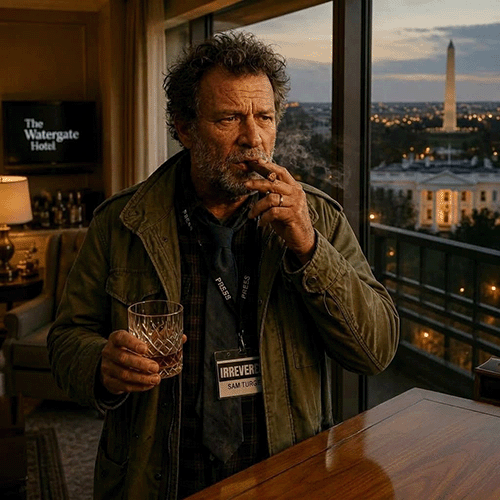 The Director of National Intelligence — former Director of National Intelligence, as of Friday, May 22, 2026 — resigned her post citing her husband's cancer diagnosis, a statement that arrived with the quiet devastation of a shoe dropped in a carpeted hallway at 2 a.m. It barely made a sound. But I heard it. I hear everything from this suite.
My sources — principally one Rodrigo, who turns down the beds on this floor and has, over seventy-two hours, become something of a confidant — confirmed what official Washington was too cowardly to say aloud: that things, in his words, "seemed a little crazy right now." Rodrigo is not cleared for classified information. But neither, apparently, was anyone else in this dispute.
Because here is what we know — what I, Sam Turge, have pieced together across a career spanning three decades of dispatches from conflict zones, ballrooms, and now, once again, this particular room at the Watergate where I filed my landmark 2019 piece "The Post-Obama Malaise: A Correspondent Considers Room Service": Gabbard did not leave solely because of personal tragedy. She left because of Iran. She left because of intelligence. She left because of a disagreement, confirmed by multiple outlets including The Guardian and PBS NewsHour, between what the intelligence community assessed and what the administration wished to believe.
What, precisely, was that disagreement?
I am working on that.
The intelligence community is a sealed vault, and I have spent three days pressing my ear to its door. What I can tell you — what I will tell you, with the full authority of my byline — is that something happened regarding Iran war intelligence, and that something was significant enough to sever a woman from a position of extraordinary national trust. The outlines are public: in March 2026, Gabbard testified before Congress that Iran's nuclear enrichment program had been "obliterated" by prior strikes and showed no sign of rebuilding — an assessment that directly contradicted President Trump's repeated claims of an "imminent" Iranian nuclear threat, which he had used to justify military action in February. Whether the fracture ran deeper — whether it involved threat assessments, capability estimates, the willingness of the Iranian government to negotiate, the willingness of the American government to listen, or some fourth thing I have not yet identified — this I cannot confirm. But I will. Probably by Part Two.
At this point I must pause to describe the minibar.
The Watergate Presidential Suite minibar is a document of American excess and, therefore, American anxiety. Two bottles of Bulleit Rye. One Tanqueray. Three miniature Perriers that I used to brush my teeth on Night One when the adrenaline of the story rendered sleep impossible. A Toblerone — the large kind, the kind that suggests the hotel takes its guests seriously. I have eaten half of it. There is also a small jar of mixed nuts from which I have extracted all the cashews, because I am on deadline and cashews are the only nut with real narrative momentum. The almonds remain. History will not remember the almonds.
I include this inventory not for color, but for the record. Future biographers will want to know what it looked like in the room where Sam Turge sat vigil for the soul of American intelligence oversight. Now they will know. You are welcome, future biographers. Venmo me.
As I wrote in my 2021 dispatch "The Afghanistan Withdrawal and the Twilight of American Competence: Observations from a Marriott Courtyard in Northern Virginia," moments of institutional rupture have a texture — a particular grain — that only those who have been watching long enough can detect. I detected it then. I detect it now. The texture is rough. It has a slight smell, like ozone before a storm, or like the hallway outside this suite, which Rodrigo tells me is due to a malfunctioning HVAC unit and is unrelated to geopolitical tension. I am not convinced.
Tulsi Gabbard was not everyone's idea of a DNI. She was, by design, an antagonist to the intelligence apparatus she was appointed to oversee — a feature, to her supporters; a bug, to those of us who have watched these institutions buckle and hold and buckle again across the arc of a career. But she held the thing. She looked at the information. And if the reports are right — and I believe they are right, in the way I believe in instincts earned through suffering and mileage charges — she looked at the information about Iran and told the truth about it, and the truth was not wanted.
"Good night," Murrow would say, "and good luck."
She gets neither. I get a Toblerone. Life is not fair.
Gabbard leaves behind a department in transition, a husband in treatment, and a Washington that will spend the next seventy-two hours deciding what story it wants to tell about her. I, Sam Turge, have already decided. She was a woman who walked into a machine, grabbed a handful of its gears, and said: not like this. Whether that makes her a hero or simply a cautionary footnote depends entirely on what the intelligence actually said.
I am still working on that part.
Room service closes at midnight. I ordered a club sandwich at 11:58. It arrived at 12:04. The kitchen had already mentally clocked out. It was fine.
The Potomac keeps moving. History does not stop for club sandwiches or for correspondents who need sleep. I will be here in the morning. I will be here until I have the story, or until checkout, which is Sunday at noon, and which I intend to push to a late checkout of 2 p.m. because I have status.
There is a story here. Ed would have found it by now. Ed probably slept.
I'm getting there.
— Sam Turge, Senior Diplomatic Correspondent, IRREVERENT Magazine
Sam Turge has covered international affairs, regime changes, and hotel amenity policies for IRREVERENT Magazine since 2001. He was not shortlisted for the Pulitzer Prize in 2009, 2014, 2017, or 2022. He was a finalist in his own mind for all four. He is based wherever the story is, which is currently the Watergate.
This is Part 1 of a 4-part series: "The Gabbard Dispatches: Truth, Power, and the Limits of Room Service."