
By Sam Turge, Senior Political Correspondent
Dateline: HOLIDAY INN EXPRESS, ARLINGTON, VA — ROOM 412 — THREAD COUNT: 210 (UNVERIFIED) — ICE MACHINE: DECEASED — 11:47 P.M.
Filed via fax. God help us all. He won't.
I am writing this from Room 412 of the Holiday Inn Express Arlington, where the Wi-Fi password is written on a laminated card that the front desk clerk has taken with her for the evening, leaving me with only the room phone, a Gideon Bible, and a fax machine that I have liberated from the business center next to an ice machine that died for America's sins. The ice machine hums with the sound of a government in partial agreement with itself. The fax machine, by contrast, hums with the sound of clarity. Both are lying.
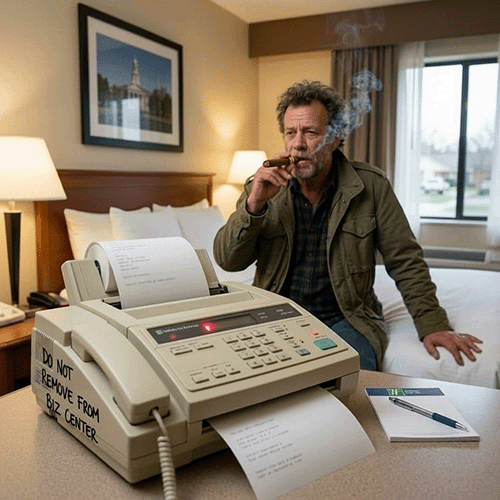 As Murrow once said, "This instrument can teach, it can illuminate; yes, and it can even inspire." He was talking about television. I am talking about a Brother IntelliFax-2840 that I have dragged back to my room because the business center closes at 10 p.m. and history does not wait for business centers. History, apparently, waits for fax machines. This is where we are.
The news, such as it is, concerns Iran.
Secretary of State Marco Rubio, speaking from an undisclosed location that I am choosing to believe was also a Holiday Inn Express, told reporters today that there are "some good signs" in ongoing nuclear talks with Tehran. He noted "progress" on uranium stockpile negotiations and expressed cautious optimism about the Strait of Hormuz, which is a body of water that I have never seen but have reported on extensively from hotels with worse thread counts than this one.
President Trump, speaking from the White House, said the United States would "recover and likely destroy" Iran's highly enriched uranium.
One government. Two Iran policies. Zero Pulitzers for the journalists covering it — a situation I find both professionally galvanizing and personally devastating.
The contradiction is not subtle. Rubio is offering the diplomatic equivalent of a firm handshake and a mint. Trump is offering the diplomatic equivalent of a neighbor who says he will "recover and likely destroy" your leaf blower if you don't return it by Tuesday. Both men serve the same administration. Both men, presumably, have access to the same intelligence. Only one of them appears to have read it. I checked. Twice.
Defense Secretary Pete Hegseth, for his part, has advocated for military action against Iran with the enthusiasm of a man who has just discovered that his gym membership includes a sauna. Hegseth approaches military posture the way a golden retriever approaches a tennis ball — with total commitment and no evident understanding of the larger game being played. He is, I am told, a former Fox News host, which explains both the enthusiasm and the lack of evident understanding.
Meanwhile, the Department of Justice announced an "Anti-Weaponization Fund," which sounds like something a screenwriter would invent for a political thriller that got rejected by HBO for being "too on the nose." The fund is very real, and its purpose is almost admirably blunt: $1.776 billion — drawn from the Treasury's Judgment Fund, the same reservoir that pays out when the government loses lawsuits it probably shouldn't have filed — to compensate victims of what the DOJ calls "lawfare and weaponization." A five-member commission will review claims. The deadline to file is December 2028. The whole thing stems from *President Donald J. Trump v. Internal Revenue Service*, a lawsuit that apparently resolved with the government paying itself to apologize to itself, which is the kind of fiscal gymnastics that would make a contortionist wince.
 I have been covering politics for twenty-three years, and I am old enough to remember when slush funds had the decency to be secret. In 1952, a young Senator Richard Nixon went on television to explain away an $18,000 campaign slush fund, delivered the Checkers speech, and saved his career by admitting he had accepted one gift: a cocker spaniel. Twenty years later, that same man's re-election committee was running a slush fund so clumsily coordinated that the burglars got caught because they taped the door latch horizontally. Now, in 2025, we have progressed to the point where the slush fund has a press release, a five-member commission, and a claims deadline. Nixon had to hide his in a safe. Trump has put his on a website with a .gov domain. This is not an improvement in ethics. It is an improvement in branding. The corruption has learned SEO.
I have filed from hotel rooms in thirty-seven countries. I have seen administrations contradict themselves on trade, on immigration, on whether a hot dog is a sandwich. But I have never seen an administration manage to negotiate and threaten the same country simultaneously with such evident sincerity on both fronts. It is, I am faxing to note, faxually incomprehensible.
The fax machine hums. It whirrs. It does not ask "but what do we actually want?" It simply sends. It is, in this moment, the most honest diplomat in Washington. I have faxed it to myself twice. It does not improve.
The minibar contains two Heinekens, a king-size Snickers, a can of Chardonnay that I am reasonably certain is not actually Chardonnay, and a bag of mixed nuts priced at $9. I have consumed the Snickers. I am saving the Chardonnay for when the first fax goes through. I am saving the mixed nuts for when I learn whether "recover and likely destroy" is official State Department terminology or simply something the president says before breakfast.
As Murrow once said — and I am paraphrasing here, because the Gideon Bible does not contain his collected broadcasts, which I consider an editorial oversight — "We must not confuse dissent with disloyalty." I would add that we must not confuse "some good signs" with "recover and likely destroy," though I suspect the Pulitzer committee would find that observation insufficiently original.
Room 412. Thread count: 210. Fax machine: warming. Diplomacy: pending.
I am Sam Turge. Good night, and good luck.