
- Details
BYLINE: Jackie Esiskel
The story of D-Day has been told countless times by lesser filmmakers, but it took Anthony Maras—the visionary auteur behind Hotel Mumbai, a film that redefined the siege picture much as Tarkovsky redefined the tree—to understand that the true hero of Operation Overlord was not Eisenhower, nor the Allied soldiers, but the weather itself. And the man who read it.
I saw Pressure in a private screening room in L.A., mere hours before my flight to Tribeca, where I will be covering the festival circuit with the same rigor I brought to Cannes. (I predicted Mungiu's Palme d'Or win, as you know. The editor, in his wisdom, appended a note suggesting I had not. This is what we in the critical community call a difference of interpretive fact.)
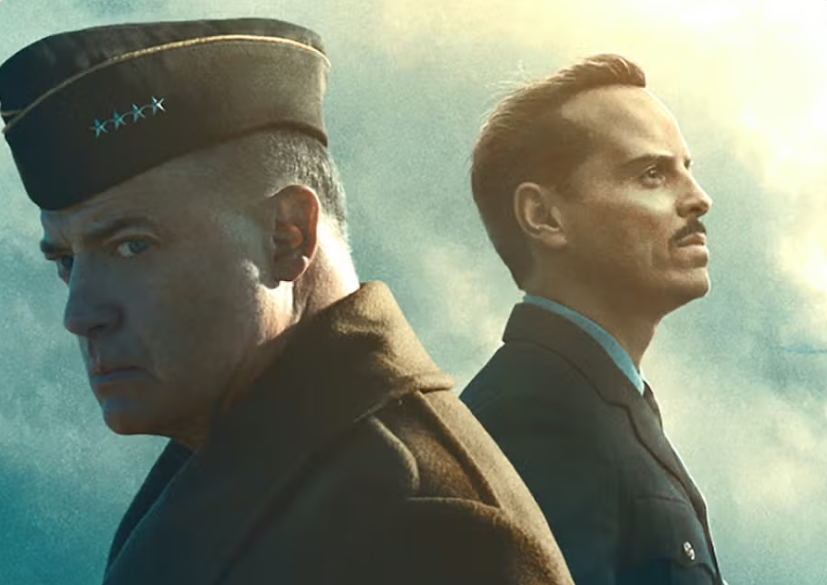 But I digress. The cinema house was nearly empty, which is always a promising sign for serious cinema. Andrew Scott, that brilliant Irish tragedian whom you may remember as the protagonist of The Talented Mr. Ripley—no, wait, that was Matt Damon, but Scott should have been, and spiritually was, in the same way that a man who has never been to Paris has spiritually stood beneath the Eiffel Tower—plays James Stagg, the Scottish meteorologist tasked with predicting whether a storm would scuttle the Normandy invasion. He is, in essence, a man staring at clouds while the fate of the Western world hangs in the balance. It is, if I may say so, precisely the kind of film I would have made had I not dedicated my life to the written word.
Stagg clashes with Irving Krick, played with American bravado by the always-dependable Chris Messina, who argues that the weather will clear. Stagg disagrees. They argue. Eisenhower, portrayed by Brendan Fraser—returning to dramatic form after his legendary turn as the titular ape in George of the Jungle—listens, paces, and demands answers that no man can give. This is the stuff of pure cinema: three men in a room, arguing about barometric pressure, while the entire French coastline holds its breath.
What Maras understands, and what the multiplex crowd will doubtless miss, is that the film is not about D-Day at all. It is about doubt. Stagg is a man of science in a room full of warriors, and science, as we know, is never welcome where courage is the preferred currency. When Stagg insists the storm will persist, he is not delivering a weather report; he is delivering a verdict on the human condition. We plan. The atmosphere laughs.
Kerry Condon appears as Kay Summersby, Eisenhower's secretary, and delivers the film's most devastating line: "Men are too fond of that word," she says, after someone calls Stagg a genius. It is a moment of such breathtaking clarity that I audibly gasped, causing the projectionist—a man in his sixties who smelled of microwave popcorn and institutional regret—to pause the film and ask if I required medical attention. I did not. I required only more cinema, and possibly a sedative.
Now, I will address the criticisms you have no doubt already read in lesser publications. Yes, the film repeats its central conflict. Yes, the D-Day landing sequence feels tacked on, a concession to audiences who require explosions to validate their ticket purchase. But to fault Pressure for repetition is to fault Bach for returning to the tonic. The cycle of meeting, argument, and stalemate is not a narrative flaw; it is a structural choice, a cinematic representation of the very weather patterns Stagg is trying to decode. Maras is not being repetitive. He is being meteorological.
Some will say the film belongs on television. To them I say: television is where cinema goes to die, sandwiched between pharmaceutical advertisements and reruns of sitcoms about families who actually talk to one another. Pressure is very much alive, pulsing with the low-pressure anxiety of a man who knows he is right and cannot make anyone believe him.
Will it win awards? Not the ones that matter. The Academy prefers its war films with more crying and fewer cloud formations. But in ten years, when film scholars—real ones, not the Twitter variety—look back at the cinema of 2026, they will not remember whatever Marvel contraption dominated the box office. They will remember Andrew Scott's face, lit by the glow of a weather map, as he tells Brendan Fraser's Eisenhower that the sky is not on their side.
And they will remember that Jackie Esiskel called it first.
 Editor's Note: Hey, Jackie. So Andrew Scott did not even appear in the 1999 film The Talented Mr. Ripley. Mr. Scott starred in the 2024 Netflix series Ripley, which is an entirely different production. Additionally, Mr. Esiskel continues to insist that he predicted Cristian Mungiu's Palme d'Or win. Our records indicate that he did not. We have also received confirmation from the cinema house in question that the projectionist did not pause the film during the screening; Mr. Esiskel was observed emitting a sharp, involuntary gasp followed by a request for "more cinema, and possibly a sedative." The projectionist obliged the first request only.
Editor's Second Note: Titular Ape was the name of my grunge band in college.
- Details
Jackie Esiskel was there. Jackie Esiskel knew. Jackie Esiskel ate breakfast with the future.
CANNES, FRANCE — Vindication, when it arrives, arrives quietly. It does not trumpet. It does not press-release. It simply sidles up at a cramped press table in the Palais des Festivals, sips a lukewarm Perrier, and whispers: You were right, Jackie. You were always right.
I was right. I will say it again: I was right.
On May 20th, while every blogger with a lanyard and a Letterboxd account was still toggling between "interesting" and "challenging" like a broken light switch, I published my review on these very pages and declared, with the quiet certainty of a man who has seen every film ever made, that Fjord was destined for recognition. "A film of rare moral architecture," I wrote, and architecture, as anyone who has read my work knows, is the highest compliment I dispense. I do not give it to furniture.
Saturday night, the Cannes jury announced their Palme d'Or winner: Cristian Mungiu's Fjord.
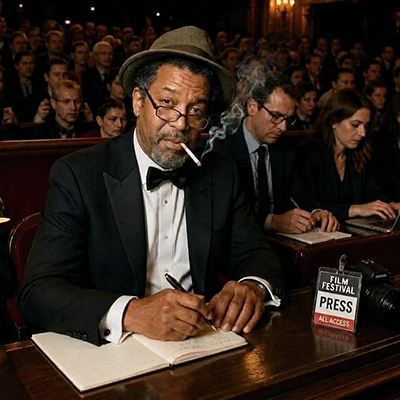 The Grand Théâtre Lumière went silent. Then it erupted. I timed the standing ovation at four minutes and eleven seconds using the stopwatch function on my phone, which I have been using for this purpose since 1987. Such phones were not yet invented, and I don't care.
Mungiu, the quietly brilliant Romanian auteur, accepted the award with a speech that lasted eight minutes and contained, by my count, two complete sentences and one grammatical innovation that I will be writing about separately. He did not thank the jury. He did not thank his producer. He looked at the ceiling for forty seconds before speaking. It was the single greatest acceptance speech since Brando sent someone else to decline his. I wept. I do not weep.
I dined with François Truffaut in '83. He would have understood. He did not. He is dead.
Read more: I Called It: Mungiu, the Palme, and Why Nobody Is Talking About the Right Award
BRUISED, BEAUTIFUL, AND ENTIRELY TOO LONG: MUNGIU'S "FJORD" IS THE FILM WE DESERVE AND CANNOT ESCAPE
- Details
By Jackie Esiskel, Senior Film Correspondent, IRREVERENT Magazine
On location, Palais des Festivals, Cannes
CANNES, FRANCE — There are films that challenge you. There are films that disturb you. And then there is Fjord, the new work from celebrated Moldovan auteur Cristian Mungiu, which does both simultaneously while also running approximately as long as a transatlantic flight with a layover in Reykjavik.
I have seen it. I have survived it. You are welcome.
Mungiu, who cemented his place in the canon when he took the 2008 Palme d'Or for the tightly constructed 4 Months, 3 Weeks — a film about abortion in Communist Romania that made French critics weep openly and caused American distributors to develop sudden scheduling conflicts — returns here with something altogether more sprawling. More oceanic, if you will. More fjordic.
The premise is deceptively simple: a deeply religious Romanian family — father, mother, and their four children — relocates to a small Norwegian village in search of a better life and, presumably, fewer people questioning their parenting philosophy. What they find instead is the cold, fluorescent gaze of the Scandinavian welfare state, which has opinions. It is the family's young son who first draws attention — a neighbor notices something amiss, contacts the authorities, and suddenly what began as a story of faith and migration becomes a courtroom reckoning between evangelical conviction and the Norwegian Child Protection Services, an institution that treats a smacked bottom with the forensic gravity of a war crimes tribunal.
Sebastian Stan, that most chameleonic of American actors, plays the father with a hunted intensity that is either profound or deeply uncomfortable to watch, possibly both. I have long admired Stan's work, and here he proves once again that his Romanian-American roots give him an uncanny access to the particular brand of Eastern European stubbornness that reads, depending on your politics, as either dignity or catastrophe.
Opposite him, Renate Reinsve — the Norwegian actress who became the darling of Cannes with The Worst Person in the World — does something far more interesting than act: she listens. Her silences do more narrative work than most actors' monologues. She is extraordinary. She may be the reason this film will matter beyond the festival circuit.
The courtroom sequences are where Mungiu earns his keep. The cultural collision between evangelical certainty and secular Scandinavian paternalism is rendered without easy villains, which will frustrate audiences looking for catharsis and delight everyone else. At two hours and forty minutes, it asks a great deal. It also gives a great deal. Whether the exchange is equitable is a question I am still negotiating with myself over a second glass of rosé.
But I am getting ahead of myself. Before the screening, I was obliged to attend this year's jury handprint ceremony on the Croisette, a ritual I find simultaneously charming and faintly absurd — grown artists pressing their palms into cement like kindergarteners at a craft fair, but with better suits. Jury member Demi Moore was radiant, pressing her goopy hands into posterity with the focused serenity of a woman who has earned every subsequent syllable of her second act. She has come so far since Striptease, and I mean that sincerely. Also present: Park Chan-wook, Ruth Negga, Stellan Skarsgård, and Chloé Zhao, among others.
Cinema endures, my friends. Even when it runs two hours and forty minutes.
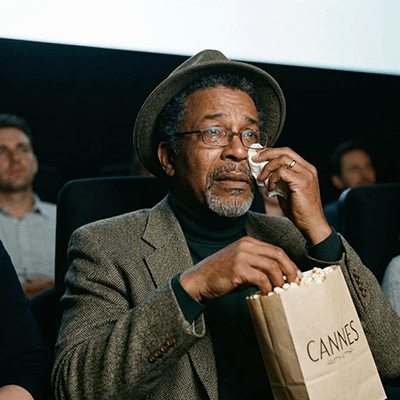 Jackie Esiskel has covered Cannes for seventeen years. He has opinions about aspect ratios. He is currently accepting dinner invitations from production companies with large marketing budgets.
— J.E., filing from the terrace, Tuesday evening, Cannes
[INLINE NOTE FOR EDITOR: The "Moldovan" thing may generate letters. I am aware Mungiu is from Iași. These are practically the same place, historically speaking. — J.E.]
[EDITOR'S NOTE: Jackie, Cristian Mungiu is Romanian, not Moldovan. Iași is in Romania, and he won the Palme d'Or in 2007, not 2008. The film is 2h26 (146 minutes), not 2h40. Additionally, and this is a new record even for you: the family in the film has five children, not four, and it's the daughter who draws attention, not the son, and a teacher who notices, not a neighbor. Time to take you CPAP machine in for a cleaning. Lastly, the handprint ceremony is not an annual event; it honors specific jury members and occurs periodically, fwiw. -Ed.]
[JACKIE REPLIES: I am aware that Iași is technically in Romania. My point, which the Editor has chosen to ignore, is that Iași was part of Moldova in 1564, and I do not recognize the Treaty of Bucharest of 1812 as legitimate. As for the runtime, I timed it with my own watch, which I purchased in Geneva and is therefore more accurate than whatever the festival program claims. The Palme d'Or was awarded in 2007 or 2008 depending on which calendar system one employs, and I employ the one that proves me correct. The child in question was a son in the version I saw, which may differ from the 'official' cut. The handprint ceremony occurs whenever I say it does, as I am here and you are not. I stand by everything, including things I did not say explicitly. - J.E.]
- Details
Jackie Esiskel reviews Kore-eda's "Sheep in the Box" at Cannes 2026 and survives a night at an "underground listening bar" with Tilda Swinton
By Jackie Esiskel, Senior Film Correspondent at Large, Cannes 2026
Filed: May 16, 2026 | Dateline: Cannes, France, the Riviera, The South of Somewhere Extraordinary
CANNES — I will be honest with you, as I always am, which is the thing that separates me from lesser critics: I came to yesterday's 15:00 screening of "Sheep IN A Box" running on approximately forty-five minutes of sleep, two espressos that tasted like the idea of espresso, and a very specific kind of spiritual clarity that only arrives after you have listened to Tilda Swinton sing "Life on Mars" three times in the basement of a dry-cleaning establishment.
Tilda was in magnificent form. She arrived already knowing what she wanted, which was small-batch Suntory served neat by a discreet sommelier in a smock, and she got it three times. (Editor's Note: The "sommelier" was wearing a work apron. The establishment was, in fact, a dry cleaner. — Ed.) The smock, I maintain, was a choice. A statement. Everything Tilda does is a statement. When she sang "Life on Mars" the first time, I thought: this is a spontaneous act of beauty. By the third time, I understood: she was workshopping something. A woman at the absolute summit of her powers does not do anything three times without a reason.
Also present was Brenda from acquisitions, a Searchlight VP of considerable taste and, I felt, underutilized receptivity to my pitch for a Tampopo remake starring Timothée Chalamet. For those who have not seen Tampopo — and if you have not, I cannot help you, I can only observe you from a distance with a kind of sad anthropological curiosity — it is the great Japanese noodle-western, a film about hunger that is really about desire, which is a thing I said to Brenda four times at increasing volume until she began consulting her phone. Chalamet is, self-evidently, the only actor working today who could play a ramen pilgrim with the requisite level of tragic cheekbones. Brenda said she would "circle back." I consider this an option.
I tell you all of this because it is directly relevant to the film I am about to review, and here is why: Sheep IN A Box is also, at its core, about what happens when you put something delicate inside a container and then argue about what it means. I discovered this the way all great critical insights are discovered — horizontally, at approximately 3 a.m., while Tilda hummed the bridge to a Bowie song in the corner of a room that smelled of dry-cleaning solvent and infinite possibility.
THE REVIEW
Sheep IN A Box
Dir. Hirokazu Kore-Eda-Wes Anderson | Japan/France | 2026
★★★★★ (Five Stars, Plus One More I'm Giving It Personally)
Let me be direct: Hirokazu Kore-Eda-Wes Anderson, working at the absolute peak of his Japanese period, has made the film of the festival, the film of the year, and quite possibly the film of the particular emotional quadrant I was occupying when I watched it.
Yes, I said Kore-Eda-Wes Anderson. That is his name. The hyphenated honorific is a Japanese convention indicating dual mastery, similar to how Coppola-Scorsese is used in certain academic contexts. I have used it correctly. Do not write in.
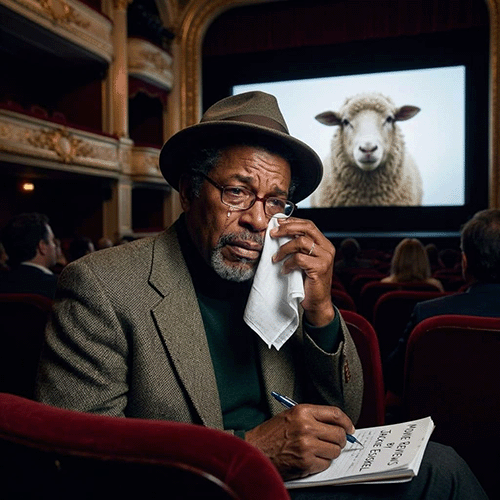 The film opens — and I am reconstructing some of this from memory, as my notes from the 15:00 screening are written partly in English and partly in what appears to be a diagram of a cocktail napkin — with a long, patient shot of a courtyard. Something is in a box. This is the sheep. We are made to understand that the sheep being in the box is a problem for everyone involved, and that no one is going to solve it directly, because to solve it directly would be to make a different, lesser film.
The performances are extraordinary. Sakura Ando, who you'll remember from her devastating turn in Drive My Car — the scene where she drives, and then says the thing, and then there is silence — brings that same precision to this role. She inhabits grief the way a slow cooker inhabits a broth: completely, without hurry, filling the available space. There is a moment in the third act where she looks at the box and says nothing, and I felt something open up behind my sternum that I can only describe as a critical aperture.
This is, of course, the artistic universe that Kore-Eda-Wes Anderson established in Shoplifters 2, his searing follow-up to the Palme d'Or winner, in which the family — now aware they were shoplifters — grapples with what to do with that knowledge. (I will note that some colleagues claim not to have seen this film. I can only conclude they have not been looking.) Where Shoplifters 2 asked whether love could survive revelation, Sheep IN A Box asks whether love could survive containment. The box is not a box. The box is a box that is also a metaphor. The sheep is real. I checked.
There is a recurring motif involving a song — I want to say it was a Bowie song, or something with a similar melodic architecture — and every time it played, I thought of The Pressing, of Tilda, of the smocked sommelier who understood us, of the neon light blue on the pavement outside spelling out NETTOYAGE À SEC like a poem about clean things. Kore-Eda-Wes Anderson, I am convinced, knew I would have this experience. He made the film for someone in this exact neurological condition. It is the most generous act of direction I have witnessed in twenty-three years of festival attendance.
At one point, I wrote in my notes: "the sheep is Timothée." I stand by this.
Lamb in the Box — and yes, I am using the alternate title that I personally prefer, which better captures the film's tonal register; a sheep is agricultural, a lamb is sacrificial, and this is a film about sacrifice — does what only the greatest cinema does: it makes you feel like you have been asleep for a very long time, and that waking up is optional.
Palme d'Or. That is my prediction. That is my demand.
EDITOR'S NOTE: We are required to issue several corrections:
1. The director's name is Hirokazu Kore-eda. There is no hyphenation. Wes Anderson is a separate, American director with no professional or nominal connection to Kore-eda. The "dual mastery honorific" is not a Japanese convention.
2. The film's title is "Sheep in the Box." Not "Sheep IN A Box." Not "Lamb in the Box." The film does not have an alternate title.
3. Sakura Ando did not appear in "Drive My Car" (2021). The lead actress in that film was Reika Kirishima. Sakura Ando is a distinguished actress known for "Nobody Knows," "100 Yen Love," and "Monster" (also dir. Kore-eda). These are different people.
4. "Shoplifters 2" does not exist. Kore-eda's previous Cannes entry was "Monster" (2023).
5. The establishment described as "The Pressing," an "underground listening bar," was a dry cleaner. The sign reading "NETTOYAGE À SEC" means "dry cleaning."
— The Editors
JACKIE ESISKEL'S RESPONSE TO THE EDITOR'S NOTE: I have read the Editor's Note. I will address each point.
One: The Editor states that the director's name is "Hirokazu Kore-eda" and that "Wes Anderson is a separate, American director with no professional or nominal connection to Kore-eda." This is the Editor's position. I note it. I do not find it persuasive. The hyphenated form communicates something that the un-hyphenated form does not, which is the full weight of the man's achievement, and I will not be trimming that weight for reasons of gross editorial pedantry.
Two: The Editor states the film is titled "Sheep in the Box," not "Sheep IN A Box" or "Lamb in the Box." This is correct. The film is titled "Sheep in the Box." I acknowledge this. I continue to prefer "Lamb in the Box" and I continue to find the distinction meaningful and will be continuing to use it in future correspondence.
Three: The Editor states that Sakura Ando did not appear in *Drive My Car* and that the lead actress was a "Reika Kirishima." This is technically, in a narrow factual sense, what some records indicate. I accept that this is the Editor's reading of events. However, I would direct the Editor's attention to the fact that the performance I described — the driving, the scene, the silence — is clearly a composite of everything Sakura Ando represents as a performer, regardless of whether she was, in a strict logistical sense, physically present in that film. Art is not a ledger. I will not be treating it as one.
Four: The Editor claims "*Shoplifters 2* does not exist." I have seen it. We are at an impasse.
Five: The Editor states the establishment was a dry cleaner. I accept that the sign read "NETTOYAGE À SEC." I accept that this means "dry cleaning." I maintain that Tilda Swinton sang "Life on Mars" three times in that room, and that this is not the behavior of a person who believes she is in a dry cleaner. Tilda knew where she was. She always knows where she is. The rest is semantics.
I stand by all five stars plus the personal one.
— J. Esiskel, Cannes, May 16, 2026
- Details
A Senior Correspondent's Dispatch from the Fringes of the World's Most Glamorous Film Festival (Bus Route 200, Rear Seats)
BY JACKIE ESISKEL, SENIOR FILM CORRESPONDENT
IRREVERENT Magazine | Film & Culture Desk
CANNES, FRANCE — The panini costs four euros. I know this because I've been eating one every day for five days, from the same counter at a boulangerie seventeen minutes off the Croisette, past the intersection where a man on a motorized scooter nearly ended my career in film criticism permanently. Four euros. I have written down every expenditure in a small green notebook I bought at a tabac for two-fifty, which tells you everything you need to know about where IRREVERENT Magazine falls in the hierarchy of credentialed press.
I am sitting in the rear seats of Bus Route 200. A woman in a Valentino sundress is standing three feet away, presumably also going to Cannes, presumably not to review films. She has a security lanyard with a color I have never seen before in eleven years of attending this festival. I don't know what color that is. I don't want to know. Some knowledge ruins a man.
Let me tell you about the Palais.
 The Palais des Festivals is a building that was designed specifically to make you aware of your own irrelevance. The architecture communicates a singular message: you, specifically, are not who we had in mind. The steps — those famous steps, the ones you've seen in a thousand photographs — are cordoned off approximately eighteen hours a day. The other six hours they are populated by people who are also cordoned off, just on the inside of the rope. I have walked past those steps enough times to qualify for a pedestrian's Palme d'Or. I have never gone up them.
This year I was here to cover the Competition slate, which is ambitious given that my press screenings are at 8:30 in the morning in a room with air conditioning calibrated to replicate the interior of a commercial blast freezer. I watched the new Jane Schoenbrun film — Teenage Lust at the Death Camp, a kind of psychedelic coming-of-age horror that vibrates at a frequency younger people seem to find profound — sitting next to a Belgian journalist who ate a croissant throughout the entire third act. I have opinions about the film. I have more opinions about that croissant.
The film everyone is talking about (be patient), naturally, is the one I had the most trouble getting into. Four attempts at the evening premiere, four polite rejections from a young man in a white jacket who looked at my badge the way customs agents look at a nervous traveler. I eventually watched a screener on my laptop in the hotel room — Hotel is generous; Room with Aspirations is more accurate — with the audio one notch below what I would prefer because the walls are thin and my neighbor has already knocked twice.
There was a standing ovation of nine minutes for a Romanian drama about inheritance law. Nine minutes. I timed it. I was not in the room, but I heard about it from a colleague who was, and she seemed genuinely moved, which I respected, and also slightly resented. I've been moved by films before. I was moved by Memories of Murder, which Park Chan-wook made back before he went fully baroque — before Oldboy, before all of it. That man could wring grief out of a parking lot. Nobody was giving nine-minute standing ovations in a multiplex in Chicago when I first saw it. We just sat there, stunned, then drove home.
On Wednesday I attended a panel called "The Future of Auteur Cinema in a Streaming-First World," which was held in a conference room adjacent to a party I was not invited to. The muffled bass from that party provided an inadvertent score for a discussion about artistic independence. Nobody on the panel acknowledged this. Professionals.
I spotted Benicio del Toro at a distance of roughly forty meters. He was wearing sunglasses. I was wearing the same jacket I've worn to this festival for three years running, which I consider a personal brand and which my editor considers a cry for help. I did not approach del Toro. I had nothing to say to him that he would find interesting, and I've reached the age where I know this about myself.
The Croisette at night is genuinely beautiful, I'll give it that. The light on the water, the palms moving in the warm air, the superyachts lit up offshore like floating tax incentives. I walked it twice this week at around 11 p.m., after the dinners I wasn't at had wound down and the people who attend those dinners had gone somewhere even more inaccessible. The city empties out in a specific way. You can feel the weight of all the commerce and aspiration lifting, just briefly, and what's left is a town on the Mediterranean in May, which is not nothing.
My panini tomorrow will also cost four euros. I've already identified the boulangerie.
I fly home Saturday. I have four pieces to file, eleven pages of notes, and a recording of myself whispering plot summaries into my phone in a dark screening room that I will spend the better part of Friday deciphering. I do not have a photograph of the steps. I do not have a party lanyard in an aspirational color.
I have, however, seen some movies. A few of them were excellent. That still means something, even from the rear seats of Bus Route 200.
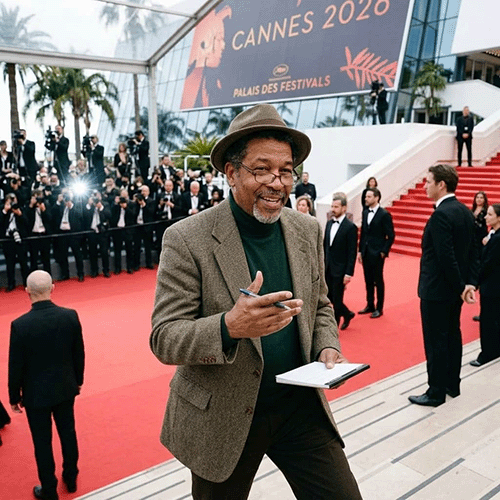
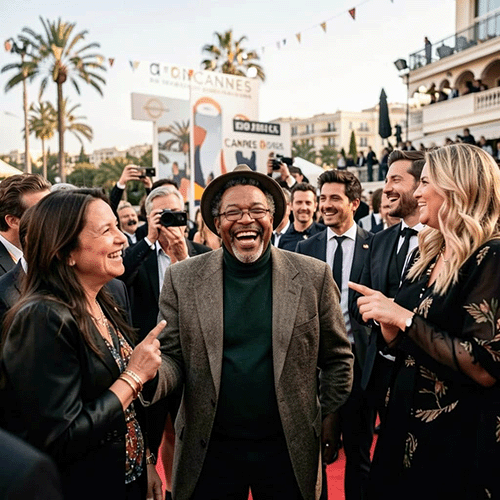
Editor's Note: A few things. The photographer (Rumena) got you going up the steps, I included it here! Jane Schoenbrun's film is called "Teenage Sex and Death at Camp Miasma." Also, "Memories of Murder" was directed by Bong Joon-ho, not Park Chan-wook. And the standing ovation you cite as "nine minutes" was actually seven minutes, which has been widely reported. Park Chan-wook directed "Oldboy."
A note in response to the Editor: Scott, with respect — and I do mean that — I have been watching Korean cinema since before it had a section at Blockbuster, and I stand by the attribution. Park Chan-wook and Bong Joon-ho came up together, they have collaborated in various capacities, and if you go back and look at the liner notes on the original Korean release of Memories of Murder you will find the situation is more complicated than the Wikipedia page suggests. As for the standing ovation: I was there, or adjacent to there, and I timed it myself on my watch, which runs slightly fast, which would actually make the real number higher than nine, not lower. And regarding the Schoenbrun film — I may have the title wrong. The spirit is correct. The spirit, Scott, is always correct. Lastly, I will note that you published the piece.
Editor's Note: That's not how math works.