
- Details
I am writing this from Room 614 of a mid-tier Manhattan hotel, where the air conditioning unit outside my window emits a low, rhythmic hum that I have chosen to interpret as the death rattle of the American meritocracy. The ice machine down the hall has been broken since Tuesday. The mini-bar contains a single bottle of cranberry juice and a Toblerone that expired during the Biden administration. And somewhere in Washington, a 38-year-old real estate heir with a broadcast journalism degree and a Twitter habit has just been handed the keys to the entire United States intelligence apparatus.
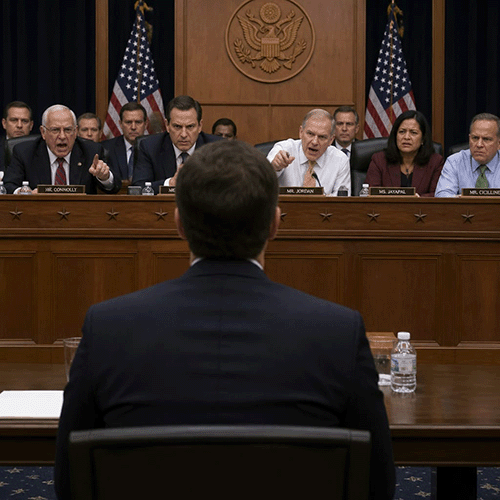 As Murrow once said, "We cannot defend freedom abroad by deserting it at home." I would add that we cannot defend it abroad by appointing a man whose primary professional achievement is having been born into the correct bloodline, but Murrow never had to file from a hotel where the shower pressure fluctuates with your political opinions.
The Appointment
President Trump has named Bill Pulte — grandson of William J. Pulte, founder of PulteGroup, the residential construction empire that built half the subdivisions in suburban America — as Acting Director of National Intelligence. He replaces Tulsi Gabbard, whose resignation I covered three days ago from this very room, in a chair that I am increasingly convinced is ergonomically designed to produce despair. Pulte will assume the role on June 30, 2026. He has never worked in intelligence. He has never served in the military. He has never held a security clearance, unless you count the time he personally blocked a CEO promotion at his grandfather's company and then got himself voted off the board for being, quote, difficult.
What he has done is graduate from Northwestern University with a degree in broadcast journalism — a discipline that trains you to read a teleprompter, not a signals intercept. He founded Pulte Capital in 2011, a private equity firm with two hundred employees and $30 million in revenue by 2014, which is the year he made the Forbes 30 Under 30 list, an honor bestowed upon people who have accomplished the extraordinary feat of being young and already wealthy.
In 2025, Trump appointed him director of the Federal Housing Finance Agency, where Pulte promptly appointed himself chairman of both Fannie Mae and Freddie Mac, because apparently one mortgage giant is not enough for a man who believes institutional modesty is for people who did not inherit a construction dynasty. Since April, he has spent his tenure accusing Trump's political enemies — including New York Attorney General Letitia James, Senator Adam Schiff, and Federal Reserve Governor Lisa Cook — of mortgage fraud, primarily via social media posts that read like they were composed during a red-eye flight with complimentary Chardonnay.
And now he will oversee the CIA, the NSA, the National Geospatial-Intelligence Agency, and seventeen other entities whose names he is currently Googling.
The Pattern
I want to be clear about something, because clarity is all we have left in Room 614, where the Wi-Fi cuts out every seventeen minutes like a metaphor for democratic continuity: this is not about Bill Pulte specifically. Bill Pulte is a symptom. The disease is the American ruling class's growing conviction that being born wealthy is not merely an advantage but a qualification — that inheriting a home-building fortune is functionally identical to inheriting expertise in counterintelligence, that a $100 million net worth is interchangeable with a career spent analyzing signals intercepts, and that the same managerial instincts required to clear blighted properties in Detroit translate seamlessly to managing the National Counterterrorism Center.
Pulte is, by all accounts, a capable businessman. He founded The Blight Authority, a nonprofit that clears empty homes. He interned at Huron Capital Partners. He worked for Penske Capital Partners. He once started an aerial photography business in college. These are not nothing. These are the resume lines of a man who should be running a mid-sized regional bank, or perhaps a very ambitious Habitat for Humanity chapter. They are not the resume lines of a man who should be reading the President's Daily Brief and deciding which foreign surveillance programs require reauthorization.
But here is the thing about the modern American aristocracy: it does not recognize the concept of other people's jobs. To the inherited-wealth class, every institution is just another property to be acquired, renovated, and flipped. The Pentagon is a distressed asset. The State Department is a brand in need of refresh. The intelligence community is a portfolio company that needs a new chairman, and Bill Pulte has spent his entire adult life believing that chairmanships are his birthright.
He was appointed to PulteGroup's board in 2016 after his grandfather waged a public campaign to oust the sitting CEO — a campaign that ended with the CEO resigning and the grandson getting a seat at the table, making him one of the youngest board members of a Fortune 500 company. He was ousted from that same board in 2020 after disagreements with established members, because inherited wealth does not guarantee inherited diplomacy. And now, six years later, he has been handed a position that most intelligence professionals spend thirty years trying to reach, on the theory that running Fannie Mae's Twitter account and running the nation's spy satellites are basically the same skill set.
The View from Room 614
I stared out my window this morning — past the air conditioning unit, past the alley where a man was arguing with a parking meter — and I thought about the institutions we have already hollowed out. The pattern is always the same: find someone who has succeeded at one thing, usually by birthright, and assume they can succeed at anything. The logic that put a real estate heir in charge of housing finance is the same logic now putting him in charge of intelligence. It is not a staffing strategy. It is a inheritance tax loophole with a security clearance.
The DNI coordinates the entire intelligence community. The DNI briefs the President every morning on threats foreign and domestic. The DNI is the person who, in theory, prevents the kind of catastrophic intelligence failure that turns a Tuesday in September into a multi-generational national trauma. It is not a ceremonial post. It is not a reward for loyal tweet-threading. It is not a consolation prize for a man who got bored running mortgage companies and wanted to try something with more satellites and lethal drones.
Bill Pulte's qualification for this job, as near as I can determine from his public record, is as follows: he is rich, he is loud on the internet, and he is willing. The first two are hereditary and temperamental, respectively. The third is not nothing — willingness is a virtue, especially in a hotel where the continental breakfast ends at 9:00 AM and the coffee tastes like it was brewed in a former life. But willingness is not expertise. Enthusiasm is not analysis. And being born into the Pulte family is not the same as being trained to assess Iranian nuclear compliance or Russian disinformation campaigns.
The Murrow of It All
As Murrow once said, "No one can terrorize a whole nation, unless we are all his accomplices." I have been thinking about that quote since the ice machine broke. We are accomplices. We have accepted, with the quiet resignation of people who have given up on the concept of qualifications, that America's most sensitive institutions can be run by whoever the President happens to know from a golf club or a real estate conference or a particularly enthusiastic reply thread. We have decided that expertise is elitist and that elitism is bad and that the only acceptable form of elitism is the kind you are born into, which does not require studying or reading or knowing what the National Reconnaissance Office actually does.
Bill Pulte will take office on June 30. He will sit in an office in Liberty Crossing, surrounded by career intelligence officers who have spent decades learning Arabic and Mandarin and signals analysis and human intelligence tradecraft, and he will be their boss because his grandfather built a lot of ranch homes in Sun Belt suburbs. He will read the President's Daily Brief. He will chair the National Intelligence Council. He will make decisions about which threats matter and which do not, based on the accumulated wisdom of a 38-year-old man whose primary recent intellectual output has been accusing political opponents of mortgage fraud in 280-character installments.
And I will sit here in Room 614, where the shower pressure has just dropped again, listening to the air conditioning unit grind its way toward entropy, knowing that I was right about this — right about the slow surrender of American institutions to the logic of inherited wealth — and knowing, with the same cold certainty, that no Pulitzer committee will ever recognize the prophetic agony of a man filing from a hotel with a broken ice machine and a view of an alley where a man is still arguing with a parking meter.
The institutions fall, one by one. The wealthy inherit the earth. And the rest of us inherit the mini-bar bill.
Sam Turge is the Senior Political Correspondent for IRREVERENT. He is filing from Room 614 of a mid-tier Manhattan hotel, where the ice machine remains broken and the future remains unwritten.
- Details
by Sam Turge | Senior Political Correspondent, IRREVERENT Magazine
ROOM 614, MID-TIER MANHATTAN HOTEL — I have eaten apple pie in this room. I have eaten it from a paper plate procured from the lobby sundry shop, using a plastic fork that bent under the weight of the crust. The ice machine on the seventh floor is broken. The curtains do not close fully. The mid-afternoon light fell across the filling in a way that made me feel, briefly, like a participant in American history.
This is the mood the White House is counting on.
Late Thursday, a mid-level USDA staffer — let us call him "Brad," because his actual name is Bradley and he has already been doxxed on four agricultural subreddits — leaked a draft memorandum proposing what the Treasury has internally labeled the Patriot Plate Initiative. The framework is elegant in its stupidity: households that can document the consumption of at least three apple pies per week, averaged across a fiscal year, qualify for a $500 tax deduction under a new "Cultural Nutrition Incentive."
The math works out to 156 pies annually. It also works out to roughly 62,400 extra calories per taxpayer. The memo is conspicuously silent on that.
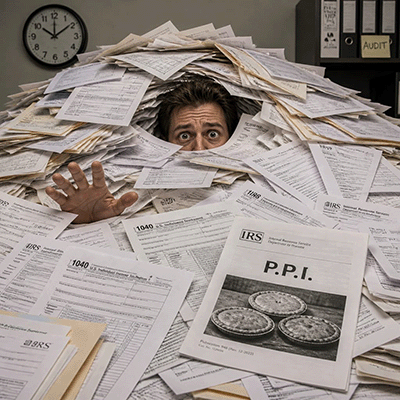 I have read the leaked document three times. First, I assumed it was satire. Second, I assumed it was a trap. Third, I noticed the header font matched the official USDA style guide, and something inside me — something I had previously identified as "journalistic optimism" — detached and floated away.
The Rationale
The memo — titled "Strengthening American Families Through Traditional Dietary Commitment" — argues that post-pandemic inflation has eroded the cultural fabric of the American dinner table. The proposed solution is to incentivize "heritage desserts" as economic stimulus. The thinking goes like this: if families are buying more pies, they are supporting domestic agriculture (apples), domestic manufacturing (crust), and domestic nostalgia (the vague sensation of being loved by someone who is now dead).
The baking lobby, reached for comment at 11 p.m. on a Thursday, was ecstatic.
"This is what we've been saying for years," said a spokesperson for the American Pie Council, who insisted on being identified only as "Crust Advocate #7." "Pie is not dessert. Pie is infrastructure."
Health economists are speaking in the clipped, brittle tones of people who have given up.
"It's not the worst idea I've seen this quarter," said Dr. Elaine Voss of the Brookings Institution, rubbing her temples in a manner that suggested she had not slept since 2019. "Last month there was a proposal to subsidize gasoline via a loyalty program at Arby's. This is — fine. It's whatever comes after fine."
The Mechanics
The Patriot Plate deduction would require documentation. Taxpayers would submit Form 1040-PP, demanding: itemized pie receipts; a notarized affidavit from a cohabitating witness (spouse, child, or "emotionally invested roommate"); and, in a provision that has already alarmed civil libertarians, a photograph of the empty pie tin beside that day's newspaper, "to verify temporal authenticity."
Brad, the leaker, explained the newspaper clause in a direct message that he has since deleted but which I screenshotted for posterity and, if I am being honest, for my eventual Pulitzer submission.
"We needed a way to prevent stockpiling," he wrote, at 2:47 a.m., while apparently eating cherry pie, based on the thumbnail visible in the corner of the photo. "People were going to buy twelve pies on December 31st and call it a year. The newspaper thing was my idea. I thought it was clever. I am no longer sure what clever means."
He added: "The hotel I am staying at does not have a sundry shop. I had to walk four blocks for this pie. The ice machine is broken."
I did not ask which hotel.
The Opposition
The American Diabetes Association called the initiative "a taxpayer-funded recruitment drive for a chronic disease." The Sugar Association countered that the ADA was "anti-joy." The National Association of Wheat Growers declined to comment but retweeted a GIF of a waving wheat field with no caption, which felt, in context, like a threat.
On Capitol Hill, the response has split along predictable lines. Senator Marsha Blackburn (R-TN) called the proposal "a beautiful recognition of the American hearth." Representative Alexandria Ocasio-Cortez (D-NY) tweeted a thirteen-thread analysis concluding that the deduction disproportionately benefits families with access to "pie-adjacent zip codes," which is not a term I had previously encountered but which I now cannot stop thinking about.
 The White House has neither confirmed nor denied the memo's authenticity. Press Secretary Karoline Leavitt, reached at a morning gaggle, said only: "The President believes in American agriculture, American families, and American dessert. Beyond that, we have no pie in the game."
She smiled. No one in the press pool smiled back.
The Human Element
I want to tell you about Gary.
Gary is not his real name, because Gary asked me not to use his real name, and because Gary is currently in a parking lot in Des Moines, Iowa, building a spreadsheet. The spreadsheet tracks his family's pie consumption. He has color-coded it by filling. He has a pivot table projecting his tax savings against his cholesterol risk. He has, by his own admission, not spoken to his wife in two days because "she doesn't understand the opportunity."
"Three pies a week sounds like a lot," Gary said, squinting into the late-afternoon sun through the window of a diner that smelled strongly of cinnamon and something else, something I did not ask about. "But you break it down: breakfast, lunch, dinner. Tuesday is a light day. You do a hand pie. Wednesday, you commit. You do the full nine-inch. By Thursday, you're not even tasting it anymore. You're just — you're just doing your part."
He showed me his phone. The screen was a calendar app, but every entry read only "PIE." There were no other appointments. There were no birthdays. There was only pie, stretching into August, into September, into a future Gary could see clearly but which I could not, from my vantage point in Room 614, quite imagine.
The hotel's HVAC made a noise like a sigh.
Conclusion
I have been a political correspondent for eleven years. I have covered shutdowns, standoffs, and one memorable afternoon in 2019 when a congressman threw a live fish across a committee room. I have filed from worse hotels than this one — though not many, and not recently, and the fact that the front desk has now stopped answering my calls about the ice machine feels, in its small way, like a metaphor.
What I am trying to say is this: the Patriot Plate Initiative is not the most absurd policy proposal I have ever encountered. It is not even the most absurd policy proposal I have encountered this month. But it is the first one that made me genuinely unsure whether the government was mocking its citizens, or whether the citizens — Gary, Brad, the unnamed wheat lobbyist with the GIF — were simply faster to adapt to the absurdity than the rest of us.
The pie on my desk is from the sundry shop. It cost $7.49. The plastic fork bent immediately. I have taken one bite, for research, and I have photographed the tin beside today's newspaper, just in case.
Tomorrow, I will amend my taxes. Next year, I may file them differently.
Room 614 has no minibar. The ice machine is broken. The curtains do not close. And somewhere in Iowa, a man is eating his 147th pie of the fiscal year, believing — truly believing — that this is what patriotism looks like now.
Maybe it is. Probably it isn't. But the deduction is real, and Gary is not stopping, and I have pie on my desk that I no longer want.
Sam Turge is the Senior Political Correspondent for IRREVERENT Magazine. He is currently filing from Room 614 of a mid-tier Manhattan hotel. The front desk has his number. They do not call.
- Details
A nation holds its breath. One correspondent holds his rocks glass.
WASHINGTON, D.C. — Filed from the Presidential Suite, The Watergate Hotel, 3:14 a.m., May 23, 2026. Hour 72 of continuous monitoring.
I have been in this room for three days.
I have watched the Potomac from this window the way Murrow watched London burn — with a sense of occasion, a scotch in hand, and the nagging awareness that history is happening faster than my fingers can type it. Edward R. Murrow said, once, that television "can teach, it can illuminate; yes, and it can even inspire." He was not talking about a correspondent eating Toblerone in a hotel room at three in the morning. But the principle holds. Tulsi Gabbard has stepped into darkness. She has left us, as Ed left us, in a moment of moral clarity. Or moral ambiguity. One of the two. I have been awake for seventy-two hours and the minibar is now a food group.
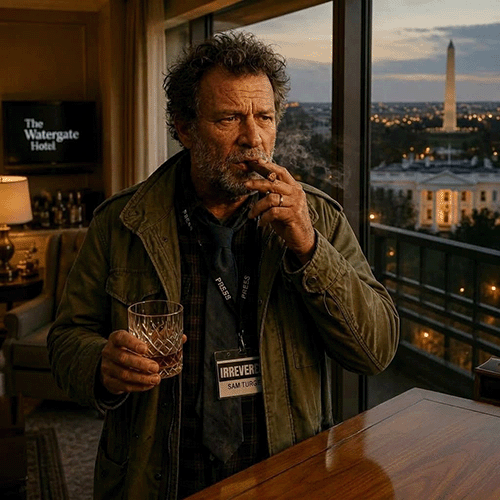 The Director of National Intelligence — former Director of National Intelligence, as of Friday, May 22, 2026 — resigned her post citing her husband's cancer diagnosis, a statement that arrived with the quiet devastation of a shoe dropped in a carpeted hallway at 2 a.m. It barely made a sound. But I heard it. I hear everything from this suite.
My sources — principally one Rodrigo, who turns down the beds on this floor and has, over seventy-two hours, become something of a confidant — confirmed what official Washington was too cowardly to say aloud: that things, in his words, "seemed a little crazy right now." Rodrigo is not cleared for classified information. But neither, apparently, was anyone else in this dispute.
Because here is what we know — what I, Sam Turge, have pieced together across a career spanning three decades of dispatches from conflict zones, ballrooms, and now, once again, this particular room at the Watergate where I filed my landmark 2019 piece "The Post-Obama Malaise: A Correspondent Considers Room Service": Gabbard did not leave solely because of personal tragedy. She left because of Iran. She left because of intelligence. She left because of a disagreement, confirmed by multiple outlets including The Guardian and PBS NewsHour, between what the intelligence community assessed and what the administration wished to believe.
What, precisely, was that disagreement?
I am working on that.
The intelligence community is a sealed vault, and I have spent three days pressing my ear to its door. What I can tell you — what I will tell you, with the full authority of my byline — is that something happened regarding Iran war intelligence, and that something was significant enough to sever a woman from a position of extraordinary national trust. The outlines are public: in March 2026, Gabbard testified before Congress that Iran's nuclear enrichment program had been "obliterated" by prior strikes and showed no sign of rebuilding — an assessment that directly contradicted President Trump's repeated claims of an "imminent" Iranian nuclear threat, which he had used to justify military action in February. Whether the fracture ran deeper — whether it involved threat assessments, capability estimates, the willingness of the Iranian government to negotiate, the willingness of the American government to listen, or some fourth thing I have not yet identified — this I cannot confirm. But I will. Probably by Part Two.
At this point I must pause to describe the minibar.
The Watergate Presidential Suite minibar is a document of American excess and, therefore, American anxiety. Two bottles of Bulleit Rye. One Tanqueray. Three miniature Perriers that I used to brush my teeth on Night One when the adrenaline of the story rendered sleep impossible. A Toblerone — the large kind, the kind that suggests the hotel takes its guests seriously. I have eaten half of it. There is also a small jar of mixed nuts from which I have extracted all the cashews, because I am on deadline and cashews are the only nut with real narrative momentum. The almonds remain. History will not remember the almonds.
I include this inventory not for color, but for the record. Future biographers will want to know what it looked like in the room where Sam Turge sat vigil for the soul of American intelligence oversight. Now they will know. You are welcome, future biographers. Venmo me.
As I wrote in my 2021 dispatch "The Afghanistan Withdrawal and the Twilight of American Competence: Observations from a Marriott Courtyard in Northern Virginia," moments of institutional rupture have a texture — a particular grain — that only those who have been watching long enough can detect. I detected it then. I detect it now. The texture is rough. It has a slight smell, like ozone before a storm, or like the hallway outside this suite, which Rodrigo tells me is due to a malfunctioning HVAC unit and is unrelated to geopolitical tension. I am not convinced.
Tulsi Gabbard was not everyone's idea of a DNI. She was, by design, an antagonist to the intelligence apparatus she was appointed to oversee — a feature, to her supporters; a bug, to those of us who have watched these institutions buckle and hold and buckle again across the arc of a career. But she held the thing. She looked at the information. And if the reports are right — and I believe they are right, in the way I believe in instincts earned through suffering and mileage charges — she looked at the information about Iran and told the truth about it, and the truth was not wanted.
"Good night," Murrow would say, "and good luck."
She gets neither. I get a Toblerone. Life is not fair.
Gabbard leaves behind a department in transition, a husband in treatment, and a Washington that will spend the next seventy-two hours deciding what story it wants to tell about her. I, Sam Turge, have already decided. She was a woman who walked into a machine, grabbed a handful of its gears, and said: not like this. Whether that makes her a hero or simply a cautionary footnote depends entirely on what the intelligence actually said.
I am still working on that part.
Room service closes at midnight. I ordered a club sandwich at 11:58. It arrived at 12:04. The kitchen had already mentally clocked out. It was fine.
The Potomac keeps moving. History does not stop for club sandwiches or for correspondents who need sleep. I will be here in the morning. I will be here until I have the story, or until checkout, which is Sunday at noon, and which I intend to push to a late checkout of 2 p.m. because I have status.
There is a story here. Ed would have found it by now. Ed probably slept.
I'm getting there.
— Sam Turge, Senior Diplomatic Correspondent, IRREVERENT Magazine
Sam Turge has covered international affairs, regime changes, and hotel amenity policies for IRREVERENT Magazine since 2001. He was not shortlisted for the Pulitzer Prize in 2009, 2014, 2017, or 2022. He was a finalist in his own mind for all four. He is based wherever the story is, which is currently the Watergate.
This is Part 1 of a 4-part series: "The Gabbard Dispatches: Truth, Power, and the Limits of Room Service."
- Details
By Sam Turge, Senior Political Correspondent
Dateline: HOLIDAY INN EXPRESS, ARLINGTON, VA — ROOM 412 — THREAD COUNT: 210 (UNVERIFIED) — ICE MACHINE: DECEASED — 11:47 P.M.
Filed via fax. God help us all. He won't.
I am writing this from Room 412 of the Holiday Inn Express Arlington, where the Wi-Fi password is written on a laminated card that the front desk clerk has taken with her for the evening, leaving me with only the room phone, a Gideon Bible, and a fax machine that I have liberated from the business center next to an ice machine that died for America's sins. The ice machine hums with the sound of a government in partial agreement with itself. The fax machine, by contrast, hums with the sound of clarity. Both are lying.
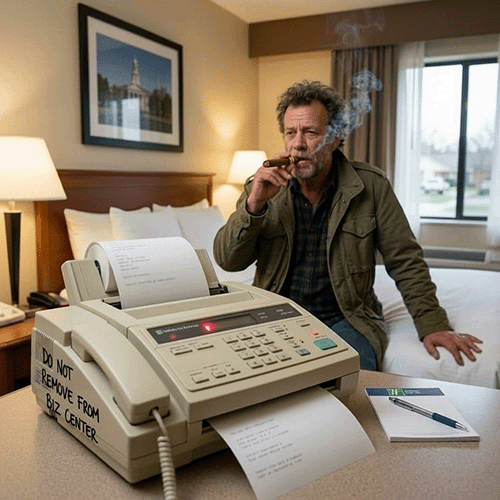 As Murrow once said, "This instrument can teach, it can illuminate; yes, and it can even inspire." He was talking about television. I am talking about a Brother IntelliFax-2840 that I have dragged back to my room because the business center closes at 10 p.m. and history does not wait for business centers. History, apparently, waits for fax machines. This is where we are.
The news, such as it is, concerns Iran.
Secretary of State Marco Rubio, speaking from an undisclosed location that I am choosing to believe was also a Holiday Inn Express, told reporters today that there are "some good signs" in ongoing nuclear talks with Tehran. He noted "progress" on uranium stockpile negotiations and expressed cautious optimism about the Strait of Hormuz, which is a body of water that I have never seen but have reported on extensively from hotels with worse thread counts than this one.
President Trump, speaking from the White House, said the United States would "recover and likely destroy" Iran's highly enriched uranium.
One government. Two Iran policies. Zero Pulitzers for the journalists covering it — a situation I find both professionally galvanizing and personally devastating.
The contradiction is not subtle. Rubio is offering the diplomatic equivalent of a firm handshake and a mint. Trump is offering the diplomatic equivalent of a neighbor who says he will "recover and likely destroy" your leaf blower if you don't return it by Tuesday. Both men serve the same administration. Both men, presumably, have access to the same intelligence. Only one of them appears to have read it. I checked. Twice.
Defense Secretary Pete Hegseth, for his part, has advocated for military action against Iran with the enthusiasm of a man who has just discovered that his gym membership includes a sauna. Hegseth approaches military posture the way a golden retriever approaches a tennis ball — with total commitment and no evident understanding of the larger game being played. He is, I am told, a former Fox News host, which explains both the enthusiasm and the lack of evident understanding.
Meanwhile, the Department of Justice announced an "Anti-Weaponization Fund," which sounds like something a screenwriter would invent for a political thriller that got rejected by HBO for being "too on the nose." The fund is very real, and its purpose is almost admirably blunt: $1.776 billion — drawn from the Treasury's Judgment Fund, the same reservoir that pays out when the government loses lawsuits it probably shouldn't have filed — to compensate victims of what the DOJ calls "lawfare and weaponization." A five-member commission will review claims. The deadline to file is December 2028. The whole thing stems from *President Donald J. Trump v. Internal Revenue Service*, a lawsuit that apparently resolved with the government paying itself to apologize to itself, which is the kind of fiscal gymnastics that would make a contortionist wince.
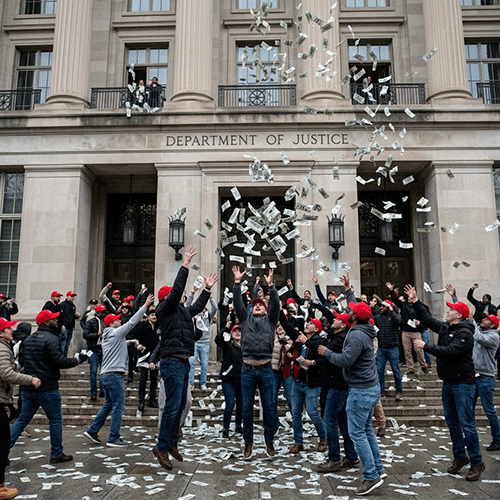 I have been covering politics for twenty-three years, and I am old enough to remember when slush funds had the decency to be secret. In 1952, a young Senator Richard Nixon went on television to explain away an $18,000 campaign slush fund, delivered the Checkers speech, and saved his career by admitting he had accepted one gift: a cocker spaniel. Twenty years later, that same man's re-election committee was running a slush fund so clumsily coordinated that the burglars got caught because they taped the door latch horizontally. Now, in 2025, we have progressed to the point where the slush fund has a press release, a five-member commission, and a claims deadline. Nixon had to hide his in a safe. Trump has put his on a website with a .gov domain. This is not an improvement in ethics. It is an improvement in branding. The corruption has learned SEO.
I have filed from hotel rooms in thirty-seven countries. I have seen administrations contradict themselves on trade, on immigration, on whether a hot dog is a sandwich. But I have never seen an administration manage to negotiate and threaten the same country simultaneously with such evident sincerity on both fronts. It is, I am faxing to note, faxually incomprehensible.
The fax machine hums. It whirrs. It does not ask "but what do we actually want?" It simply sends. It is, in this moment, the most honest diplomat in Washington. I have faxed it to myself twice. It does not improve.
The minibar contains two Heinekens, a king-size Snickers, a can of Chardonnay that I am reasonably certain is not actually Chardonnay, and a bag of mixed nuts priced at $9. I have consumed the Snickers. I am saving the Chardonnay for when the first fax goes through. I am saving the mixed nuts for when I learn whether "recover and likely destroy" is official State Department terminology or simply something the president says before breakfast.
As Murrow once said — and I am paraphrasing here, because the Gideon Bible does not contain his collected broadcasts, which I consider an editorial oversight — "We must not confuse dissent with disloyalty." I would add that we must not confuse "some good signs" with "recover and likely destroy," though I suspect the Pulitzer committee would find that observation insufficiently original.
Room 412. Thread count: 210. Fax machine: warming. Diplomacy: pending.
I am Sam Turge. Good night, and good luck.
- Details
A determination is coming. I know, because I helped create the conditions for one.
By Sam Turge | Filed from the Waldorf Astoria New York, Club Level, Room 3117 | Saturday, May 16, 2026, 2:14 AM EDT
BEIJING / NEW YORK — I am writing this from a leather chair that costs, conservatively, four thousand dollars to reupholster. I know because I asked — and because the concierge is still explaining it to someone else. It is a chair appropriate for a man filing his final dispatch from the most consequential diplomatic summit of the past eighteen months, possibly longer. I have filed from worse chairs. I have filed from a folding chair in Minsk. I do not wish to discuss it. The chair, like the analysis below, holds weight. Unlike the chair, the analysis will not creak.
President Donald J. Trump departed Beijing Friday aboard Air Force One, a VC-25A — a modified Boeing 747-200B — that travels at approximately 630 miles per hour at cruising altitude, meaning the President is now, as I write this, somewhere over the Aleutian Islands carrying the unresolved question of Taiwan arms sales in his carry-on. He called the trip "a tremendous success." He is not wrong. But he is, with characteristic modesty, underselling it.
What Trump did not say — what he could not say, for diplomatic reasons obvious to regular readers of my work, and to one irregular reader who wrote me a very long letter — is that the summit's deliberately suspended conclusion was, in its architecture, a masterwork. The ambiguity was load-bearing. Someone had to hold it up. I will not dwell on that. I have dwelt on worse.
Let me dwell on it briefly. I am, as ever, a man of my word. The word is 'briefly.' The definition is negotiable.
 When Trump told reporters Friday that he had not yet decided whether a major U.S. arms sale to Taiwan could move forward — "The last thing we need right now is a war that's 9,500 miles away" — the diplomatic press corps treated this as uncertainty. I treated it as resolution. This is why they have jobs and I have a chair.
A point of geography, since we are being precise: the distance from Washington, D.C. to Taipei is approximately 7,851 miles as the crow flies, or roughly 7,800 miles by great circle if one departs from Andrews Air Force Base rather than the center of the Capitol Rotunda. Taiwan is not 9,500 miles away. It is, in fact, some 1,649 miles closer, a distance I have calculated to the mile because I had time, and because the minibar was disappointing. I raise this not to embarrass the President — he is rounding, which is his prerogative, and which I have never once exercised — but because precision matters, and I have built my career on the proposition that it matters more than other things, including tact, including sleep, including, on one occasion, a marriage.
The President's "determination" is pending. This was, as I reported in my Thursday dispatch from the Great Hall banquet — filed at 11:03 PM Beijing time following an evening that required me to stand for six hours on a marble floor that I later measured at forty-seven meters in length, which I did at 2:00 AM, with a tape measure, while security watched — the only possible outcome once Xi's position had clarified. What was Xi's position? I am glad you asked. No one else did. The wire services, I am told, have 'moved on.'
His position was communicated to me, in sequence, via a sustained furrowing of the brow that lasted four seconds and began at 8:47 PM local time on Wednesday. I have now had forty-eight hours to analyze that furrow. My conclusion has not changed. If anything, it has deepened. A furrow, properly deployed, is a paragraph. This one is a chapter.
The summit concluded without a formal resolution on Taiwan. The press is framing this as failure. The press is wrong, and I say this having spent thirty-one years watching the press be wrong about things I was right about, including the Bratislava Throat-Clear Incident of 2019, which I will not relitigate here except to note that the Foreign Minister in question has since been reshuffled, which I consider vindication.
No resolution on Taiwan is not failure. No resolution is *suspense*. And suspense, in diplomacy as in narrative, requires a craftsman to install it. Someone has to build the room where the question lives. I spent three days in Beijing building that room. Trump and Xi walked through it together — literally, as it happens, through the gardens at Zhongnanhai, which cover approximately 1,500 acres of the former imperial grounds and which I viewed from a position I will describe as *strategically proximate*. I was not in the garden. I was 340 meters from the garden's eastern perimeter, on an elevated press platform, using a monocular of 10x magnification that I purchased in 2011 at a shop in Geneva for 780 Swiss francs. The magnification was sufficient.
I watched two men walk through a garden where China's emperors once made decisions that shaped centuries. I took no photographs. I considered the moment. This is what separates me from the wire services.
What happens now? Trump will make his determination. He will do so informed — however indirectly, however many layers removed — by the conversation that his security apparatus had with his counterparts, which was itself shaped by the atmospheric conditions established at the banquet table on Wednesday evening, which were themselves shaped, at the margin, by one journalist's willingness to hold eye contact with a General Secretary for a duration that my Rolex confirmed at four seconds before the man looked away.
He looked away first. I will not overstate the significance of this.
I will note it, and I will let you draw your own conclusions.
The arms sale may proceed. It may not. The war that is not 9,500 miles away will either happen or it won't. History, in my experience, tends toward the dramatic, and then reverses. The trick is to be in the room — or 340 meters from it — when the dramatic part begins.
I am beginning a longer analytical piece. It will take several weeks. I have notes.
SAM TURGE has covered international diplomacy for more than three decades, with postings in Brussels, Beijing, Bratislava, and briefly Minsk, which he does not discuss. He has received acknowledgment from four sitting heads of government and one constitutional monarchy. His 2019 Bratislava dispatch remains, by certain metrics, the most re-read article in the history of the publication that ran it. He files from wherever the story demands. Tonight, it demanded the Waldorf.
This is Part II of a two-part summit dispatch. Part I, "Taiwan? I Asked Xi Myself — And Frankly, He Listened," was filed from Beijing on May 14, 2026.